
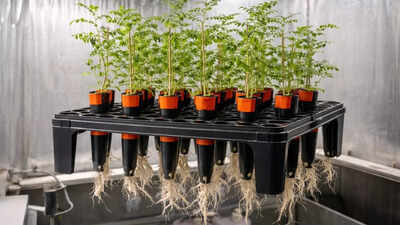
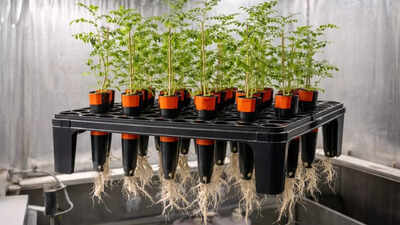
As the US plans a long-duration mission to the Moon under the Artemis Programme, one of the biggest challenges that the scientists face is what astronauts will eat in space. This challenge has led researchers to explore whether crops can be grown directly using material present on the Moon.A recent study led by researchers from the University of Texas at Austin and Texas A&M University provided an important step toward that goal.In research published in the journal Scientific Reports, scientists successfully grew and harvested chickpeas in simulated “moon dirt”, also known as lunar regolith simulant. Sara Santos, who is the project principal investigator, said that this work represents a major step towards understanding what food could be grown on the moon and what the future lunar explorers could eat.
How scientists grew chickpeas in simulated lunar soil
Researchers from Texas A&M University and the University of Texas at Austin used lunar regolith simulant, or simulated lunar soil, to test whether crops could grow on the Moon. This material is designed to replicate the chemical composition and physical structure of soil found on the Moon.Unlike the composition of the Earth’s soil, the lunar regolith is devoid of organic materials, microorganisms, or the necessary nutrients that are fundamentally required for plant growth.To create an environment that is favourable for plant cultivation, the lunar soil’s composition was mixed with organic compost known as vermicompost, which is a byproduct of the earthworms.The chickpea plant’s composition was also subjected to arbuscular mycorrhizal fungi, which are beneficial microorganisms that help the plant to acquire the necessary nutrients while withstanding adverse conditions.Several compositions of the soil mixture were tested, with the findings indicating that the chickpea plant is able to thrive in the lunar composition when it is subjected to organic compost.
Why were chickpeas chosen for space farming
The reason for choosing chickpeas for space farming is that it provides high nutritional value for astronauts. Chickpeas are high in plant protein, fibre, and vitamins such as iron and folate.Chickpeas are also known for their ability to grow in dry environments. They are commonly cultivated in semi-arid regions and can tolerate water stress and harsh conditions.Chickpeas are also legumes. Legumes interact with nitrogen-fixing bacteria in their roots. This biological process converts atmospheric nitrogen into forms that plants can absorb and contributes to soil fertility.
What the findings mean for future lunar missions
The cultivation of chickpeas in simulated Moon soil provides data relevant for the exploration of space, especially for missions that NASA plans to send in the near future under the Artemis programme. In order to allow the astronauts to stay on the Moon for a longer period, the ability to produce their own food should be achieved. This study shows that plants could survive in the Moon’s soil using organic materials and microbes.Although the study indicates that plants could survive in the Moon’s soil, the soil contains certain components that are detrimental to the survival of plants.In addition, the Moon has no atmosphere, stable temperature, or natural water. However, the focus in the future should be on the development and implementation of a controlled form of agricultural practice, such as greenhouses, which will be able to provide the necessary conditions required for the survival of plants in the Moon’s soil.