
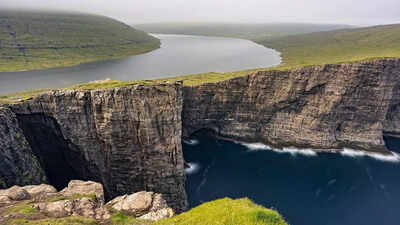
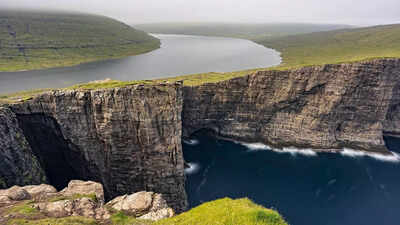
Sørvágsvatn, the largest lake in the Faroe Islands, which is also known as Leitisvatn, lies above the Atlantic Ocean and is an intriguing example of a masterclass in geology and forced perspective. The famous optical illusion caused by Sørvágsvatn challenges the laws of gravity. The photos captured from the Trælanípa cliff have created an illusion to an observer viewing the lake at a height of hundreds of metres above a crashing sea; however, according to the Faroe Islands website, it is actually 30 metres (approximately 100 feet) above sea level and is situated in a deep hollow area. The high cliffs of the Trælanípa create an optical confusion for those who view the image at an angle that will cause them to perceive the true height of the lake relative to the sea.
The geometry of an illusion on the largest lake in the Faroe Islands
The floating effect is the result of forced perspective. Use of forced-perspective techniques is common in motion pictures to make an object appear smaller, larger, or farther away than it actually is. Because the Trælanípa Cliffs have a height of 142 meters (i.e., 466 feet), they rise above the surface of Lake Sørvágsvatn. Additionally, by getting to the highest point on the cliffs and using a camera lens to compress the distance between the lake and the shoreline of the Atlantic Ocean, the human brain will perceive that the surface of the lake is at the same height as the edge of the cliffs – this creates the floating effect of the water.
The hidden 30-meter gap secret
Contrary to what we see visually, the lake water’s physical characteristics are very credible. Sørvágsvatn is approximately 3.4 square kilometres in area, making it the largest freshwater source in the Faroe Islands. As a result, it is considered to sit in a natural depression in the earth left by past volcanic activity. The surface of Lake Sørvágsvatn appears high enough to reach the clouds; however, it is only 30 meters (100 feet) above the Atlantic Ocean. In other words, there is a 30-meter (100-foot) vertical drop between the edge of the lake and the Atlantic Ocean, created by a narrow rock ledge that prevents the lake from draining into the ocean.
The waterfall that breaks the illusion
Bøsdalafossur waterfall is where the lake that appears to ‘float’ and a real lake with a ground outlet come together. The waterfall acts as a natural drain, and when it rains heavily, it keeps the lake full by carrying excess water over the 30-meter cliffs into the sea. If there were no drainage at Bøsdalafossur, the lake would rise with the rain, thereby preventing people on the other side from seeing the ‘floating’ effect.
The geological origins
The island chain’s basaltic rock forms the original structure of the Sørvágsvatn anomaly. A huge amount of lava poured into the area that is now the Faroe Islands about 11 million years ago, and much of the island was later shaped by heavy glacial activity. Glaciation shaped the landscape around Sørvágsvatn, and oceanic erosion carved the steep, vertical sides of Trælanípa. The lake remains ‘floating’ because of two distinct erosional forces acting on the same massive block of basalt. While ancient glaciers scooped out the deep central basin that holds the freshwater, the relentless Atlantic Ocean simultaneously sheared away the island’s edge to create the vertical Trælanípa cliffs. This leaves a solid rock ‘rim’ that keeps the two bodies of water completely separate despite their proximity.