
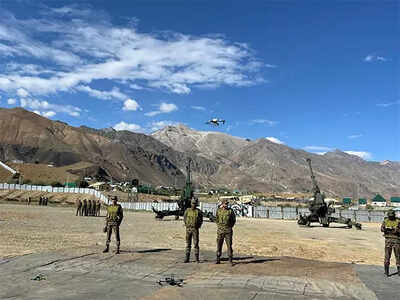
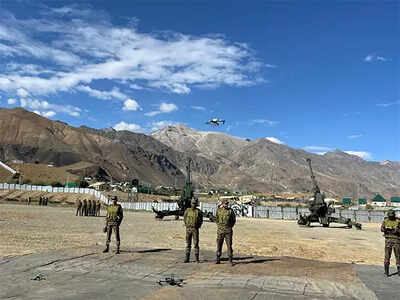
FRAMEWORK TO REMOVE CHINA’S SHADOW FROM INDIAN DRONES (Representative image)
Since their introduction, drones have been rewriting the way in which wars are fought. The Indian armed forces too are increasing the role and scope of these drones across India’s vast frontiers including in the high Himalayas. As these drones will be deployed in some of the most sensitive areas along the borders, steps are being taken to ensure that these drones operate in a secure ecosystem.The ministry of defence has released a draft document that seeks recommendations till April 8 and this framework will be a part of the upcoming Defence Acquisition Procedure (DAP) 2026. The paper was formulated jointly by the three armed forces, National Security Council Secretariat (NSCS), Ministry of Civil Aviation, Ministry of Electronics and Information Technology, DRDO, accredited labs as well as industry bodies. Work on the document began in September 2024
The paper claims that these consultations revealed that “the present domestic capabilities towards the drone component design & development, manufacturing and testing will take time to mature”. Efforts are underway to improve to work on these shortcomings in order to “complete indigenise and foolproof supply chain verification”.This step is being taken to secure what the document terms “low, slow and small” drones, this would include nano, micro, and small drones such as quadcopters and hexacopters. Such drones are expected to constitute 95% of all aerial vehicles over the battlespace.Drones are increasingly becoming an important part of the Indian armed forces and particularly the army. The army has already inducted multiple types of drones for various purposes. The force has already made structural changes to take full advantage of these systems. As of now the army has implemented Ashni platoons in the infantry and has announced the raising of Divyastra batteries and Shaktiban Regiments for its Artillery arm. The Armoured Corps is also expected to raise a Shaurya Squadron in each regiment that will leverage drones to dominate the battlefield. Thus it becomes even more important to have a secure ecosystem as all three services will be operating small unmanned systems..The document seeks to have an indigenous drone environment that “follow(s) ‘secure-by-design’ principles to proactively avoid the vulnerabilities and emerging threats,” as mentioned in the document. The security requirements as per the document will be implemented write from the Request For Information (RFI) phase, through the procurement in phase and will continue even in service as when upgrades are implemented. This method also ensures multiple levels of checks to ensure a secure working environment.The vision document also seeks to reduce what it terms “Security vulnerability in this context refers to a security flaw, weakness or error within the drone system that can be leveraged by an adversary, thus compromising its operational performance. Such insecure drones are vulnerable to cyber threats and physical risks, compromising safety, functionality and data security which may lead to data breach, unauthorised access and physical harm. Hence, there is a need to detect these vulnerabilities and prevent them from causing any adversarial effect”.One of the primary aims is to reduce dependency on components that are made in China, this step is also expected to increase the participation of domestic firms in drone manufacturing.In August 2024 incident in which a domestically produced Indian drone crossed the Line of Controlin the Poonch sector and landed on the Pakistani side. It was reported at the time that drone was lost to a technical malfunction. The Indian Army has in the past cancelled a drone order over Chinese components in February 2025.The aim now is to ensure the security of not just the drone, but also the ecosystem in which it operates. The drone ecosystem will be protected from:
- Interception of communication between the drone and the controller with the use of Software Defined Radios
- Protection from GPS Jamming and Spoofing. Small drones depend on GPS for navigation and they can be confused by GPS jammers. In such an attack, the drone is expected to be redirected to its launch point.
- Protection against control hijacking, this can be achieved by exploiting vulnerabilities in communication links or malware planted in the drone.
- Protection of data from the ecosystem can be achieved via ensuring secure links and by thoroughly searching for malware.
The “ideal solution” according to the document is to have the drone and its critical component (down to the chip level) be designed, developed and made domestically. This method would reduce many of the vulnerabilities and ensure greater control over supply chains. Efforts will also be made to test and validate the drone and its capabilities within the country.