
“It’s not rocket science” is a popular phrase used to describe something that’s not particularly difficult. That’s because rocket science – of all sciences – has the least room for error, where said error can result in horrendous deaths. But as Sheldon Cooper would point out, rocket science is perhaps a little less difficult to understand than quantum mechanics. And one of quantum mechanics’ most enduring memes is Schrödinger’s Cat, a kitty whose state of mortal incertitude gave rise to one of the greatest thought experiments.For those unfamiliar with the physics – or those who haven’t watched The Big Bang Theory – Schrödinger’s cat refers to a famous thought experiment in which said kitty is supposed to be both dead and alive at the same time till the box it’s locked in is opened. It was devised by physicist Erwin Schrödinger in a discussion with Albert Einstein, and the cat’s state is one of quantum superposition of two possibilities, which is only resolved once the box is opened.The term Schrödinger’s XYZ has since slipped into the modern lexicon to describe any situation of uncertainty, and it certainly fits the description for the current imbroglio in the Middle East.
At the time of writing, the word ‘ceasefire’ is – to borrow a phrase from a loquacious Indian politician – an exasperating farrago of distortions which are as terminologically accurate as the Holy Roman Empire, the United States of America, and income tax returns. The Schrödinger’s ceasefire – involving drafts that were ostensibly drafted at the White House and showing the perils of X’s (formerly Twitter) editing feature – came the day Trump threatened to “end civilisation”. But much like the cat, we are forced to question if it even is a ceasefire if folks haven’t ceased firing.Even those monitoring the situation aren’t quite clear, so let us seize this opportunity to give us the laydown.
What was promised?
The ‘ceasefire’ is less a single agreement and more a stack of competing press releases. Trump framed it as a two-week pause conditioned on reopening the Strait of Hormuz, with “zero enrichment” as the nuclear bottom line.Iran said the US had accepted a 10-point “framework” that includes enrichment, sweeping sanctions relief, continued Iranian control over Hormuz, and a regional cessation of hostilities including Lebanon.Pakistan, meanwhile, beaming in its role as broker/drafter extraordinaire, presented the truce as broader than Washington acknowledged, including Lebanon.In a normal treaty, these would be different emphases on the same agreement. But much like a Bob Dylan song that contains multitudes, here the agreements are completely different.
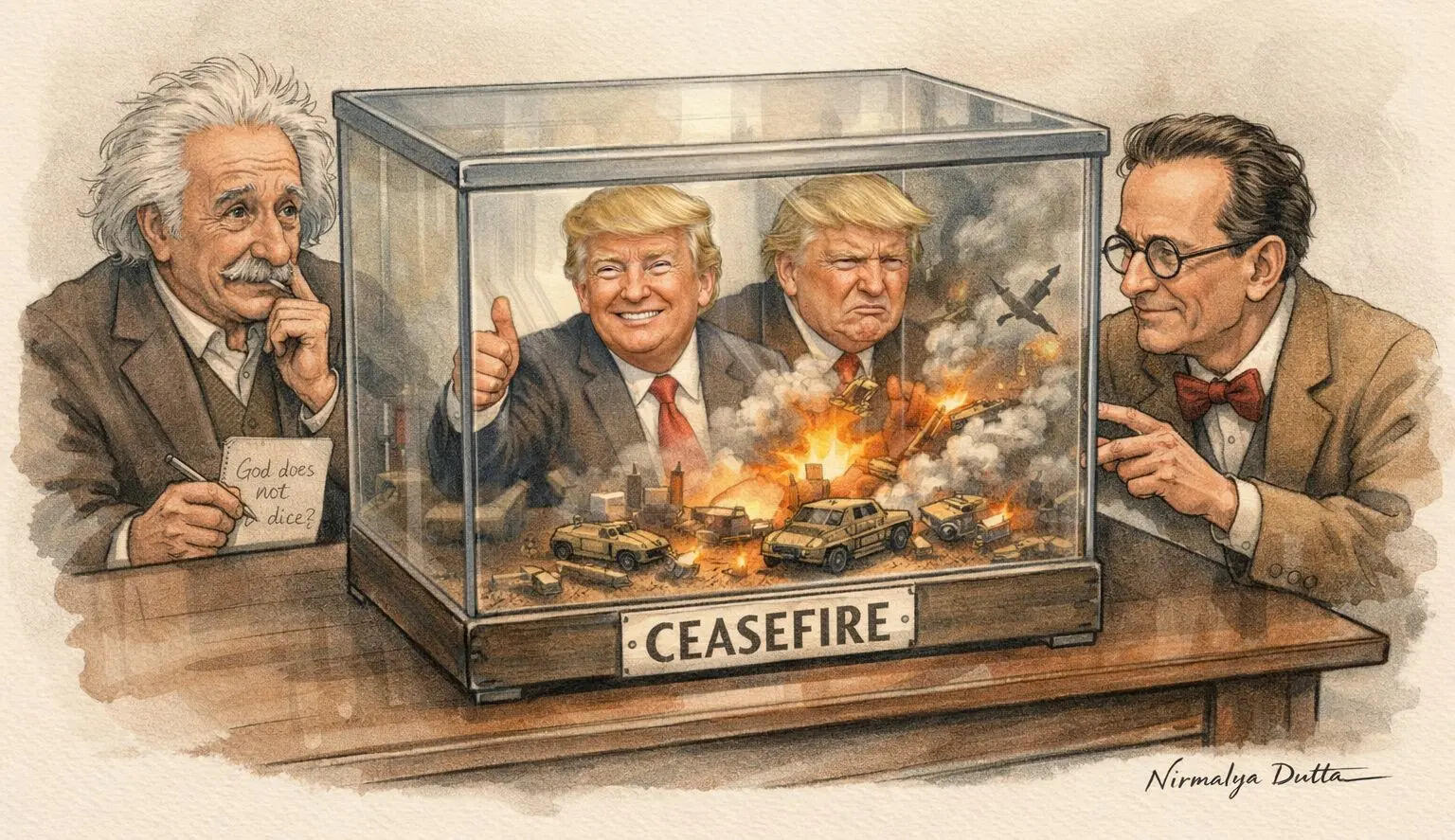
Because beneath the language of diplomacy lie the various disagreements. The fictional adman Don Draper used to say: if you don’t like what they are saying, change the conversation. Here everyone is having their own.The US thinks it has secured a pause on its terms and got an off-ramp to save face.Iran assumes it has secured recognition of its own resolve against the mighty Satan.Pakistan thinks it has brokered something historic.Israel thinks it can continue to do what it wants outside Iran.And the EU thinks its view matters.Basically, at this moment in the ceasefire, there’s no consensus, with everyone agreeing to disagree – publicly, simultaneously, and with great bluster.
What the players say
Washington has spent the last two days quietly trimming the ceasefire down to size. Lebanon, it insists, was never part of the deal. Enrichment is off the table. Hormuz must reopen without conditions. Even Trump’s own musings about toll-collecting “joint ventures” were quickly walked back, as if the idea had wandered in from a different conversation altogether. JD Vance calling Lebanon a “legitimate misunderstanding” is perhaps the most honest line to emerge from the entire exercise.Tehran, on the other hand, has done the opposite. It has expanded the ceasefire into something far more ambitious. It has claimed that the ceasefire is a structured framework of non-aggression, sanctions relief, continued control over Hormuz, the right to enrichment, and that the ceasefire extends across all theatres of conflict including Lebanon.Pakistan has chosen Panglossian optimism. As broker, it has presented the ceasefire as broad, regional, and consequential — a diplomatic success large enough to include Lebanon, even if Washington would rather it didn’t.Israel, meanwhile, has dispensed with interpretation altogether. For Jerusalem, the ceasefire applies to Iran and Iran alone. Hezbollah is a separate problem, and one that continues to be dealt with accordingly. Strikes in Lebanon have continued, not as a violation of the ceasefire, but as a reminder that Israel never quite agreed to the version of it everyone else seems to be debating.
What was not hashed out?
The devil, they say, is in the details, which are very few in this particular hellish pitch. The nuclear question is still up in the air. The US says zero enrichment; Iran says right to enrich. The same goes for sanctions. Iran talks of relief, rollback, and even compensation. The US says nothing doing.The same goes for Hormuz. In reality, it remains whatever Iran wants it to be, letting only friendly ships through.And Lebanon is where the ambiguity turns fatal: Iran says it’s part of the same theatre, the US does not, and Israel continued to pound it.When Neville Chamberlain came back with Hitler’s version of peace, he at least had a piece of paper to promise peace in our time. Right now there is no shared text, no neutral arbiter, no agreed definition of what constitutes a violation. Every action is both compliant and non-compliant, depending on who is doing the explaining.Finally, enforcement — or the lack of it. There is no shared text, no neutral arbiter, no agreed definition of what constitutes a violation. Which means that every action can be both compliant and non-compliant, depending on who is doing the explaining.At which point the ceasefire stops looking incomplete and starts looking intentional.All of which brings us back to the proverbial cat, whose fate we can only ascertain once the box is opened. Till then, we will just have to assume that the ceasefire remains in a state of superposition till the clarity of time peels away the outside of the box.
Back in the day, Einstein, the greatest mind of all time, could never make peace with the uncertainty, contradiction, and probabilities of quantum mechanics, insisting God doesn’t play dice. But if he were alive today, the great pacifist would have been tormented by the war wrought by men playing dice, where a ceasefire is both declared and denied, where multiple versions of the truth exist at the same time, where the war is both paused and un-paused, refusing to collapse into a single, observable truth.Unfortunately for us, we are all like the cat, facing moral peril, stuck in a box right now, and only the passage of time will tell us whether we survive or not.