
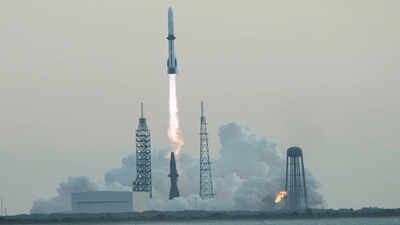
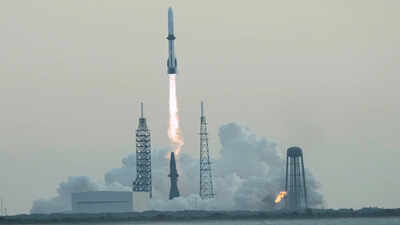
Earlier this week, Blue Origin founder Jeff Bezos shared a photo of the space company’s New Glenn rockets. Bezos’ post on X, formerly Twitter, got ‘Congrats’ message from CEO of Blue Origin’s biggest rival Spacex. This was the first time Blue Origin re-used a previously flown New Glenn booster — the same one that flew during New Glenn’s second mission. Roughly 10 minutes after liftoff, the booster came back down and landed on a drone ship in the ocean, just like it had last November. The footage of the booster’s landing on Drone ship is what Bezos shared on X, and Elon Musk offered his ‘congratulations’ on. However, after initial lift-off and landing the rockets failed at its primary mission: Delivering a communications satellite to orbit for customer AST SpaceMobile. Roughly two hours after the launch, Blue Origin itself announced in its own post that the New Glenn upper stage placed AST SpaceMobile’s satellite in an “off-nominal orbit.” In layman’s language, the rocket looked good on the way up, but the upper stage wasn’t able to put its payload into the correct orbit.AST SpaceMobile too issued a statement that the upper stage of the New Glenn rocket placed BlueBird 7 satellite into an orbit that was “lower than planned.” The satellite successfully separated from the rocket and powered on, the company said, but the altitude is too low “to sustain operations” and will now have to be de-orbited — left to burn up in the atmosphere of Earth.
Blue Origin CEO Dave Limp on mission’s ‘failure’
Blue Origin CEO Dave Limp too said in a post that the company “clearly didn’t deliver the mission”. He wrote, “Now that we have a more complete view, we wanted to provide an update on our NG-3 mission. While we are pleased with the nominal booster recovery, we clearly didn’t deliver the mission our customer wanted, and our team expects. Early data suggest that on our second GS2 burn, one of the BE-3U engines didn’t produce sufficient thrust to reach our target orbit. Blue Origin is leading the anomaly investigation with FAA oversight to learn from the data and implement the improvements needed to quickly return to flight operations. We have been in steady communication with the team at AST SpaceMobile, we appreciate their partnership, and we’re looking forward to many flights together.”This represents the first major failure for Blue Origin’s New Glenn programme, which only made its first flight in January 2025. This was reportedly the second mission where New Glenn carried a customer payload to space, after launching twin spacecraft bound for Mars on behalf of NASA last November.
FAA grounds Blue Origin’s New Glenn
The Federal Aviation Administration has grounded Blue Origin’s New Glenn rocket following launch from Cape Canaveral. “The FAA is aware that Blue Origin New Glenn 3 experienced a mishap during the second-stage flight sequence following a successful launch,” according to an FAA . “The FAA notified NASA, the NTSB, and the U.S. Space Force about the classification of the incident.”FAA guidelines will require Blue Origin to complete an investigation into the event before the rocket is allowed to fly again. “A mishap investigation is designed to enhance public safety, determine the root cause of the event, and identify corrective actions to avoid it from happening again. A return to flight is based on the FAA determining that any system, process, or procedure related to the mishap does not affect public safety.”The FAA has reportedly grounded several rockets because of mishaps in recent years, including SpaceX’s Falcon 9 and in-development Starship. Blue Origin had its smaller, suborbital New Shepard rocket grounded as well.