
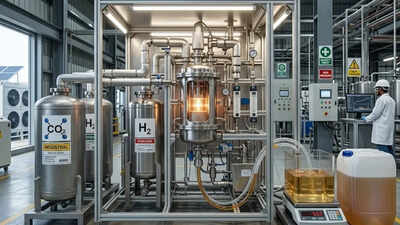
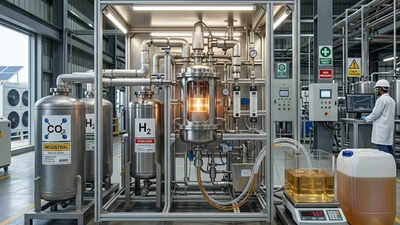
Switching from capturing carbon to utilising it is a pivotal paradigm shift in the fight against climate change. Recently, scientists introduced a new catalytic system that can turn atmospheric carbon dioxide and hydrogen into high-quality liquid fuel, producing up to 110 pounds each day. This isn’t just another lab experiment; it’s proof that synthetic fuels can work on an industrial scale. It turns a major greenhouse gas into a sustainable energy source by optimising the thermochemical reaction with a new catalyst, circumventing traditional fossil fuel extraction methods and creating a circular carbon economy. This achievement moves us closer to ‘air-to-tank’ technology, where vehicles run on recycled emissions instead of newly extracted carbon.
A new catalyst is successfully turning carbon dioxide into fuel
The breakthrough is all about a new type of catalyst that can tackle the tough carbon dioxide molecule. Scientists have come up with a high-entropy metallic composite mix, often using metals like iron or cobalt, which makes the hydrogenation process work better. This process results in long-chain hydrocarbons that are directly compatible with regular engines. According to the report in Eurekalert, in this setup, carbon dioxide and hydrogen are put under pressure and heated in a continuous flow reaction, resulting in a consistent output of 110 pounds of synthetic fuel every 24 hours.
How tandem catalysis defeats high heat
To effectively convert carbon dioxide, it’s crucial to overcome thermodynamic limitations linked to breaking the C-O bond. Today, research has turned towards using materials that are abundant on Earth for catalysing thermal and electrochemical processes, as noted in the research on the Royal Society of Chemistry. This shift helps in reducing the necessary activation energy considerably. Another approach involves tandem catalysis, where multiple active sites operate one after another. Scientists use this method to decompose carbon dioxide while forming hydrocarbon chains at the same time. This sophisticated molecular architecture in molecular engineering keeps reactions efficient on an industrial level without needing the extreme heat typically required for making synthetic fuels the traditional way.
The metric behind 110 pounds of daily production
Switching from grams to producing 110 pounds each day is a way to gauge ‘Space-Time Yield’ (STY), which looks at how productive a reactor is over time. Hitting this level of output needs a catalyst that can keep its structure when under constant pressure and flow. It also has to prevent ‘coking,’ or carbon buildup, which often shuts down the metal sites as noted in the journal Frontiers in Chemistry. Using supports with large surface areas, like zeolites or metal-organic frameworks, often helps house these catalysts. This setup allows for maximum molecular conversion every second, hitting the demanding goal of 50 kilograms of daily production.
Why liquid synthetic fuels are essential for transport
This ‘air-to-tank’ method is a great example of how we can turn emissions into liquid energy, making a circular carbon economy possible. If the hydrogen comes from electrolysis powered by renewable sources, the fuel produced becomes nearly carbon-neutral. This is crucial for industries like aviation and heavy shipping because current batteries are either too heavy or not efficient enough to replace liquid fuels. A single pilot unit can convert 110 pounds of carbon dioxide into fuel each day, which significantly helps in reducing the local carbon footprint of an industrial facility.