
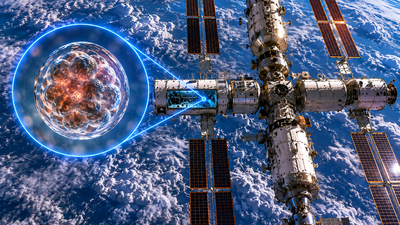
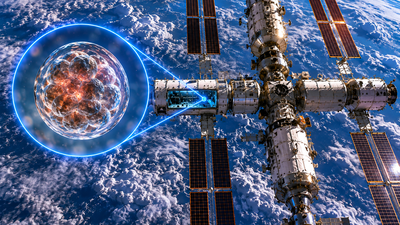
For all the ambition packed into humanity’s plans for Mars colonies, lunar bases, and permanent off-world settlements, one fundamental question has quietly gone unanswered: can humans actually reproduce in space? Gravity, radiation, and microgravity-induced biological changes present obstacles that are significant and poorly understood by current science. China has now taken the most direct step yet toward finding out. On May 10, a Long March 7 rocket carried the Tianzhou-10 resupply mission to the Tiangong space station and tucked within its seven tons of cargo was something that has never been attempted before in the history of human spaceflight: human artificial embryos, sent into orbit for the very first time.
What China’s Tianzhou-10 mission carried to the Tiangong space station
On May 10, a Long March 7 rocket lifted off from the Wenchang Space Launch Site carrying the Tianzhou-10 resupply mission loaded with around 7 tons of cargo, including food, fuel, spacesuits, and scientific equipment, bound for the Tiangong space station. The structures arrived at Tiangong in the early hours of May 11, according to state officials cited by the South China Morning Post. Once aboard, they were given five days to develop in the station’s microgravity environment before being frozen for return to Earth and analysis. Meanwhile, an identical set of embryos was grown and frozen on the ground in China, serving as a control group for comparison.
What human artificial embryos actually are and what they are not
The term “artificial embryo” needs some unpacking. These are not real human embryos in the traditional sense. They are structures grown from living human stem cells that can divide and multiply in ways that mirror early embryonic development but crucially, they are incapable of properly developing into a fetus or a baby.Leqian Yu, a researcher at the Chinese Academy of Sciences’ Institute of Zoology, leading the experiment, was clear on this point. “This is not a real human embryo and cannot develop into an individual,” Yu said in a statement issued in mid-May. “However, it can serve as a model for studying early human development.”Two distinct types of artificial embryo models were used, each representing a different stage of development between 14 and 21 days after fertilisation. The first peri-implantation model mimics the critical phase when an embryo attaches to the uterine wall. The second, a peri-gastrulation model, replicates the point at which a single layer of cells begins reorganising into distinct layers that will eventually form different tissues and organs. Both phases are considered pivotal windows in early human development.
Why space is so hostile to human reproduction and early life
The concern about reproduction in space is not hypothetical hand-wringing. Researchers have been accumulating evidence for years that space presents serious biological challenges to the earliest stages of life. Cosmic radiation, far more intense beyond Earth’s protective magnetosphere, is known to damage DNA, and developing embryonic cells are particularly vulnerable. Microgravity, the near-weightless environment experienced aboard orbiting spacecraft, is thought to disrupt a wide range of cellular processes. A recent study found that microgravity can disorient sperm cells, making egg fertilisation significantly less likely. Separately, research has shown that human stem cells age considerably faster in space than on Earth.Yu described the experiment’s broader aim to Chinese state media as an effort to explore “whether life, which has evolved under gravity for hundreds of millions of years, is affected by its sudden absence.” The developmental window being studied is particularly important because it is when “the building blocks for future organs begin to form, and the entire body axis, which determines the head and the tail, is established.“
Why this space embryo research has implications far beyond science
Alongside the human artificial embryos, the Tianzhou-10 mission also carried zebrafish embryos and mouse embryos into orbit, giving researchers comparative data across species.The implications of this research extend well beyond science. As space tourism grows and long-duration missions to the moon and Mars move from planning into reality, the question of reproduction will eventually move from theoretical to urgent. Experts have already flagged that as civilian spaceflight becomes more common, conception in space is increasingly likely to occur, planned or otherwise, current science offers almost no guidance on what happens next.For any permanent human presence off Earth to be truly self-sustaining, reproduction cannot be left as an unsolved problem. If natural conception and gestation prove impossible or dangerous under space conditions, alternatives like in vitro fertilisation conducted in orbit are already being explored by private space companies, but those pathways, too, depend on understanding how early embryonic development responds to the space environment.China’s experiment, modest in scale but historic in what it represents, is the first direct attempt to generate that understanding with human biological material in actual orbit. When the frozen samples return to Earth and are compared against their ground-grown counterparts, researchers will for the first time have real data, not models or theoretical projections, on how the space environment shapes the very beginning of human life.