
.
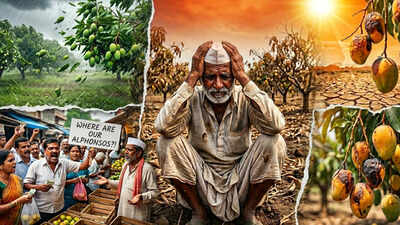
There was a time when the arrival of Alphonso mangoes felt as predictable as summer itself.Every year, as temperatures climbed and school holidays began, crates of the golden fruit would start appearing in markets across the country. For many families, Alphonso mangoes were more than a seasonal indulgence. They were a reminder that summer had arrived.This year, however, the season has felt different.For Ratnagiri’s growers, the season began with promise and ended in disappointment. Abundant flowering initially raised hopes of a bumper crop, but a combination of unseasonal cold, fungal attacks, pollution and later heatwaves dramatically reduced yields, leaving markets short of one of India’s most prized fruits.The shortage has created two parallel challenges. The first is obvious: farmers are struggling to meet demand. The second is protecting the identity of the Ratnagiri Hapus.While Alphonso mangoes are grown across parts of the Konkan belt and beyond, Ratnagiri and Devgad enjoy Geographical Indication (GI) status for their distinctive variety, prized for its aroma, flavour and texture. Growers say that in a year when genuine supply has fallen sharply, visually similar mangoes from other regions are increasingly being sold under the Ratnagiri Alphonso label.The concern is not competition but confusion.In a season marked by shortages, growers say lookalike varieties have increasingly entered the market under the Ratnagiri Hapus name, blurring the distinction between genuine GI-certified fruit and cheaper substitutes. For farmers, the bigger fear is that consumers may eventually stop recognising what makes a true Ratnagiri Alphonso different.
The season of hope vs uncertainty
Mohammad Hussain Dhanshe, a farmer and trader from Bankot in Ratnagiri who runs Danshe Farm, said the problems began during the flowering stage.“Normally, flowering starts from October 20 onwards. But this year, the rain in November delayed the flowering,” he said.According to Dhanshe, Alphonso cultivation depends heavily on stable seasonal rhythms.
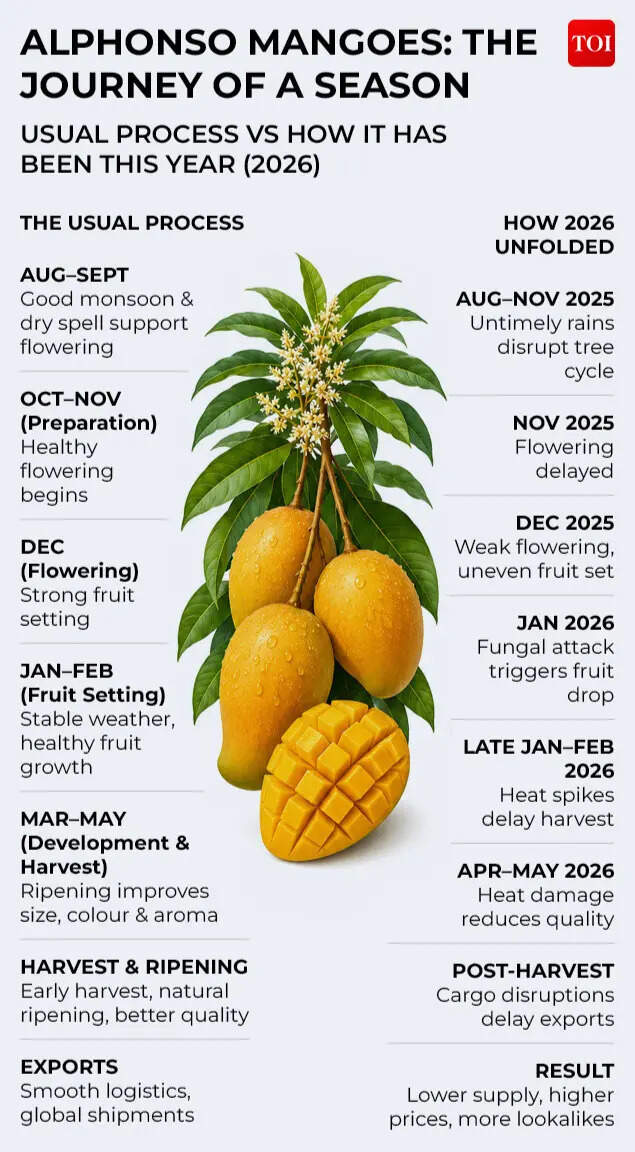
“For one month, the tree should not get water to induce flowering. We have to make the tree thirsty,” he explained.After the delayed flowering finally arrived, farmers initially expected a strong crop.“The flowering happened and it was very good. It seemed that a lot of mangoes would come out,” Dhanshe said. “But there was a fungal attack in the second week of January. It was very deep and consistent,” he said.Many growers struggled to protect their orchards.Dhanshe, who described himself as an “educated farmer”, said his losses remained lower because of intensive fungicide and nutrition management. He said that his awareness with the use of medicines and pesticides helped him minimise the damage, however, this season the damage to the farmers have been as huge as 80-85 per cent of loss.The same figure was echoed by Prasad Jadhav, a generational Alphonso farmer from Ratnagiri whose family has been growing Hapus mangoes for more than 3 generations.“We are a group of farmers. We keep having interactions with each other regarding the growth and what we need. This year the yeilding was very disappointing, to the point that it was concerning. 80-85 per cent of mango buds in my orchard never bloomed because of the freezing temperature. And this is not just me, all the farmers faced similar losses because of the weather,” he said.
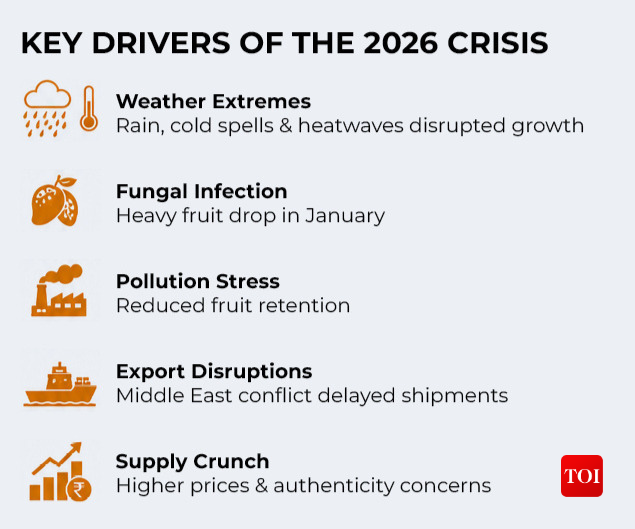
His cousin brother, Lahu Jadhav, blamed both cold weather and industrial pollution.“The pollution was very high this year. From November to February, it was very cold. The small fruits would come and then fall,” Jadhav said.He estimated that orchards that had operated at full productivity earlier had dropped to only 30-40 per cent output. Prasad also described how later heatwaves damaged fruit quality internally.He explained the delicate nurturing the Alphonsos need. “The Alphonso mango is delicate, much like an egg. It requires constant, meticulous attention,” he said. “But because of the heat, the mangoes became spongy inside. Some were scorched completely. In our local dialect, we say they ‘took flight’ (meaning they were ruined beyond recovery).
Shortage that changed the market
The sharp decline in genuine Alphonso supply triggered dramatic price spikes in wholesale markets during the early part of the season. “I have never seen such rates in my life,” Dhanshe said.According to him, wholesale prices briefly touched Rs 3,000 to Rs 3,800 per dozen for premium early-season fruit.But the shortage also created another market phenomenon: the rapid spread of lookalike mangoes being sold under the Alphonso label. Growers say consumers in major cities often cannot distinguish between genuine GI-certified Ratnagiri Alphonso mangoes and visually similar varieties grown elsewhere.“People are selling Karnataka mangoes as Ratnagiri and Devgad mangoes,” Jadhav said.Another grower explained how the shortage encouraged relabelling.“The brokers at the agencies whom we sell the mangoes to know what mangoes they are purchasing but no one admits they are selling Karnataka mangoes. They use the Ratnagiri name because it gets better rates,” Lahu Jadhav said.The issue is especially significant because Alphonso commands one of the highest price premiums among Indian mangoes. In wholesale and retail markets, consumers are often buying based on the reputation attached to the name rather than the traceability of origin.Prashant Powle, a GI-certified Alphonso grower and trader who sources mangoes from 48 villages across Ratnagiri and Sindhudurg districts, said this year’s shortage intensified the problem.“There was competition from lookalike Karnataka mangoes. Many people took advantage of the shortage,” he said. Powle stressed that the concern is not about the quality of mangoes grown in other states, “The problem is authenticity of origin.”
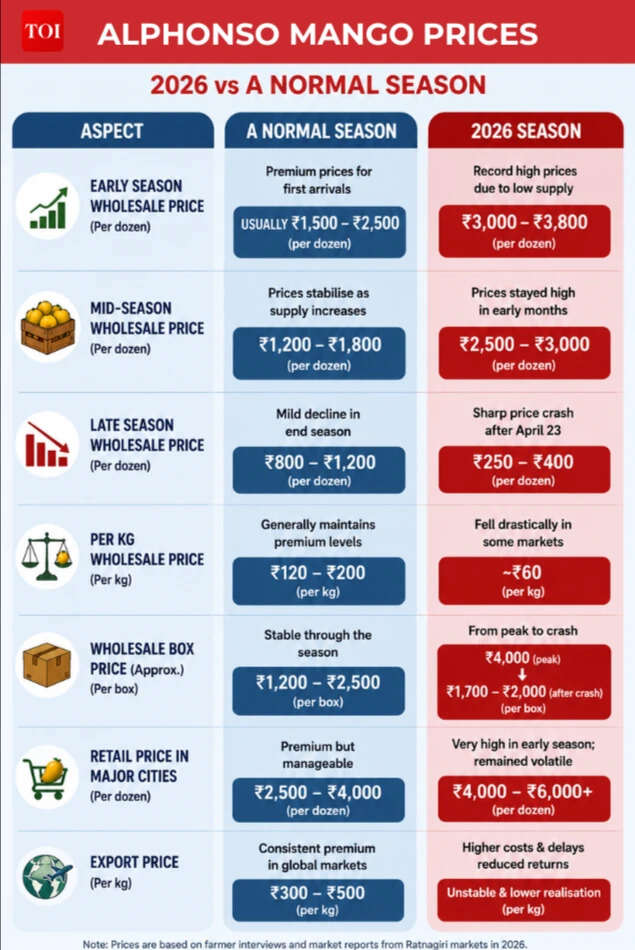
Alphonsi mango prices: Normal season vs 2026
According to him, many consumers ordering Alphonso mangoes online or buying them in cities are unaware of the distinction.“When people taste a real Ratnagiri Alphonso, they understand why it is called the king of mangoes. When you eat it and even after washing your hands when the aroma does not leave your hands for 1-2 hours, that is when you understand the authenticity of Devgad Alphonso. And then you will want to purchase it again,” he said.
Risk to Alphonso identity
Farmers say the larger concern is what a single blow like this season could lead to for Alphonso. The Jadhav brothers say that their families have been carrying the legacy of Alphonso cultivation, have never witnessed a season like this.The Ratnagiri and Devgad Alphonso carry decades of consumer loyalty. But the shortage this year has pushed the customer base to rattle. Due to the demand and supply disparity, the prices have shot up. However, to maintain the return rate, the farmers are burning their own funds to not lose their loyal customers.Prasad Jadhav says, “If we do not meet the demand, the customers will not return to us. Of course, we don’t have the option to explain the crisis. They wouldn’t understand the price hike, either, because they have alternatives.”He explains that the market does not acknowledge the crisis because they cannot risk losing the customers to Alphonso, which is not from Ratnagiri. The crisis is about protecting a product whose reputation depends almost entirely on trust.“If someone keeps eating a different mango sold as Alphonso, eventually they will believe that is the actual Alphonso taste,” Powle said.That shift, farmers argue, could weaken long-term demand for genuine GI-certified fruit.The concern becomes even sharper in overseas markets.The Gulf, UK and parts of Europe remain key destinations for premium Alphonso exports. But this year, the Middle East conflict disrupted cargo movement and increased delays.“We export to many countries, but this year material started getting offloaded multiple times,” Powle said. Because Alphonso mangoes are highly perishable, delays rapidly reduce quality.“After two days of delay, the ripening starts and the mangoes go bad,” he said.The complexity of international exports has also contributed to the lower exports. Without strong logistical support, smaller exporters often avoid overseas shipments entirely. “For the UK, we need one treatment process. For the US, there is a different water treatment process. Japan has different packaging standards,” Prasad explained.As genuine Alphonso exports slow or become more expensive, traders say substitute varieties gain even more ground in global retail markets. That creates a dangerous cycle for the original fruit.Consumers paying premium prices abroad may believe they are experiencing authentic Alphonso mangoes while actually tasting lower-cost substitutes marketed under the same identity.Over time, growers fear this could dilute the premium reputation Ratnagiri and Devgad Alphonso mangoes have built over decades.
Climate stress worsening problem
The identity crisis unfolding around Alphonso mangoes is closely tied to climate volatility.This season saw untimely rain, fluctuating winter temperatures, fungal outbreaks and sudden heat spikes all within a few months. One thing consistent across the farmers was the sensitivity of mango flowering and fruit-setting stages to temperature changes.Even short fluctuations can affect pollination, fruit retention and fruit quality.Farmers capable of relying on forecasting tools, fungicides and intensive orchard management to maintain crop stability have taken it a step further. While Dhanshe said proper scientific intervention made a major difference this year, Powle explained how his experience in IT helped him build an AI-incorporated system that enhances the organic yielding of their mango orchards.“If the environment is healthy, anyone can grow good mangoes. But in emergency situations, farmers must know how to save the crop,” Dhanshe said.Powle’s company has begun experimenting with AI-enabled orchard management, using cameras, sensors and IoT systems to monitor crop conditions.“We analyse what each tree requires, whether it is nutrition, moisture or protection,” he said.But such technology remains expensive and inaccessible for many small growers.As climate pressures intensify, production instability could become more frequent, increasing dependence on substitute supply chains.That, in turn, may widen the gap between authentic Alphonso mangoes and what consumers encounter in retail markets.
Fighting to preserve a legacy
Across Ratnagiri and Devgad, many growers see themselves as custodians of more than just a crop.They are preserving a legacy that has been built over generations and sustained by trust. Some continue harvesting before sunrise using techniques passed down through their families. Others are investing in AI-enabled farming, traceability systems and direct-to-consumer platforms to protect quality and improve resilience.Yet despite the technological changes, the anxiety remains the same.Climate volatility is making production increasingly unpredictable. At the same time, shortages are creating opportunities for substitutes to enter the market under the Alphonso name.For farmers, the challenge is no longer simply producing enough fruit.It is ensuring that consumers in Mumbai, Delhi, Dubai or London still know what a genuine Ratnagiri Hapus tastes like.“The problem is authenticity,” Powle said. “If someone keeps eating a different mango sold as Alphonso, eventually they will believe that is the actual Alphonso taste.”That, growers fear, is the bigger risk.A poor season can be survived. Weather shocks can be managed. Markets can recover.But if consumers lose faith in what the Alphonso name stands for, rebuilding that trust could prove far more difficult.As climate pressures intensify and supply chains become more complex, Ratnagiri’s growers fear the greatest threat may not be a failed harvest, but a future in which India’s most celebrated mango slowly loses the distinct identity that made it iconic in the first place.