
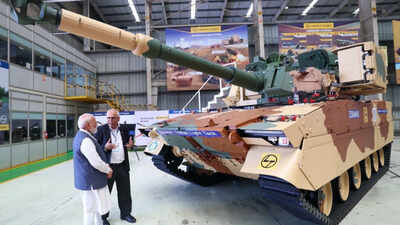
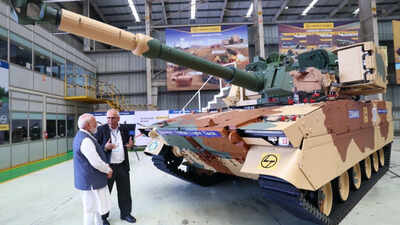
From a light tank built for the Himalayas and a battle-tested artillery gun deployed in Ladakh to laser weapons designed to counter drones, Prime Minister Narendra Modi’s visit to Larsen & Toubro’s Hazira facility offered a snapshot of India’s rapidly expanding indigenous defence ecosystem. The showcase brought together some of the country’s most ambitious military platforms and next-generation technologies, highlighting the growing role of the private sector in advancing the Atmanirbhar Bharat vision.Among the key systems displayed were the Zorawar light tank developed with the Combat Vehicles Research and Development Establishment (CVRDE), the K9 Vajra-T self-propelled artillery gun, the Trajan towed gun system, and the BvS-10 Sindhu articulated all-terrain vehicle. The showcase also featured futuristic technologies such as the TEJASTRA High Energy Laser System, an indigenous 1,500-horsepower tank engine and transmission, and a 30 mm unmanned turret designed for the Future Infantry Combat Vehicle (FICV).The Zorawar light tank represents India’s efforts to develop platforms tailored to its unique operational requirements. The 25-tonne tank, armed with a 105 mm gun, is designed for deployment across plains, deserts and high-altitude regions. Its modular architecture is intended to accommodate future upgrades and emerging technologies, enhancing its long-term operational relevance.Another highlight was the K9 Vajra-T, which has already been inducted into the Indian Army and deployed in eastern Ladakh. Manufactured by L&T in collaboration with South Korea’s Hanwha Defence, the 155 mm tracked self-propelled artillery system combines long-range firepower, mobility and rapid deployment capabilities. Its “shoot-and-scoot” feature allows it to relocate quickly after firing, improving survivability in combat conditions.L&T also showcased the Trajan 155 mm towed artillery gun system, developed in collaboration with French defence major KNDS. The system adds to India’s growing artillery manufacturing ecosystem and complements the country’s broader efforts to expand indigenous defence production.The company further displayed an upgraded close-in weapon system based on the L-70 gun platform. The L-70 played a significant role during Operation Sindoor, where gun-based air defence systems were used to counter Pakistani drones. The upgraded version incorporates an advanced fire-control system, enhancing its effectiveness against a range of aerial threats, including fighter aircraft, cruise missiles and drones.In the mobility segment, the BvS-10 Sindhu was presented as a versatile platform capable of operating across diverse terrains. A modified version of Sweden’s BvS10 vehicle, the Sindhu is already in service with the Indian Army. Its articulated dual-cabin design enables it to undertake a variety of missions in deserts, marshes, riverine areas and high-altitude regions.India’s push into next-generation warfare technologies was reflected in the TEJASTRA High Energy Laser System, designed for counter-drone and missile-defence roles. The system represents the country’s growing focus on non-kinetic capabilities as part of a layered air-defence architecture.The Hazira facility also showcased a major breakthrough in indigenous propulsion technology: a 1,500-horsepower engine and transmission developed for armoured vehicles. The system has the potential to reduce dependence on foreign suppliers and strengthen India’s strategic autonomy in critical defence technologies.Another notable exhibit was the 30 mm unmanned turret developed for the Future Infantry Combat Vehicle programme. Equipped with an anti-tank guided missile launcher, the remotely operated turret is designed to enhance battlefield lethality while reducing crew exposure to enemy fire through advanced targeting and fire-control systems.Taken together, the platforms on display reflected the growing capabilities of India’s defence industrial base and the increasing role of the private sector in military manufacturing. The exhibition highlighted how indigenous innovation, combined with global partnerships, is contributing to the development of advanced systems for the armed forces while advancing the vision of Atmanirbhar Bharat.