
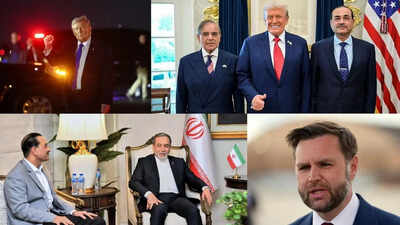
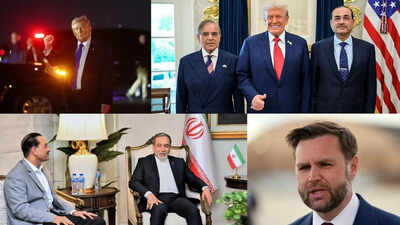
US President Donald Trump on Monday announced that Washington and Tehran had finalised a peace agreement aimed at ending the war between the two countries, with the deal set to be formally signed in Geneva, Switzerland, on June 19.The breakthrough follows months of negotiations involving senior officials from the United States, Iran and allegedly Pakistan, which emerged as a key mediator during the conflict. Here is a look at the principal figures who helped shape the agreement.
US President Donald Trump
Trump, who has repeatedly cast himself as a peacemaker during his second term, has been the driving force behind Washington’s push for a deal with Iran. More than three months after launching military action against Iran, Trump on Sunday approved a ‘memorandum of understanding’ representing the biggest breakthrough in peace efforts so far, including Tehran’s commitment to reopen the Strait of Hormuz.The US president has positioned the agreement as one of the defining foreign policy achievements of his presidency, framing it as a pathway to ending hostilities and restoring stability in the region.
J D Vance
US Vice President JD Vance played a central role in the administration’s war cabinet as the conflict entered its fourth month.Vance was closely involved in discussions surrounding the 14-point memorandum of understanding that underpins the agreement. He also led the American delegation during marathon negotiations with Iranian officials in Islamabad in early April.
Steve Witkoff
Trump’s special envoy for West Asia, Steve Witkoff, led the US negotiating team in a series of back-channel talks with Iranian interlocutors.Witkoff is credited with helping shape the framework agreement and worked alongside Pakistani mediators to bridge differences between US and Tehran.
Jared Kushner
Former White House adviser and Trump’s son-in-law Jared Kushner, participated in the wider diplomatic effort in an informal capacity.Drawing on relationships established during Trump’s first term, Kushner assisted negotiations alongside Witkoff and Vance as discussions gathered momentum.
Abbas Araghchi
Iranian Foreign Minister Abbas Araghchi emerged as one of Tehran’s most influential diplomatic voices during the conflict.Araghchi managed Iran’s engagement with global powers, neighbouring states and international organisations, while serving as Tehran’s principal representative in discussions with Pakistan’s mediation team.
Mohammad Bagher Ghalibaf
Iranian Parliament Speaker Mohammad Bagher Ghalibaf, a prominent hardline figure and one of the country’s most influential non-clerical leaders, emerged as a key architect of Tehran’s wartime strategy and diplomatic outreach.The 64-year-old spearheaded Iran’s negotiating effort that culminated in Monday’s agreement to halt hostilities and served as Tehran’s chief negotiator during the first direct US-Iran talks in nearly five decades, held in Islamabad in April.
Asim Munir
Pakistan Army Chief Field Marshal Asim Munir played a pivotal role in Islamabad’s mediation efforts, in what many observers regard as Pakistan’s most significant diplomatic intervention in decades.His behind-the-scenes engagement with American and Iranian representatives is widely credited with helping prevent the negotiations from collapsing at critical stages.
Shehbaz Sharif
Pakistan Prime Minister Shehbaz Sharif took a public leadership role in the mediation process.Sharif revealed on X on Saturday that the agreement was expected to be finalised ‘within the next 24 hours’ and signed electronically. Pakistan had earlier hosted the first direct talks between the United States and Iran in 47 years in April.
Ishaq Dar
The Deputy Prime Minister and Foreign Minister Ishaq Dar was deeply involved in the diplomatic effort.He held discussions with US Secretary of State Marco Rubio, Iranian Foreign Minister Abbas Araghchi and foreign ministers from several countries, while coordinating closely with regional partners including Turkey and Qatar to sustain momentum behind the talks.
Mohsin Naqvi
Pakistan Interior Minister Mohsin Naqvi, a close ally of Field Marshal Munir, travelled to Tehran on multiple occasions during the negotiations.According to PTI, his meetings with Iranian leaders formed part of Islamabad’s efforts to reduce tensions and build confidence ahead of the anticipated signing of the agreement.