
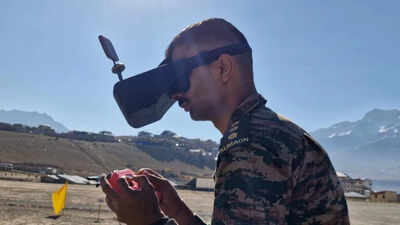
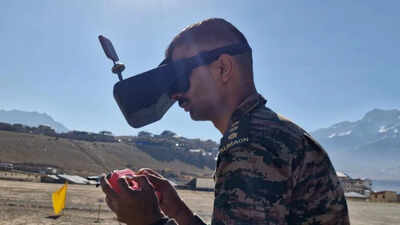
Drones are changing how militaries operate. While this transformation has been most visible in the offensive use of drones, it is now extending to logistics as well. The Indian Army is looking to use logistics drones to resupply high-altitude posts. Some of these remote posts can only be reached either by helicopter or on foot. Helicopter sorties have traditionally been the primary means of resupply, but they are costly, weather-dependent and contribute to wear and tear on critical air assets, especially as many of the Army’s Cheetah helicopters are showing their age. Transporting supplies on foot is slow and labour-intensive. Drones offer a solution to these challenges. They are less expensive to operate than helicopters and significantly faster than moving supplies by foot.The Army’s requirement for these drones is clearly defined. The platforms should be capable of carrying payloads between 20 and 40 kilograms, operating at altitudes of up to 18,000 feet above sea level and flying at least 500 metres above ground level. These specifications reflect the Army’s need for reliable aerial lifelines in regions such as Ladakh, Sikkim, Arunachal Pradesh and Uttarakhand.
To meet the Army’s requirements, the domestic industry has stepped forward with innovative platforms. BonV Aero’s Air Hans drone offers a payload capacity of 20 kilograms, a mission range of 12 kilometres, an endurance of 30 minutes and an operational ceiling of 16,500 feet. Meanwhile, IdeaForge’s Yeti drone has been designed for extreme conditions, with a maximum take-off weight ranging from 50 to 200 kilograms and an altitude capability of up to 6,500 metres.To accelerate innovation, the Army has launched competitions such as HIM-DRONE-A-THON. The initiative invited indigenous manufacturers to demonstrate drones for logistics, surveillance, loitering munitions, swarms and specialised payloads under actual high-altitude conditions between 4,000 and 5,000 metres. Complementing this effort, the HIMTECH competition was organised in Leh by FICCI. It showcased unmanned systems, autonomous mobility and advanced soldier technologies, positioning Leh as a hub for high-altitude defence innovation.These initiatives demonstrate India’s push under the Make in India and Atmanirbhar Bharat programmes to indigenise logistics solutions. With drones such as Air Hans and Yeti, frontline troops may soon rely on autonomous aerial lifelines, redefining sustainment in some of the harshest conditions on the Himalayan frontier.