
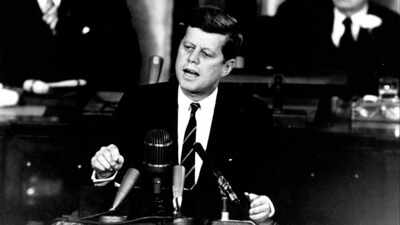
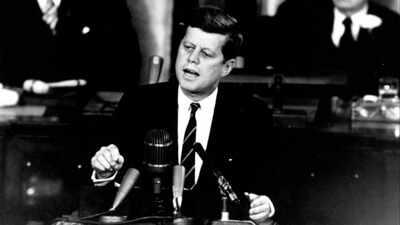
On June 11, 1963, Alabama Governor George Wallace stood directly in the doorway of Foster Auditorium at the University of Alabama in Tuscaloosa. His goal was to block two Black students, Vivian Malone and James Hood, from enrolling. Federalized National Guard troops eventually forced Wallace to step aside.Later that evening, United States President John F. Kennedy sat behind the Oval Office desk to give a talk on national television. Speaking directly to the American public, Kennedy explained that civil rights was not just a political debate, but a moral test for the country.“The rights of every man are diminished when the rights of one man are threatened,” Kennedy said.This quote points out a simple truth about society: human rights are not a pie divided among competing groups. When a society allows one person’s basic protections to be taken away, it weakens the shield that keeps everyone else safe.
The political crisis behind the speech
The summer of 1963 was a key moment in the American Civil Rights Movement. Months earlier, police in Birmingham, Alabama, used powerful fire hoses and attack dogs on peaceful protesters led by Martin Luther King Jr. People across the country grew angry as pictures of the violence appeared in newspapers.Kennedy had previously moved slowly on civil rights laws. He was worried about losing the support of Southern politicians whose votes he needed for other plans. But the standoff at the University of Alabama made it impossible to stay quiet.Working with his speechwriter Theodore Sorensen, Kennedy asked television networks for airtime just a few hours before going live. Parts of the speech were spoken from quick notes rather than a full script, giving his words a direct and real feeling.During the broadcast, Kennedy asked Congress to pass new civil rights laws. He wanted to guarantee equal access to public places, protect voting rights, and speed up school integration. That proposal became the foundation for the Civil Rights Act of 1964, signed into law by President Lyndon B. Johnson after Kennedy was killed in an assassination.
The idea of shared safety
At its core, Kennedy’s idea matches the thinking of Alexis de Tocqueville, a famous political thinker from the 1800s. Tocqueville noticed that democracies stay strong only when citizens realize that helping others protect their freedoms is the best way to keep their own.English poet John Donne wrote something similar back in 1624, saying that no person stands completely alone, and that any person’s suffering hurts everyone because we are all connected.In legal philosophy, this matches a famous idea by thinker John Rawls called the “veil of ignorance.” Proposed in 1971, Rawls argued that a fair society is one you would design if you did not know what your own wealth, race, or social standing would be beforehand. If you could end up as the weakest person in society, you would naturally want strong laws to protect that person.When legal protections are taken away from a small group, a dangerous habit begins. Once a government shows that rights can be ignored for one set of people, that same power can easily be used against anyone else when political moods change.
How this idea works today
This principle of shared rights remains important today, especially regarding digital privacy, technology, and workplace fairness.When companies or government agencies use automated surveillance or facial recognition tools against marginalized groups, the immediate impact hits those specific communities. But the technology itself expands, building a system that can track anyone. In 2023, the European Union’s Fundamental Rights Agency warned that biased automated tools tested on vulnerable migrants were quickly adapted for broader decisions about housing, healthcare, and job applications for the general public.Similarly, when companies weaken worker protections for delivery drivers or short-term workers, it sets a new standard for regular jobs. What starts as a small loss of rights for a few workers slowly changes expectations for the whole workforce.In international news, when a government targets individual journalists or researchers, it usually signals coming dangers for businesses too. Human rights monitors at Freedom House consistently note that countries that restrict free speech quickly move to break contract laws and take over private property.Kennedy’s words remind us that human rights are connected. Protecting the rights of the most vulnerable person in a community is not just an act of kindness, it is the best way to protect your own freedom.