
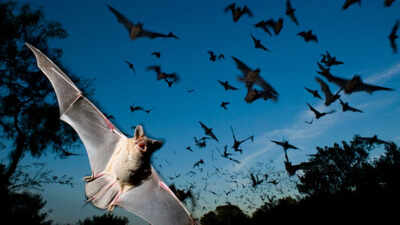
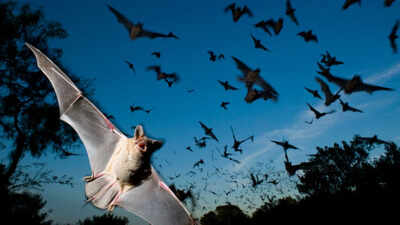
Bats rely on echolocation to move through the dark and hunt insects. They send out high-pitched sound waves that bounce off nearby objects and return as echoes which helps them judge where things are.But when many bats send out similar sound waves at the same time, their signals can overlap. It creates noise that could make it harder for a bat to identify the echoes from its own calls.A new study published in the Journal of Comparative Physiology A by researchers from Doshisha University in Japan. has found that greater Japanese horseshoe bats have a unique way of dealing with this challenge, Science X reported.These bats gradually adjust their calls so that members of the same colony use almost the same frequency.
CJP Jantar Mantar Protest Updates
Researchers say this helps the bats receive clearer echoes and better detect prey while flying together.
How bats use sound to ‘see’
Bats are among the few animals that mainly depend on echolocation. Since many species are active at night, they cannot always rely on eyesight.They produce ultrasonic calls, which are too high for humans to hear. These sound waves hit insects, trees, cave walls and other objects before bouncing back. By listening to these returning echoes, bats can work out where an object is, how far away it is and even whether it is moving.Scientists also study bat echolocation because it has inspired improvements in sonar systems and sensing technology used in robots and other devices.
A different echolocation
Most bat species use sound calls whose frequency changes during each call. However, greater Japanese horseshoe bats are different. According to the research, their calls include both changing frequencies and a long section that stays at a nearly constant frequency, which helps bats detect tiny changes in echoes.Bats also have a highly specialisedhearing system that is extremely sensitive to a narrow range of sound frequencies. This allows them to notice very small differences in returning echoes.
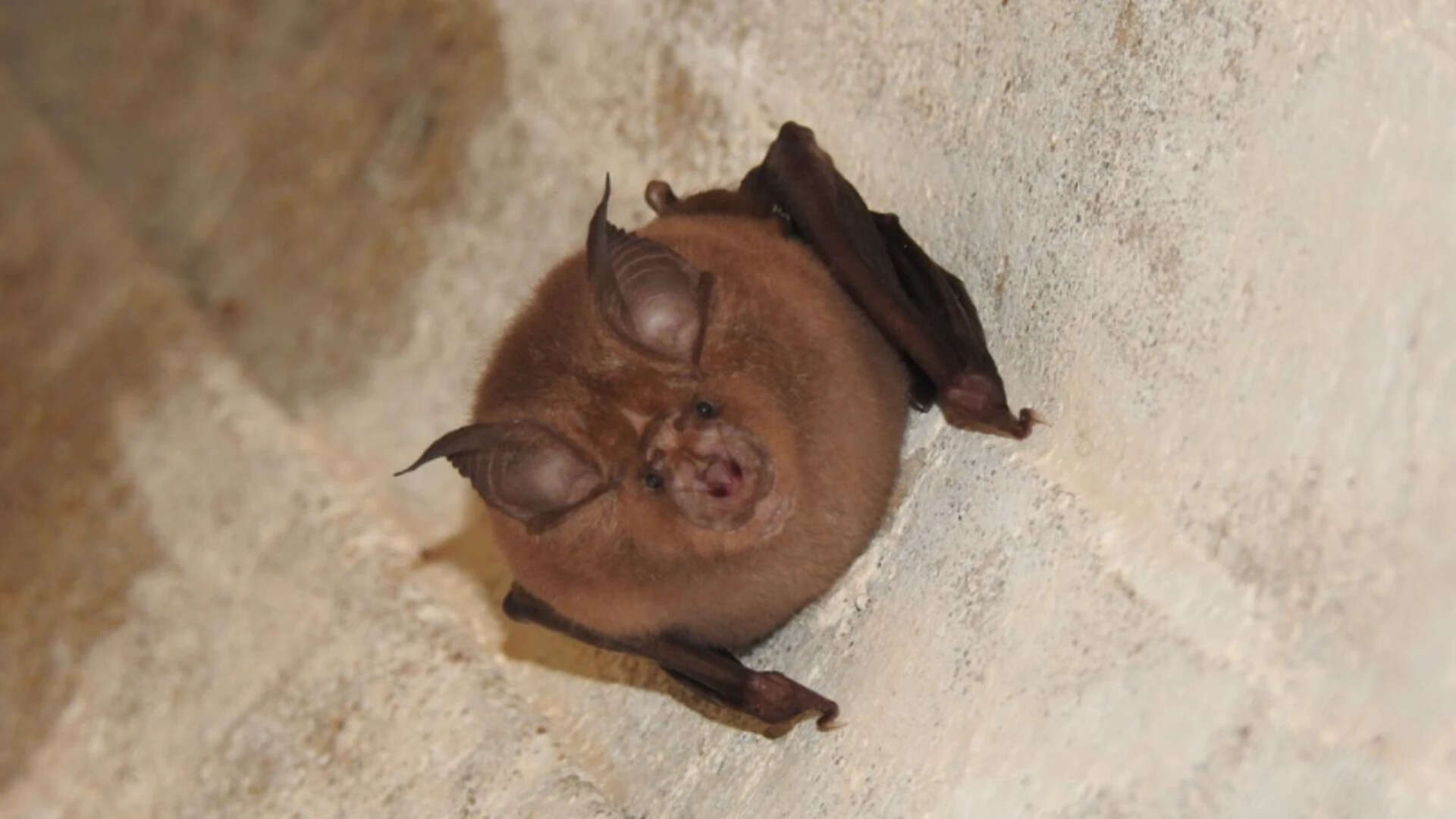
Japanese Greater Horseshoe Bat (Picture source: I Naturalist)
They also compensate for the ‘Doppler shift’. It happens when the bat or its target is movin which changes the frequency of the returning sound slightly. By adjusting their calls, bats make sure the returning echoes stay within the frequency range where their hearing is most sensitive.
When many bats use similar calls
The researchers wanted to understand what happens when many horseshoe bats with slightly different call frequencies live together. For this, they studied wild greater Japanese horseshoe bats that were brought into captive colonies of the same species.They measured the bats’ echolocation frequencies before they entered the colony. They measured them again after they had spent about one month living with the other bats.The study used data collected from 2008 to 2024. The researchers recorded bats from 15 different capture events during the period.Researchers found that the bats did not spread out their call frequencies to avoid interference, but they slowly moved towards a shared frequency.This was especially true for bats whose calls started at lower frequencies. These bats increased their call frequencies after joining the colony, while bats that already used higher frequencies hardly changed.Also, when wild and captive bats already had similar call frequencies before joining the colony, this adjustment did not happen.According to the researchers, this suggests that the bats only change their calls when there is a noticeable difference between individuals.
‘Silent spectral window’
The researchers believe this shared frequency helps create a ‘silent spectral window.’ When many bats are calling together, most background sounds stay below a certain frequency. This leaves a relatively quiet range of frequencies where important echoes from moving insects can stand out more clearly.Scientists compare it to trying to hear someone speaking in a noisy room. If the voice one wants to hear is in a part of the sound range where there is less background noise, it becomes much easier to understand.For horseshoe bats, this quieter frequency range allows them to detect the echoes from fluttering insects more reliably.Lower-frequency bats benefited the most by shifting their calls upwards. Without this adjustment, the echoes returning from prey could overlap with the calls of higher-frequency bats.By moving to a higher frequency these bats reduced that conflict, while still keeping their prey echoes within the clearer listening range.