
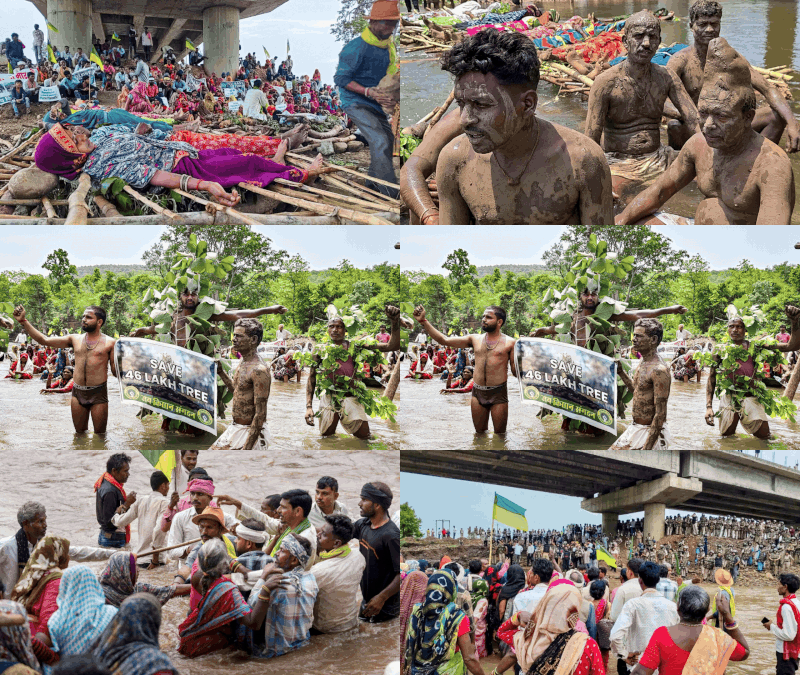
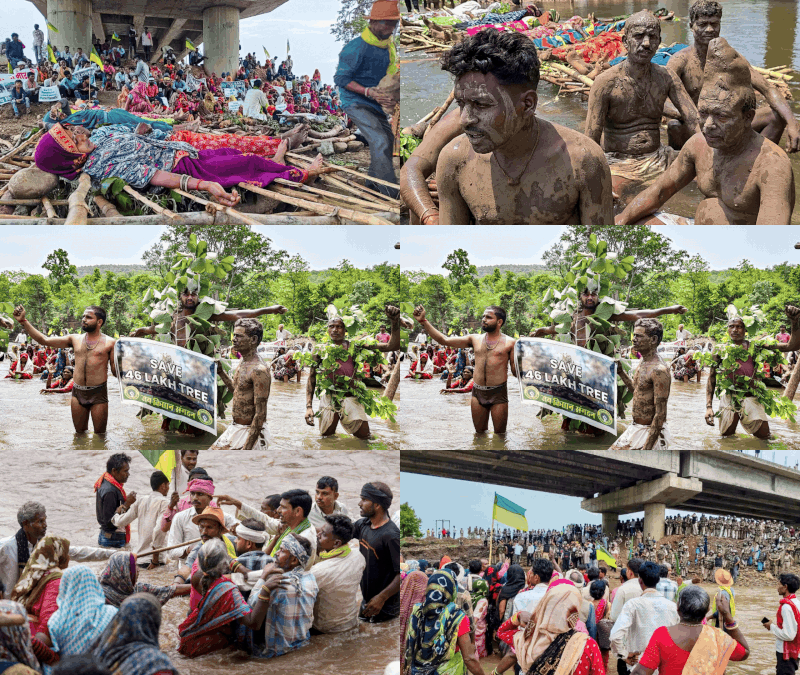
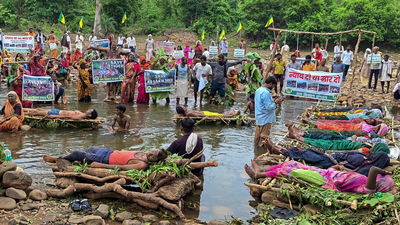
NEW DELHI: They first stood in the river. Then they lay beside funeral pyres. When that, too, failed to draw a response, they climbed symbolic gallows.Over the past month, the ‘Chita Andolan’ in Madhya Pradesh has transformed an otherwise local land acquisition dispute into one of the country’s most striking protest movements, that was forcefully ended by the administration, citing threats to protesters due to rising water levels.Its haunting imagery, however, has thrown a spotlight on the repercussions that the Ken-Betwa River Linking Project, a flagship infrastructure initiative that promises water security for millions but has also triggered a fierce battle over compensation, will have on the locals, questioning the rehabilitation and the rights of tribal communities facing displacement.The movement gathered further attention after activist Amit Bhatnagar completed an 18-day hunger strike, insisting he had only suspended—not ended—his fast because “until the last person gets justice, the fast will continue.”
CJP Jantar Mantar Protest Updates
Bhatnagar broke the hunger strike because villagers, especially women and children and 400 leading social activists from across the country, including Medha Patkar appealed to him since his health had started deteriorating. But it was the government’s assurance of a fresh survey to include the names of those left out from rehabilitation that changed his decision.Bhatnagar’s protest became the face of growing resistance to the ‘Ken-Betwa River Linking Project’, India’s first river-linking initiative under the National Perspective Plan. The Centre and the Madhya Pradesh government hail the project as a landmark intervention that will transform the drought-prone Bundelkhand region through irrigation, drinking water supply and power generation. But for thousands of tribal families living in its path, it has become a battle over land, forests, livelihoods and identity.Over the past month, villagers have staged some of the country’s most striking demonstrations. They stood waist-deep in river water in ‘Jal Satyagraha’, lay beside symbolic funeral pyres in the ‘Chita Andolan’ and even climbed symbolic gallows in a ‘Faansi Satyagraha’. Police eventually cleared the protest site on July 19, citing safety concerns due to rising water levels in the Barana river. Protesters alleged they were forcibly removed, while the administration maintained that the evacuation was necessary to prevent loss of life.The movement has revived questions India has wrestled with since the Narmada Bachao Andolan: Can large infrastructure projects be built without sacrificing the rights of the communities that bear their greatest costs?
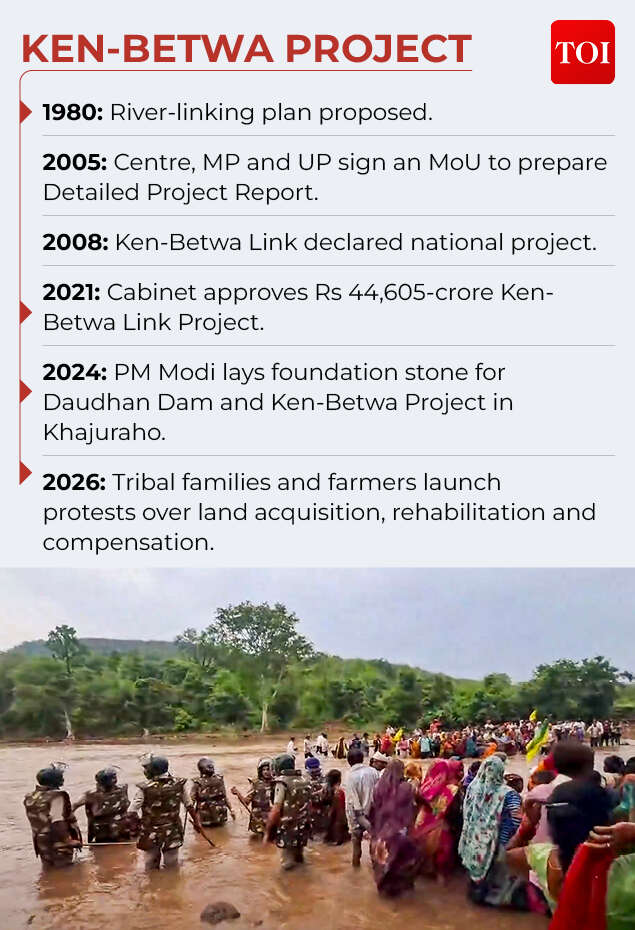
TIMELINE | Ken-Betwa Project
A project decades in the making
The Ken-Betwa Link Project has its origins in the National Perspective Plan for interlinking rivers proposed in 1980. After decades of planning, agreements and environmental clearances, the Union Cabinet approved the project in 2021, and Prime Minister Narendra Modi laid its foundation stone in December 2024.The project proposed to transfer what the government describes as surplus water from the Ken river to the Betwa river through the Daudhan Dam, tunnels and a 221-kilometre canal.The project is expected to irrigate 10.61 lakh hectares, providing drinking water to around 65 lakh people in Madhya Pradesh and Uttar Pradesh, generating 103 MW of hydropower and 27 MW of solar power and reduce the chronic water scarcity that has plagued Bundelkhand for decades.Officials argue that it will boost agricultural productivity, reduce migration and improve groundwater recharge by restoring historical Chandela-era ponds.For supporters, however, it is a long-awaited solution to one of central India’s most persistent development challenges.
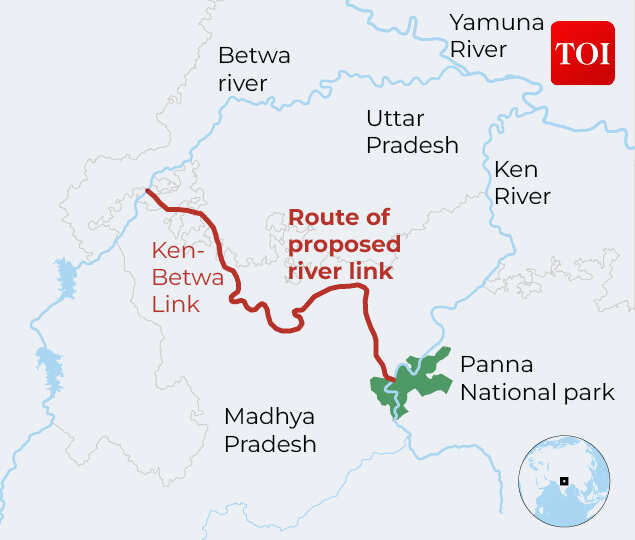
The surplus water of Ken River will be transferred to Betwa River through the 221 km long link canal from Daudhan Dam, providing irrigation and drinking water facilities in both MP and UP.
Why are people protesting?
For many tribal families in Chhatarpur and Panna districts, the project threatens the loss of ancestral land without adequate rehabilitation.Bhatnagar says the issue extends far beyond compensation. “Our demand is that people should be given land in exchange for land. But even if the government only fulfils what it has committed, that much should at least be delivered.”He argues that tribal communities who depend on forests cannot rebuild their lives simply through financial assistance. “People who are being displaced from forests should either be resettled in forest areas or, at the very least, they should be given land and a village to live in. That has been our main demand from the beginning.”The state government had announced an in-principle increase in the rehabilitation package from Rs 5 lakh to Rs 12.5 lakh per eligible displaced family, with a formal notification expected.Bhatnagar, however, says the revised compensation alone does not solve the problem. “The way these people lived in forests and depended on the forest, simply giving them Rs 12.5 lakh is not enough.”He claims many displaced villagers have little experience navigating land markets and are vulnerable to exploitation. “Unscrupulous people are misleading them by offering fake land at cheap prices. They end up buying fake land or fake houses. Later they discover that the property itself was fraudulent. They lose both their money and then get trapped in legal disputes.”
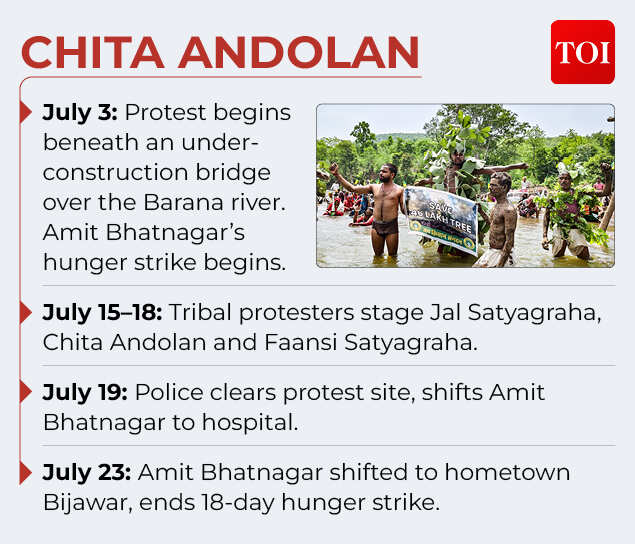
TIMELINE | CHITA ANDOLAN
One of the biggest disagreements concerns the number of affected families. The government estimates that around 7,100 families are affected by the Ken-Betwa project. Bhatnagar disputes that figure.“In the Ken-Betwa project, the government says there are 7,100 affected families. But the actual number is around 10,000, in fact more than 10,000. If we talk about all the projects together, nearly 50,000 people have been affected.”He alleges that survey teams have excluded genuine beneficiaries. “The survey teams have included the names of many fake beneficiaries. For example, in one village where Rs 11 crore was sanctioned for housing compensation, Rs 8 crore went to fake beneficiaries, while only Rs 3 crore reached the actual villagers.”While the administration has rejected allegations of corruption, a fresh survey team was announced to identify families who may have been left out. TOI reached out to Chhatarpur district magistrate and is still awaiting a response from the administration. We will update the story accordingly.The govt’s fresh assurances made Bhatnagar suspend his hunger strike. “The administration did whatever it could from its side. It formed a new survey team for those people who had been left out. Our farmers’ organisation has also been included in that survey team so that the names of everyone who was left out can be properly verified.”“We remain hopeful. But the officers and employees working for the government function very slowly. Their pens don’t move unless money is involved. We have faith in the government. But if the government does not do this, then our protest will continue,” he warned, despite being hopeful.
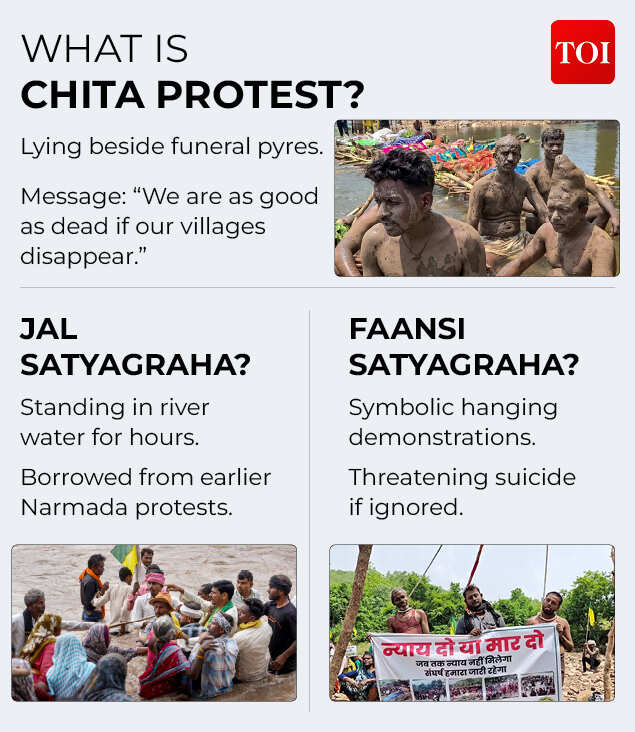
The unique protest has drawn national attention.
How the ‘Chita Andolan’ was born
Perhaps the most striking aspect of the movement has been its symbolism.The image of tribal families lying beside funeral pyres captured national attention and prompted comparisons with the Narmada Bachao Andolan’s iconic Jal Satyagrahas.Bhatnagar says the idea emerged after protesters felt every avenue of democratic dissent had been blocked. “Wherever we tried to protest, Section 144 notices were imposed. People were intimidated. When we were trying to go to Delhi, we were stopped, our vehicles fined, our entire stock of rations looted. We were stopped at several places.”He alleges that even after the movement got restricted to the villages, essential supplies were cut off. “Food and water were cut off. Water tankers were removed. Even the borewell that was supplying water was shut down. We were forced to drink river water.”Then came the thought that gave the protest its name.“If they are trying to kill us anyway, if our own government wants us to die, then let us light our own funeral pyre,” said Bhatnagar.As restrictions tightened, the forms of protest evolved.“There were other forms of protest too, like standing in the river. Then the Jal Satyagraha began. After that, they stopped our ration, food, medicines and even doctors from reaching us. Then they threatened us, saying they would hang us. So we ourselves climbed onto the gallows. That is how one form of protest after another kept evolving.”
Why was the protest site cleared
The protest took another turn on July 19, when police dispersed demonstrators. Officials said continuous rainfall had raised the river level, making the site unsafe, and shifted Bhatnagar to hospital after his health deteriorated.Bhatnagar alleges that women were injured during the operation. “Women’s sarees were torn, many women lost their mangalsutras, and many people were injured. Naturally, there is a lot of anger among the people,” he said.Despite the anger, he insists the movement remains committed to non-violence.“We follow Gandhian principles and believe in democratic values. We do not want such things. Yes, there is tremendous anger. There is pain. Our effort is to maintain a balance between that pain and anger, and to ensure that people get justice through the right path,” he said.
More than one project
While public attention has focused on the Ken-Betwa link, Bhatnagar says the movement also represents people affected by the Majhgaon and Runjh irrigation projects.“There are five such projects in Chhatarpur and Panna where the law has not been followed.”He says surveys have restarted only in a limited area. “Right now, this process has begun only in a small area, in 11 villages of the Chhatarpur project. The people of Panna district have not yet received any response.”
The larger debate
The Ken-Betwa project has also faced criticism from environmental groups concerned about the impact of the Daudhan Dam on parts of the Panna Tiger Reserve. Conservationists have questioned forest submergence and biodiversity loss, while the government says all necessary environmental clearances have been obtained and mitigation measures are in place.Ultimately, the dispute has become larger than one dam or one canal.It reflects a recurring question in India’s development journey: Can projects that promise benefits for millions be implemented without leaving displaced communities behind?For the government, the Ken-Betwa project is a blueprint for India’s future water security.For many tribal families living along the Barana river, it is a fight to ensure that development does not come at the cost of their homes, livelihoods and identity.As survey teams begin their work once again, the project’s success may ultimately depend not only on engineering but on whether the promises of rehabilitation and justice reach every family that stands to lose the most.