
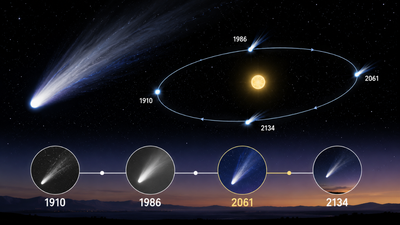
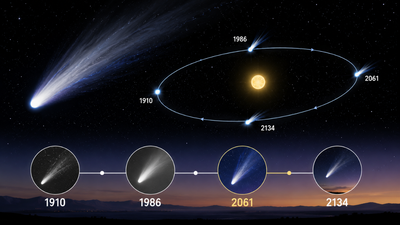
Halley’s Comet is already on course for its next appearance in the inner solar system, but the wait for its return will stretch across decades. The famous periodic comet is due to reach perihelion, its closest point to the Sun, on July 28, 2061, following its last visit in 1986. By then, a new generation of skywatchers will have the chance to see the same comet that has been observed for more than 2,000 years. Its unusual 76-year orbit means that this return could be the only realistic opportunity for many people alive today to witness Halley itself. The comet’s significance goes beyond its familiar place in the night sky. Its repeated passages leave trails of dust that produce the annual Eta Aquarids and Orionids meteor showers, while its previous return in 1986 brought an international fleet of spacecraft close to the comet. After 2061, the next perihelion is expected in 2134.
Halley’s Comet 76-year orbit and next return date in 2061
As per Nasa, Halley as the comet most closely associated with the discovery that some comets are not one-off visitors. Edmond Halley compared observations of bright comets recorded in 1531, 1607 and 1682 and concluded in 1705 that they were appearances of the same object. He predicted its return, which came in 1758, establishing what Nasa describes as history’s first known periodic comet.The comet follows an orbit that takes roughly 76 years to complete, although the exact interval shifts because the planets exert gravitational forces on it. Nasa gives an average orbital period of 76 Earth years, with recorded intervals ranging from about 74.4 to 79.3 years. Its orbit is also unusual: Halley travels in the opposite direction to the planets and is tilted by about 18 degrees relative to Earth’s orbital plane.The date of the next perihelion has been calculated for decades. A 1985 special issue from the Astronomical Society of the Pacific, “July 28, 2061,” as the date of Halley’s next perihelion, with the calculation attributed to Donald K. Yeomans of JPL. The same source gives March 27, 2134 for the following perihelion.
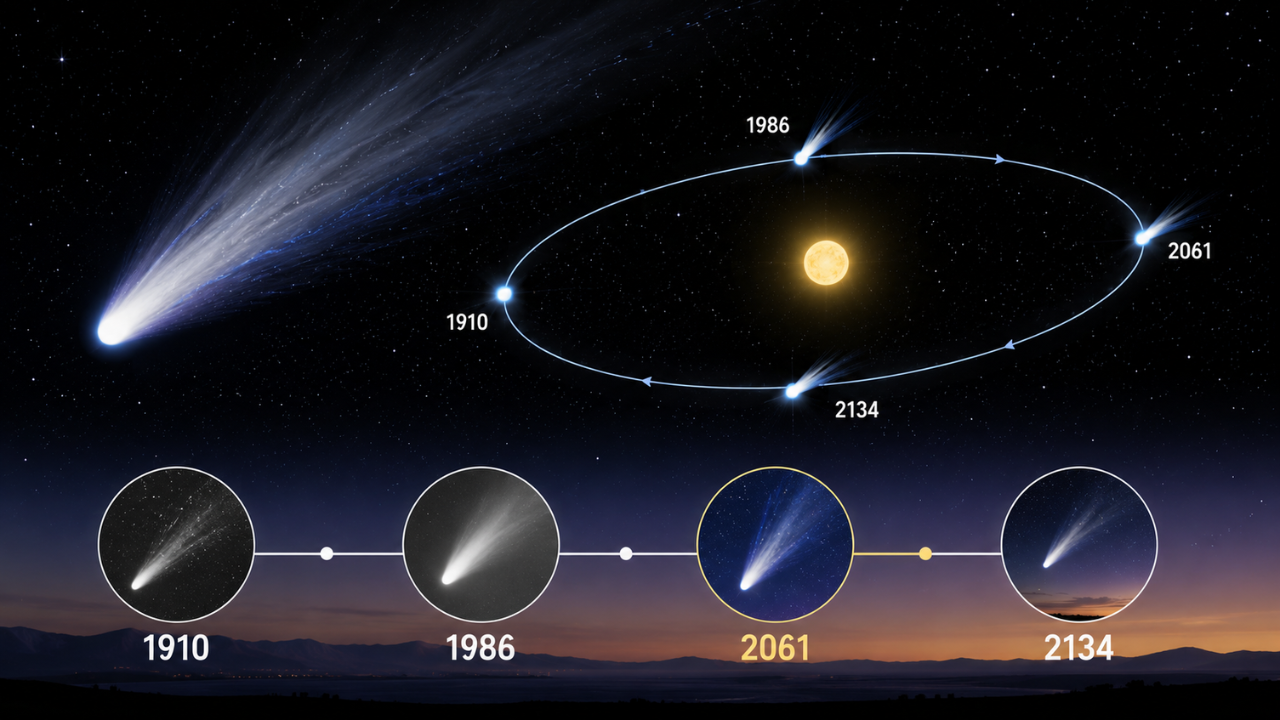
Image AI generated
Halley’s Comet 1986 return brought spacecraft close to its nucleus
The last return brought Halley much closer to spacecraft than most casual observers on Earth could appreciate. In 1986, an international group of spacecraft travelled towards the comet, including ESA’s Giotto, Japan’s Suisei and Sakigake, the Soviet Vega 1 and Vega 2 spacecraft, and the international ISEE-3 mission. Nasa also contributed observations from Pioneer spacecraft. Giotto became one of the first spacecraft to encounter and photograph a comet’s nucleus.It described plans for several spacecraft to investigate Halley’s “nucleus, the coma … and the tail”, with Giotto intended to pass within roughly 500 kilometres of the nucleus. The spacecraft eventually returned close-up observations that helped establish what the solid body of a comet actually looks like. For Earth-based observers, the 1986 apparition was not particularly favourable. The same 1985 account warned that the comet would be faint and difficult to see from many urban areas, with its position low in the sky for much of the Northern Hemisphere. Its closest approach to Earth during that passage came on April 11, 1986, when it was about 63 million kilometres away. Halley was only slightly brighter than Polaris during its 1986 appearance, with its light spread over a much larger area than that of a star.
Halley’s Comet debris produces two major annual meteor showers seen from Earth
Halley’s return is not the only reason the comet appears in the yearly night sky. Every passage through the inner solar system leaves material behind. As sunlight heats the nucleus, ice and rocky dust are released, gradually building a stream of debris along the comet’s orbit.Earth crosses parts of this debris stream every year. The result is two meteor showers: the Eta Aquarids in May and the Orionids in October. Nasa identifies 1P/Halley as the parent comet of both showers. The Eta Aquarids are produced when Earth encounters Halley-related dust in spring, while the Orionids appear later in the year.That connection means Halley is not absent between its major appearances. The comet itself remains far from the inner solar system for most of its orbit, but fragments shed during earlier passages continue to intersect Earth’s path. Nasa’s current skywatching material notes that Halley last passed through the inner solar system in 1986 and will not return until 2061.
Halley’s Comet 2061 return could be a once-in-a-lifetime event for people alive today
The gap between Halley’s appearances is what makes the 2061 return unusual for people alive now. Someone who watched the comet in 1986 would have to wait 75 years for the July 2061 perihelion. And once that passage is over, the next listed perihelion does not arrive until March 2134. That does not mean nobody alive today could see both appearances. A young person in 2026 could, in principle, still be alive in 2134. But for most people living today, 2061 is far more likely to be their realistic opportunity to see Halley itself during its next return. The comet’s 76-year rhythm is long enough to turn an ordinary astronomical event into something that spans generations.Halley will also remain scientifically interesting when it comes back. The comet loses an estimated 1 to 3 metres of surface material during each orbit, as volatile ices are gradually stripped away by repeated heating near the Sun. Yet Halley has shown no obvious signs of ageing in its recorded appearances and has been in its current orbit for at least 16,000 years.By 2061, the technology available for observing it will be very different from that of 1986. Nasa has already published concepts for possible spacecraft missions to Halley’s 2061 return, including proposals for flybys and more ambitious rendezvous missions. One Nasa-hosted mission concept describes the 2061 return as an opportunity for spacecraft to investigate the comet’s composition, structure, size, shape, mass and outgassing.For now, Halley continues its slow journey outward and back again. Its return date is not a prediction in the loose sense of guessing where a comet might be decades from now; its orbit has been studied closely enough for astronomers to place the next perihelion on the calendar. On July 28, 2061, Halley is expected to reach that point in its long journey. After that, the calendar moves on to 2134.