
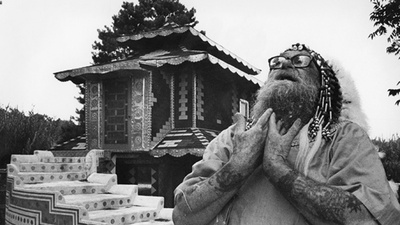
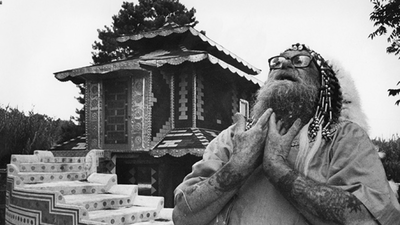
In 1957, eccentric folk artist Eddie Owens Martin returned to his rural roots near Buena Vista, Georgia, and began turning a seven-acre family property into a colourful world of painted totems, geometric designs and tall masonry walls. Over the next 29 years, Martin, who called himself “St. EOM”, built six major structures and more than 900 feet of brightly painted walls. The site became what is now considered one of North America’s most important visionary art environments. Known as Pasaquan, a name Martin created to mean “the past coming together”, the site combines Mesoamerican designs, African patterns, Eastern symbols and futuristic ideas into a highly personal style.
From fortune teller to Georgia visionary
Born in 1908 to a family of rural Georgia sharecroppers, Martin left home for New York City at 14. He spent the next three decades working in the city’s nightlife and later became a professional fortune teller. According to biographical records maintained by Columbus State University, Martin experienced powerful spiritual visions while seriously ill in 1935. He said a futuristic being told him to change his life and follow “Pasaquoyanism”, a personal spiritual system that linked growing long hair with spiritual energy, harmony with the universe and artistic creation. “You’re gon’ be the start of somethin’ new, and you’ll call yourself Saint EOM, and you’ll be a Pasaquoyan, the first one in the world,” Martin recalled of the vision, according to statements preserved by the Pasaquan Preservation Society. After his mother’s death, Martin returned to Marion County in 1957 and began building his vision on the family property. He funded the work through fortune telling and tarot readings for local residents. Without formal architectural plans, he spent decades constructing concrete buildings, circular dance platforms, two-storey pagodas and detailed shrines. “I built this place to have somethin’ to identify with, ’cause there’s nothin’ I see in this society that I identify with or desire to emulate,” Martin said in archival interviews preserved by the John Michael Kohler Arts Center.
Decay leads to major restoration
Martin died in 1986. Local supporters then formed the Pasaquan Preservation Society to protect the unusual site. Despite their efforts, years of extreme weather, high humidity and termite damage badly affected the painted walls and wooden structures. Pasaquan was added to the National Register of Historic Places in 2008, recognising its importance as a major example of outsider art. But the site still faced serious physical damage. In late 2013, preservation leaders turned to the Wisconsin-based Kohler Foundation after deciding that a full restoration was beyond the resources available locally. The foundation took responsibility for the site in 2014 and began one of the most complex efforts to restore an American art environment. The two-year project involved specialist conservators from Parma Conservation in Chicago, International Artifacts in California and regional construction teams. Workers repaired damaged masonry foundations, treated extensive termite damage, removed overgrown vegetation and carefully repainted deteriorating surfaces. Historical photographs were used to match the bright colours and designs created by St. EOM.
Preserving Pasaquan for the future
After the restoration was completed in 2016, the Kohler Foundation donated the seven-acre Pasaquan site to Columbus State University (CSU), securing its future as a public and educational site. Today, Pasaquan is managed through the university’s Department of Art. It operates as an educational centre, museum and residency site for visiting artists from around the world. Most of St. EOM’s outdoor sculptures and painted walls remain at the original site in Marion County. Some of his paintings, textiles and jewellery are also held in permanent collections at CSU and the John Michael Kohler Arts Center, helping protect his work from potential natural disasters. Pasaquan remains open for self-guided tours, educational programmes and cultural events. The colourful complex stands as a lasting record of Martin’s 29-year effort to create his own alternative world from concrete, paint and personal belief.