
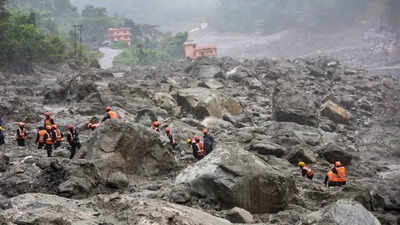
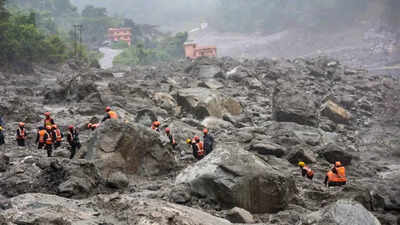
Guna Maya Bohara, a 97-year-old woman who was rescued alive from the rubble of her care home, destroyed in the Nepal flash floods, has become a remarkable story of survival. Bohara was rescued four days after the disaster swept through the country as the rescue operation continues to look for victims, survivors and the dead.Images of the mud-covered woman being carried to safety in the scoop of a digger have emerged as one of the most striking accounts of survival from the disaster. Bohara was pulled from the debris after a four-hour rescue operation and was taken to hospital, where doctors said she was recovering.Her doctors said she was recovering in hospital. Her great-nephew Dipak told BBC Nepali that Bohara looked like “a warrior” who had returned victorious from battle.Her survival came as Nepal’s flood death toll crossed 700 on Sunday, while more than 2,500 people remained missing. Rescue teams were continuing operations across the worst-hit areas, searching rubble, forests and devastated settlements for people who may still be alive.
How did the 97-year-old survive?
Bohara was trapped beneath the debris of her care home after the floods devastated the area. For four days, she remained buried before rescuers were finally able to locate and extract her.The circumstances of her survival have made her rescue one of the most striking stories to emerge from the disaster. While floodwaters swept away homes and entire settlements, Bohara remained alive beneath the wreckage until rescuers reached her.The dramatic rescue was captured in images showing the elderly woman covered in mud as she was carried away in the scoop of a digger.Her survival has offered a rare moment of hope in a disaster that has left hundreds dead and thousands unaccounted for.
Others survived by running, climbing and hiding
Across flood-hit Nepal, other survivors described similarly desperate battles to stay alive as settlements disappeared within minutes.In Timure, a town on the Nepal-Tibet border, customs agent Raju Budhathoki initially thought an earthquake had struck when the hillside suddenly began shaking on Wednesday morning.He ran towards a nearby police post, only to find police personnel fleeing themselves. As he scrambled over a wire fence, he injured his hand.When he looked back, houses in the Timure market were being swept away one after another. Some vanished into the river within seconds.Budhathoki managed to reach a forest about 500 metres uphill from the settlement. From there, he watched the destruction below.“From the forest, when I looked down at Timure, I never imagined I would get a second chance at life like this,” he told The Kathmandu Post from his hospital bed in Trishuli.Another customs agent, Prakash Gautam, also escaped into the forest as the flood engulfed Timure.He recalled hearing a huge rumbling sound before darkness covered the market and a black cloud filled the sky. Gautam ran from his room without knowing where he was going.He injured the little toe of his left foot while fleeing but eventually reached the forest above the settlement.From there, he saw bodies scattered and floating in the floodwaters while Timure was reduced to ruins.Gautam and other survivors spent Wednesday night stranded in the forest because rescuers could not reach them during the day. They survived on packets of noodles dropped by a Nepali Army helicopter.Around 10 am on Thursday, another Army helicopter arrived and flew them to Bidur.“Only after boarding the helicopter did I feel that I had actually survived,” Gautam told The Kathmandu Post.
When flood itself became a lifeline
For Tulsi Bahadur Bhandari of Dolakha, survival came through a twist of fate.He was trying to escape when a torrent of black mud and floodwater tore through the settlement. Houses began collapsing around him as he ran.The force of the flood struck Bhandari and threw him towards a hillside. That unexpected push away from the current may have saved his life.“If the current had not thrown me towards the slope, I would not be alive today,” Bhandari told The Kathmandu Post from his hospital bed.
Survivors return to find their families missing
For some survivors, escaping the floods brought another devastating reality.Sachin Khati, 33, had been staying with his wife, four-year-old son and maternal uncle Raj Kumar Diyali, who ran a jewellery business in Rasuwa.Before the flood struck on Wednesday, Diyali sent Khati to Chilime for work. Khati rushed back after hearing about the disaster.But by the time he arrived, the village where he had been staying had already been swept away.“When I hurried back after hearing about the flood, the village where I had been staying had already been swept away,” he told the Kantipur newspaper.His wife, son and Diyali remained unaccounted for.Twenty-one-year-old labourer Sujal Thapa was also rescued after being swept away from his home in Uttargaya village in Rasuwa.Thapa was sleeping when the flood arrived and said he was unaware of what was happening until the water swept him several metres away.“I was sleeping and was not aware when the flood came. I was swept several metres away from my house, where security personnel found and rescued me hours later,” Thapa told onlinekhabar.com.Rescuers found Thapa unconscious near the riverbank. He had suffered injuries to his leg, head and fingers, while his house had been washed away.He was recovering at Tribhuvan University Teaching Hospital in Kathmandu but still did not know where his mother was. His father remained in a village in Rasuwa, and Thapa hoped to see him.
One life amid a landscape of loss
The stories emerging from Nepal are of people who survived in forests, clung to hillsides, were thrown away from raging currents or waited helplessly for rescuers.Bohara’s story is different in one crucial way. At 97, she endured four days beneath the debris before rescuers finally reached her.As Nepal’s search teams continued their race to find more survivors, the image of the mud-covered elderly woman being lifted from the rubble stood out as a powerful reminder that, even after days of devastation, life can still be found where rescuers least expect it.