
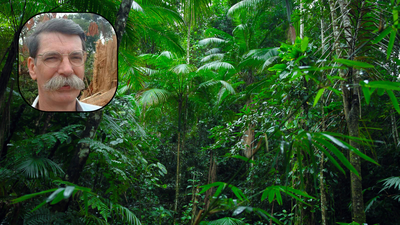
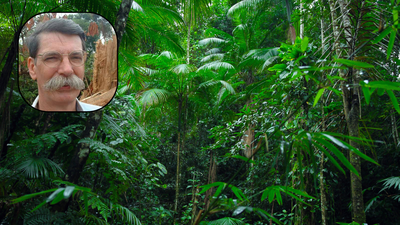
The Amazon rainforest has been described in terms of its enormous size, biodiversity and importance to the global climate. But for Philip Fearnside, understanding the forest has also meant asking a more practical question: what does it cost when the forest is cleared or altered? Fearnside began working in the Amazon in the 1970s, studying agricultural settlements along Brazil’s Trans-Amazonian Highway. Since then, his research has examined the consequences of deforestation, large infrastructure projects, hydroelectric dams and roads. A recent Mongabay profile marks 50 years of his field research. His work has included research on forest carbon, deforestation and infrastructure, as well as contributions to the Intergovernmental Panel on Climate Change (IPCC).
Starting with the highway
Fearnside’s Amazon research began during a period when Brazil was aggressively promoting settlement and development of the rainforest. In the 1970s, he spent about two years living in agricultural settlements around Altamira, Pará, established along the Trans-Amazonian Highway. Rather than simply examining the forest itself, he studied the people settling there and the agricultural systems they were attempting to establish.The experience helped shape a recurring theme in his research: examining the economic and environmental consequences of development in the Amazon. His subsequent work examined deforestation rates, the reasons forests were being cleared and the consequences of converting rainforest to other land uses. His scientific publication archive at Brazil’s National Institute for Amazonian Research (INPA) includes extensive work on deforestation rates, causes and control, as well as dams and their environmental effects.
Putting a value on forests
One of Fearnside’s important contributions has been treating Amazonian forests as more than timber or land that can be converted for agriculture. His research has examined the carbon stored in tropical forests and the greenhouse-gas emissions associated with deforestation. That approach helped demonstrate that clearing forests can carry costs that are not reflected in the immediate economic returns from activities such as cattle ranching or agriculture.In a major body of research on Amazon deforestation, Fearnside examined how government policies, land speculation, agricultural incentives and infrastructure could interact to encourage forest clearing. His work also explored how roads can transform areas that were previously difficult to access. A major highway can be followed by secondary roads, settlers, loggers and other activities, extending the footprint of development well beyond the original road itself. This became particularly relevant to his later work on BR-319, the highway connecting Manaus and Porto Velho.
Dams bring hidden costs
Hydroelectric power has also been a major subject of Fearnside’s research. The Amazon contains enormous rivers that have attracted large-scale hydropower development. But Fearnside has argued that evaluating dams only by the electricity they generate can overlook other consequences, including flooded forests, greenhouse-gas emissions, changes to river ecosystems and the infrastructure that follows construction.Research involving Amazonian dams has also examined deforestation around hydropower projects. A 2022 study, for example, used satellite imagery from 2000 to 2018 to investigate forest loss around large dams and clusters of small hydropower plants in the Brazilian Amazon. The study found that when forest loss was considered relative to installed generating capacity, small hydropower plants could have substantially higher associated forest loss per megawatt than large dams. For Fearnside, evaluating Amazonian development also means considering the environmental services and carbon storage that can be lost alongside the benefits of infrastructure.
Roads can reshape the forest
Fearnside’s concerns about roads extend beyond the physical strip of forest cleared to build them. His research has argued that highways can open previously inaccessible areas to settlement, agriculture, ranching, logging and land speculation. Secondary roads can then expand outward from the main route, creating a much larger zone of forest disturbance. That argument has been central to his opposition to rebuilding BR-319 between Manaus and Porto Velho. At a 2021 public hearing in Manaus, Fearnside argued that paving the highway could stimulate deforestation and questioned its economic viability. The hearing highlighted the political controversy surrounding environmental concerns over major infrastructure projects.
Five decades of research
Fearnside’s career has therefore followed the Amazon through several different development debates, from agricultural colonisation and highway construction to forest carbon, hydropower and climate change. He has also taken his research beyond academic journals, publishing for Brazilian audiences, speaking with journalists and participating in public discussions about proposed projects. His work has contributed to international climate assessments, including the IPCC.The central thread running through five decades of research is the attempt to make environmental costs visible. A forest may appear to be economically valuable when measured only by the land, timber or infrastructure it can provide. But Fearnside’s research has repeatedly asked what is lost when those calculations leave out carbon storage, biodiversity, water regulation and the wider effects of opening intact forest to development. After 50 years, that question remains at the heart of his work: not simply how much the Amazon can produce, but how much society stands to lose when the forest itself disappears.