
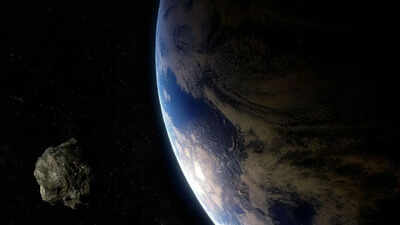
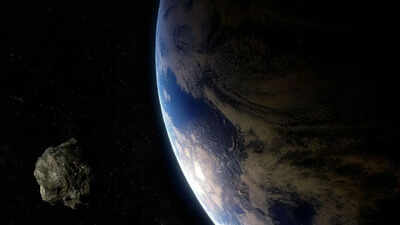
This “house-sized asteroid” is going to come within proximity of Earth on April 9. Named Asteroid 2026 GD, it is said to come past at an altitude lower than that of the Moon. On the surface, that may seem quite alarming. Well, it does in most cases because when we talk about distances in space in this manner, that can be somewhat alarming. However, NASA has made it clear that this flyby doesn’t pose any danger to Earth. The asteroid will pass by at around 156,000 miles, or about 251,000 kilometres away from the planet, which may be close but safe enough.
NASA tracks asteroid 2026 GD in a close encounter with Earth’s orbit
The asteroid 2026 GD is about 54 feet in diameter and thus classified as one of the smaller near-Earth space objects. Its size can be compared to that of a typical house. Space objects of such a magnitude are rather frequent in near-Earth space and are included in numerous tracking programs. This space object falls under a more general category called Near-Earth Objects, comprising asteroids and comets whose trajectories lie close to the trajectory of Earth. Near-Earth Objects range in size from tiny bits of cosmic dust to giant asteroids, but very few are dangerous to our planet.The 156,000-mile minimum approach distance for the asteroid falls within the mean orbital radius of the Moon at roughly 239,000 miles. Therefore, it would be considered to pass between the orbits of the Earth and the Moon. Although the distance appears relatively small compared to the two bodies, the gap between them is still large enough.
Is asteroid 2026 GD a threat to Earth during its close flyby
There is no risk associated with asteroid 2026 GD. NASA has not categorised it as a hazardous object, and its orbit does not intersect with Earth. For an asteroid to be considered potentially dangerous, it typically needs to be much larger and follow a path that brings it significantly closer over time. Such events are not uncommon, and most go unnoticed unless they produce visible streaks of light in the sky.
Significance of continuous monitoring of such objects
The monitoring of asteroid 2026 GD takes place in the context of a larger effort to understand and track near-Earth space. The observations aid in improving orbit predictions. Each such body adds another set of information for the development of protective systems for Earth against any possible threat to it in the future. Such measures aim to detect any such threat long before it comes close to us. There is also the scientific purpose of understanding the history of the Solar System, where many asteroids formed.