
Iran has launched a barrage of drones and missiles at Gulf states in retaliation for US and Israeli strikes that killed Supreme Leader Ayatollah Ali Khamenei on Saturday. The strikes continued into Tuesday, marking a sharp escalation in the regional conflict.Energy installations in Qatar and Saudi Arabia both key US allies in the Gulf State were targeted as Tehran widened its military campaign to critical infrastructure.
Saudi Aramco hit by falling drone debris
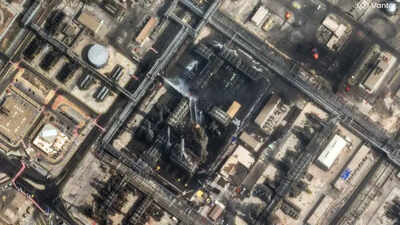
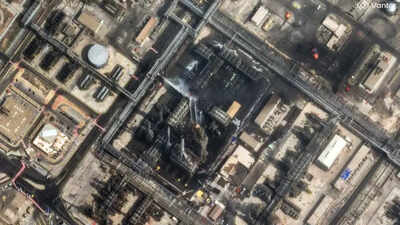
New satellite imagery shows the aftermath of an Iranian drone attack targeting the Ras Tanura Refinery, one of the world’s largest oil export facilities owned by Saudi Aramco.Saudi Arabia’s defence ministry said two drones were intercepted over the refinery on Monday, local time, but the falling debris caused a fire.Saudi defence ministry spokesperson Major General Turki al-Malki said on Al Arabiya TV that debris from an intercepted drone caused a “limited fire” at the facility, further adding that there were no injuries.The newly released images showed scorch marks and fire damage around cooling towers in the central area of the refinery, which connects storage units to a pier capable of loading four tankers simultaneously.The videos circulating online also showed thick black smoke rising from the site.Aramco said the refinery was temporarily shut down following the strike. However, Saudi state news agency SPA, citing an energy ministry official, reported that petroleum supplies to local markets were not affected, while some units were shut as a precaution.Ras Tanura produces more than 550,000 barrels per day and serves as a critical export terminal due to its location on the Persian Gulf, Reuters reported.“The attack on Saudi Arabia’s Ras Tanura refinery marks a significant escalation, with Gulf energy infrastructure now squarely in Iran’s sights,” Reuters reported, quoting Torbjorn Soltvedt, principal Middle East analyst at risk intelligence firm Verisk Maplecroft as saying. “The attack is also likely to move Saudi Arabia and neighbouring Gulf states closer to joining U.S. and Israeli military operations against Iran,” Soltvedt added.Saudi energy facilities have previously been targeted. In September 2019, drone and missile attacks on the Abqaiq and Khurais plants temporarily knocked out more than half of the kingdom’s crude production. Ras Tanura was also attacked in 2021 by Yemen’s Iran-aligned Houthi forces.
US Embassy in Riyadh targeted
An attack by two drones early Tuesday targeted the US Embassy in Riyadh, sparking a small fire. “The US Embassy in Riyadh was attacked by two drones, according to initial assessments. The attack resulted in a limited fire and minor material damage to the building,” a Saudi defence ministry statement said.Witnesses reported seeing smoke rising over the diplomatic quarter in Riyadh and hearing loud explosions.“Eight drones were intercepted and destroyed near the cities of Riyadh and Al-Kharj,” Major General Turki al-Malki said on X.
Missile strikes in Bahrain And Qatar
Iran’s state broadcaster Press TV reported an Iranian missile strike at Salman Port in Bahrain, claiming it was being used to transport American logistical equipment intended for strikes on Iran.In Qatar, the defence ministry said two ballistic missiles were intercepted early Tuesday morning. New explosions were later heard again in Riyadh.Iran’s salvos have hit ports, airports, residential buildings, hotels and military sites across the oil-rich region as Tehran presses its retaliation.
Damage at Natanz Nuclear facility
Fresh satellite imagery also shows new damage at Iran’s Natanz nuclear facility, a key component of its uranium enrichment programme.According to ABC news, the facility has not been operational since it was bombed by the United States in June 2025. However, it may still contain enriched uranium cylinders, related equipment, or recoverable centrifuges.