
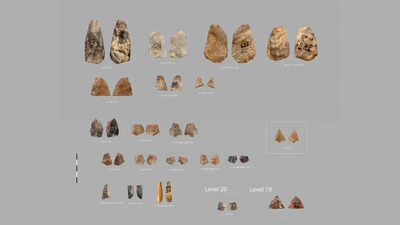
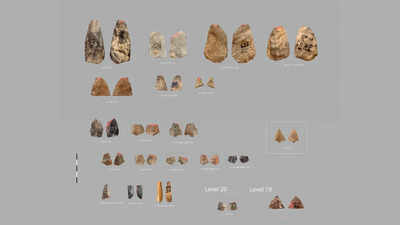
At the Obi-Rakhmat rock shelter in northeastern Uzbekistan, researchers have identified tiny triangular stone points in the site’s oldest occupation layers, dating to around 80,000 years ago. The unretouched micropoints average less than 2 centimetres in width and weigh only a few grams, with their dimensions indicating that they were designed for very small, lightweight projectile systems. The researchers argue that their shape and fracture patterns are consistent with use as projectile heads on arrow-like shafts. What makes the discovery particularly striking is that virtually identical micropoints appear at Mandrin Cave in France’s Rhône Valley roughly 25,000 years later, where they are associated with an early presence of Homo sapiens in western Europe. The two groups of points are separated by about 6,000 kilometres, yet share an unusually similar form and evidence of projectile use. The researchers do not claim that one directly descended from the other, but say the resemblance raises important questions about how lightweight projectile technology emerged and spread across Eurasia.
How researchers identified the tiny weapons hidden in an 80,000-year-old rock shelter
Obi-Rakhmat was discovered in 1962 and lies at an elevation of about 1,250 metres in the western foothills of the Tian Shan Mountains in northeastern Uzbekistan. Excavations have exposed roughly 10 metres of Pleistocene deposits spanning around 40,000 years, preserving a long sequence of human activity. For the new study titled Arrow heads at Obi-Rakhmat (Uzbekistan) 80 ka ago?, researchers examined material from the site’s deepest layers, particularly layers 20 and 21, which date to around 80,000 years ago. Rather than assuming that every pointed stone was a weapon, the team conducted a preliminary traceological investigation designed to distinguish projectile damage from fractures created during stone-tool production or other activities. From the material studied, the researchers selected 20 pieces that could be regarded as projectile armatures on the basis of their morphology and impact damage. They identified three broad classes: relatively massive points, tiny micropoints and bladelets. The micropoints were particularly significant because some showed fracture patterns and microscopic linear impact traces consistent with use as projectile heads. The authors stress that this is still a preliminary study based on material from only about 20 square metres of excavation, but say the sample is sufficient to demonstrate the presence of impacted micropoints in the oldest layers.
Why the size of the Obi-Rakhmat points matters so much
The most unusual pieces are the triangular micropoints. Unlike the site’s larger projectile points, they are extremely small and lightweight: the fractured specimens in the study have an average weight of 1.4 grams, ranging from 0.7 to 2.5 grams, while their average width is 18.2 millimetres. Their dimensions are important because the researchers argue that the points are too narrow to have functioned effectively as tips for larger projectile weapons. Geometric calculations indicate a potential shaft diameter of roughly 7.5 to 8 millimetres, which falls within the dimensions expected for an arrow shaft. The researchers therefore consider arrow-like shafts the most straightforward interpretation, while acknowledging that another technical possibility has not been experimentally tested. The evidence becomes more significant because the micropoints occur alongside much larger projectile points and bladelets. The almost complete large points weigh around 25 to 35 grams, making them substantially heavier than the micropoints. The researchers therefore suggest that the assemblage represents several types of hunting weapons rather than a single standardised projectile system. They also note that the production of the micropoints appears to have responded to a specific need for small, lightweight sharp armatures, although the precise way every bladelet was used remains uncertain.
What connects Uzbekistan’s tiny points to arrows found in France 25,000 years later
The most striking comparison comes from Mandrin Cave in the Rhône Valley of France. A layer at the site known as layer E, dating to approximately 54,000 years ago, contains tiny projectile points that the Obi-Rakhmat researchers describe as effectively identical to the Central Asian micropoints. Those French points were also impacted by use as projectile heads and have been interpreted as arrowheads. The same layer contained a deciduous tooth belonging to Homo sapiens, while a later Mousterian layer at Mandrin contained Neanderthal remains. The Mandrin occupation is therefore considered evidence for an early pioneering presence of modern humans in southern Europe. The two assemblages are separated by roughly 25,000 years and about 6,000 kilometres, yet the researchers were struck by how closely their micropoints resemble one another. However, they explicitly stop short of claiming that Obi-Rakhmat and Mandrin represent a direct technological lineage. Instead, they say the similarity raises the possibility that comparable technological solutions could have spread between different human groups or been developed independently. Similar combinations of larger points, micropoints, blades and bladelets are also beginning to be identified at other Middle Palaeolithic sites in Europe, including Cueva Millán in Spain and Riparo l’Oscurusciuto in Italy.
Why scientists are cautious about saying Homo sapiens made the Uzbekistan arrowheads
The discovery does not establish that Homo sapiens were living at Obi-Rakhmat 80,000 years ago, and the researchers are careful to separate the technological evidence from the question of biological identity. The site’s human remains are limited, and its population history remains debated. Instead, the researchers make a technological argument: projectile points occasionally found at Neanderthal sites tend to be larger and do not clearly form a separate class of lightweight projectile armatures, whereas the combination of different projectile types, including microlithic points apparently designed specifically for lightweight weapons, has so far been documented at sites associated with modern humans. Even so, the authors do not identify the Obi-Rakhmat hunters as Homo sapiens. Their comparison with Mandrin is therefore significant without proving a migration route. If future excavations reveal more of these tiny projectile points at sites between Central Asia and western Europe, they could help determine whether the technology represents a shared tradition that moved between populations, repeated independent inventions or a technological solution that emerged in several regions under similar hunting pressures. For now, the discovery provides evidence that sophisticated lightweight projectile technology existed in Central Asia around 80,000 years ago, thousands of years before the similar technology documented at Mandrin.