
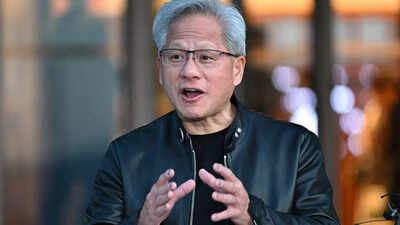
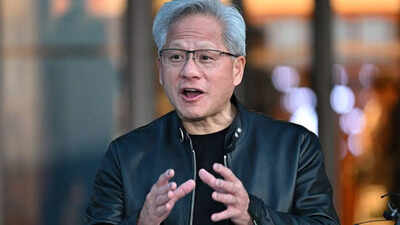
As America is set to celebrate its 250th anniversary, Forbes released a list of 250 of America’s most successful living immigrants. Placing fourth is Jensen Huang, a Taiwanese business tycoon, who is the CEO of Nvidia.At 63, Huang’s story is at the epitome of immigration and has inspired thousands across the globe. He began his career while clearing tables and scrubbing floors at Denny’s. Today, he leads one of the world’s most valuable tech empires, whose major workforce consists of millionaires.When asked about the best career advice he had ever received, Huang peculiarly pointed out that he doesn’t wear a watch. “Very few people know this but I don’t wear a watch,” said the Nvidia founder who had promised his wife that he would be a CEO by the age of 30 and made it happen. “And the reason I don’t wear a watch is that now is the most important time. Just dedicate yourself to now.”He explained the statement by sharing a story, claiming that the best career advice he got was from a gardener. He shared that he was on a family trip to Kyoto and visited a temple that had the largest moss collection in the world. “All of the moss is perfect, and every species of the world’s moss is there. It was a hot summer day – anybody who’s been to Kyoto knows how incredibly hot it is during the summer – and my family walked by this old man who was squatted down working on the moss with a bamboo tweezer. His bamboo basket was nearly empty with only two or three small pieces of dead moss,” he said.When Huang asked the old man what he was doing, he replied he was taking care of his garden, on which he had been working for almost 30 years. “But this garden is so big and your tweezers and basket are so small. How can you take care of the whole garden?” Jensen asked. “I have plenty of time,” said the old man.According to Huang, that’s the best career advice he can give to people. “Most of the time I wait for things to come to me. I’m rarely chasing things. I don’t have a watch. I’m focused on now. I’m enjoying my job. I’m the longest-running tech CEO in the world…” he said.He advised that one should dedicate themselves to learning all the time, doing the best possible work and leaving everything on the field. “By the time I go to bed I’m exhausted, and I’m happy about my day because I did everything I could… You’ll be surprised. I’m not at all ambitious. I don’t aspire to do more. I aspire to do better at what I’m currently doing. I’m not reaching for more. I wait for the world to come to me,” he added.He even surprised the audience by claiming that even the company he famously co-founded, didn’t have a long-term strategy. “Our definition of a long-term plan is, ‘What are we doing today?’ … You have plenty of time. Enjoy your work. Do the best you possibly can. Just keep learning every day, and good things will come to you.”Huang was a 30-year-old working as an engineer at Sun Microsystems in 1993 when he gathered his friends and future co-founder Chris Malachowsky and Curtis Priem in a booth at a Denny’s diner to plot what would eventually become Nvidia.At the time, he believed that they could develop a graphics processing unit (GPU) that would revolutionise computer graphics for video games. However, the company got off to a rough start when in 1996, their experimental chips turned out to be “technically poor.” The failure forced Huang to lay off nearly half of his staff. He prevented the company from going under by convincing Sega to buy out their contract, and he used that money to fund the development of a completely new series of chips from scratch. Those new chips became the company’s first hit product in 1997, selling 1 million units in just four months.Currently, Huang is the President and CEO of Nvidia, the world’s most valuable technology company encompassing artificial intelligence, computing, robotics and data centre infrastructure. Today, his company’s chips power complex AI models owned by Google, Microsoft, OpenAI and more.
Do you agree with philosophy of focusing on the now rather than chasing future ambitions?