
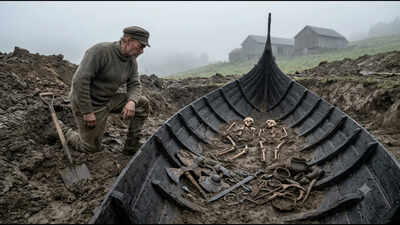
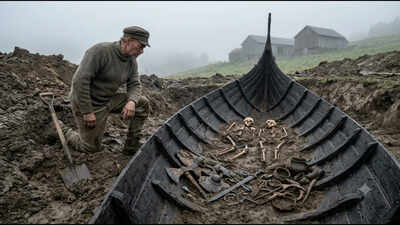
On a farm near Tønsberg, Norway, a routine look inside an old burial mound in 1903 uncovered something that had been hidden for centuries. Farmer Oskar Rom had been examining the mound on his property at Lille Oseberg when he came across what appeared to be pieces of an ancient ship. On August 8, he travelled to the capital to tell archaeologist Gabriel Gustafson what he had found. Gustafson quickly recognised that the remains could be far more significant than an ordinary burial.Within days, he was investigating the site himself. What lay beneath the mound would eventually include a Viking ship, the remains of two women and hundreds of objects, giving archaeologists an unusually detailed glimpse into life, craftsmanship and burial practices during the Viking Age.
A farmer’s discovery leads archaeologists to a Viking ship grave
On August 8, 1903, Rom arrived in the capital with news from his property at Lille Oseberg in Slagen, Vestfold. He had been examining a large mound and had come across remains that suggested a ship was buried inside it.Gustafson, who oversaw the University’s Collection of National Antiquities, did not wait long before visiting the site. Within days, he had begun examining the mound. Decorated fragments emerging from the earth soon made the significance clearer: this was not an ordinary burial, but a Viking Age ship grave.The excavation itself had to wait until the following year, partly because of the approaching autumn weather. By then, the discovery had attracted public attention. Fences, signs and a guard were needed around the site, turning the excavation into something of a public spectacle.Gustafson was not entirely pleased with the attention. His diary records the difficulty of carrying out archaeological work while people gathered to watch.
Inside the burial were hundreds of objects from Viking life
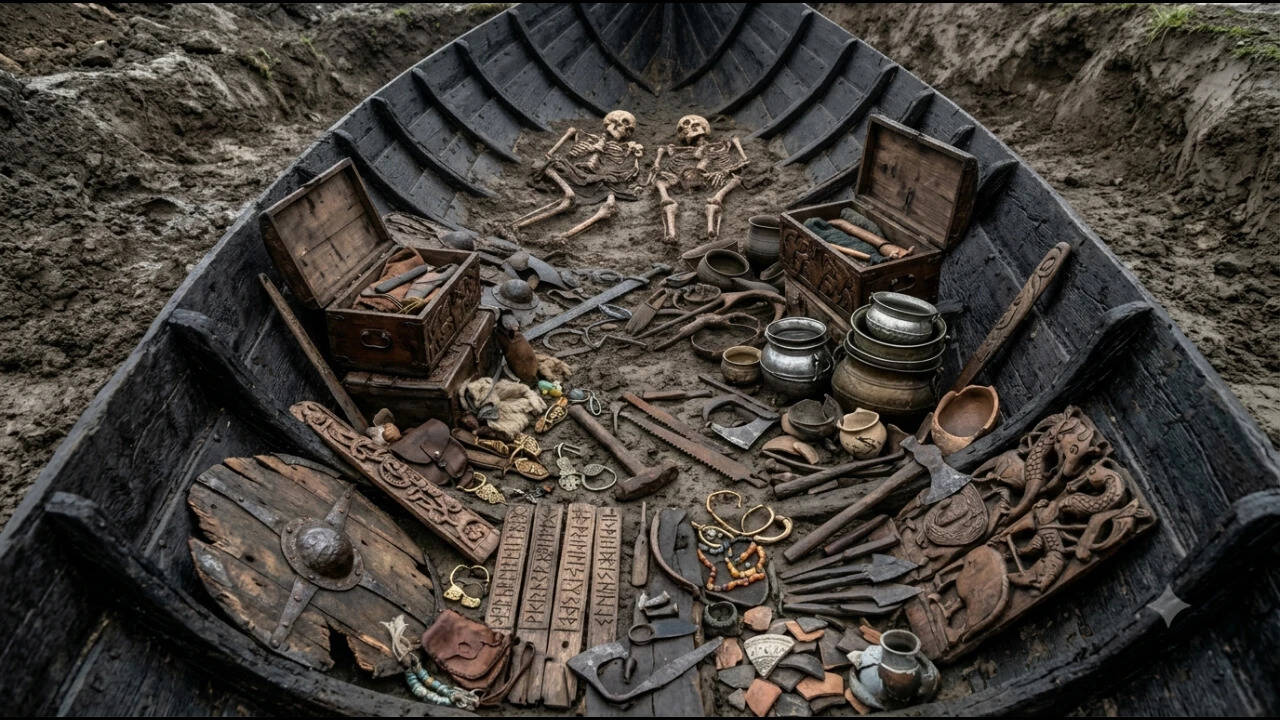
The ship had been badly crushed by the weight of the material covering it, but the burial had protected an extraordinary range of objects. As the excavation progressed, the team recovered a wagon, several sleds, carved animal heads, kitchen equipment, food remains, beds, tents and textiles.There were also remains of animals associated with the burial, including two cows, six dogs and fifteen horses. In total, several hundred objects were recovered.Many of these materials would normally have disappeared over the centuries. Wood, fabric and other organic objects rarely survive in such detail. Their presence at Oseberg meant archaeologists could study parts of Viking material culture that are usually missing from the archaeological record.The objects were not simply valuable possessions placed together at random. Their arrangement and variety offered clues about how people travelled, worked, dressed and prepared for death.
Two women were buried inside the ship
Human remains were discovered in the burial chamber, belonging to two women. Their identities remain uncertain, but the scale and contents of the grave indicate that they occupied an important place within the society that buried them.The burial also appears to have been disturbed at some point not long after it took place. Someone had gained access to the grave, adding another layer to the history of the site.The presence of two women and the extraordinary quantity of goods in the chamber have made the burial particularly important for understanding women and status during the Viking Age. The grave provides evidence that reaches beyond the usual picture of Viking history centred on warfare and seafaring.
The ship nearly became private property
Finding the ship was only the beginning of the problem. In 1904, Norwegian cultural heritage law did not yet guarantee that an archaeological discovery belonged to the state. The owner of the land could therefore sell the find.The University had already spent 5,000 kroner on the excavation, leaving Gustafson and his colleagues facing the possibility that the ship could pass into private hands, or even leave Norway.That outcome was avoided when landowner Fritz Michael Treschow bought the entire discovery for 12,000 kroner and donated it to the University’s Collection of National Antiquities. Other benefactors then helped finance its preservation. Brewery owner Ellef Ringnes and consul Axel Heiberg contributed 6,000 kroner in 1905, while the city of Kristiania provided another 10,000 kroner.Without that support, the future of the ship and its contents could have been very different.
Rebuilding the Oseberg ship took decades
The excavation itself lasted three months. Preserving what had been uncovered was a far longer undertaking.The wooden remains had to be dried extremely slowly before the ship could be reconstructed. Conservators worked to preserve and reuse the original timbers wherever possible. The process of conservation and reconstruction eventually took 21 years.The result is remarkable for the amount of original material that survived. More than 90% of the wood in the reconstructed ship is original.The ship was never simply a vessel to be placed on display. Its survival allowed archaeologists to examine Viking shipbuilding techniques alongside the objects buried with it, creating a much broader picture of the people who built, used and ultimately buried it.
What the Oseberg find revealed about Viking life
The significance of Oseberg lies partly in the things that survived alongside the ship. Textiles provide evidence of clothing and skilled textile work. Carved objects reveal artistic traditions and symbolism. Wooden furniture and equipment offer glimpses of domestic life that are rarely preserved elsewhere.The ship itself has also helped researchers understand Viking seafaring and construction. Together, the vessel and its contents provide evidence for a society capable of producing highly skilled woodwork, elaborate decoration and sophisticated textiles.The burial also offers a window into Viking attitudes towards death. The decision to place a ship and such a large collection of objects in a grave shows how material possessions, status, ritual and identity could become intertwined in burial practices.