
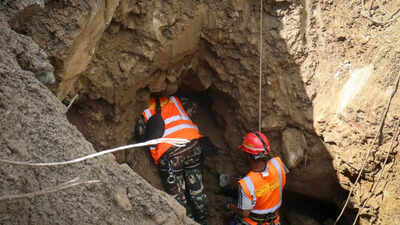
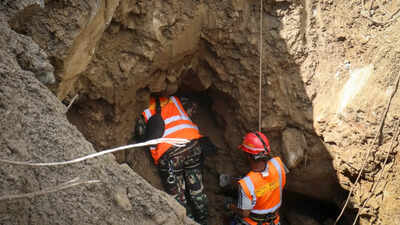
NUWAKOT (NEPAL)/DEHRADUN: Time running out for over 900 people missing from Nepal’s flood-hit hydropower projects, rescue teams led by Nepalese Army personnel intensified operations to hunt for survivors, particularly at the Upper Trishuli-3A, where they located the tunnel’s crown head and began widening an opening to send rescuers inside with oxygen cylinders.While the Independent Power Producers’ Association Nepal said 537 workers and staff were unaccounted for across nine projects, Nepal’s disaster management authority, NDRRMA, stated that 933 workers from hydropower projects were untraced.The number of dead rose to 810 Sunday – 794 in Nepal and 16 reported in Tibet – with 3,048 missing across both countries, as search ops entered a fifth day. NDRRMA listed 2,502 people missing and Tibet another 546. Nepal said 592 foreign nationals were among those missing, besides 127 Nepalese citizens travelling with foreign groups.MEA said at 5.30pm Sunday that 149 Indian nationals had been rescued in Nepal. Its latest missing-person tally, issued Saturday night, listed 275 Indian nationals missing and another 128 people of Indian origin as uncontactable. India had also not announced a confirmed number of Indian deaths by Sunday evening.Efforts to hunt for survivors at the nine hydropower projects picked up as weather improved slightly. Road access to Upper Trishuli-3A remained cut off, forcing Nepalese Army to airlift excavators, bulldozers and other earth-moving machinery to the project area using helicopters. Joint teams operated the machines through the night despite rain and moved closer to the tunnel entry point.Nepalese Army spokesperson Brig Gen Rajaram Basnet told TOI that the team, which included tunnel experts, had located the crown head – the main section – of Trishuli 3A. “A hole of 2x3ft was dug, which revealed a water surface spanning a diameter of around seven metres and extending to a significant height. An army expert entered the hole and looked for signs of life but with no luck so far,” Basnet said.“We’re now trying to widen the hole area to allow more experts to enter with oxygen cylinders and search for those trapped,” he added. By Sunday evening, around 8,500 Army personnel had been deployed across major flood-affected areas for search-and-rescue operations.
MEA cautions against relying on changing casualty figures
At Upper Trishuli-1, around 300 workers were believed to have been trapped inside the tunnel, of whom 254 had been rescued, while search operations continued for the remaining workers. At Upper Trishuli-3B, 91 of the 122 workers earlier reported missing had been rescued and 31 remained unaccounted for, showing how the rescue effort had expanded far beyond the 100-odd workers initially feared trapped at a handful of sites.Nearly 20,000 security personnel had been deployed, while ground and aerial teams continued searches along riverbanks, destroyed settlements and mud-filled tunnels. Nepal foreign secretary Amrit Bahadur Rai said, “Our immediate national priority remains clear: to save lives, locate missing persons, rescue them, provide urgent relief to survivors, and ensure that affected Nepalese as well as foreign nationals receive appropriate assistance and support.”As number of the dead and missing kept changing, MEA spokesperson Randhir Jaiswal cautioned: “We are in a dynamic situation, so figures keep going up and down. Also, we have to reconcile several lists that we are dealing with.”Among the lists of “foreign nationals”, the count of people of Indian origin is likely to be high. Many travellers formally counted as American, British, Australian, Canadian and other nationals were people of Indian origin travelling on foreign passports, several of them on or returning from Kailash Mansarovar pilgrimage.In one 77-member group caught in the disaster, 53 were people of Indian origin carrying foreign passports.The Indian picture on the Tibet side was also being counted separately. Chinese authorities said 261 foreign nationals from 23 countries were among the 546 missing in Gyirong, including 49 Indians, 104 Nepalese, 33 Latvians, 18 Americans, 15 Britons, six Canadians and six Australians.It remained unclear whether the 49 Indians listed in Tibet were already part of MEA’s broader count of 275 missing Indian citizens.Large numbers of Indian pilgrims and travellers stranded on the China side had meanwhile begun moving out. MEA said earlier Sunday that 598 Indians had crossed safely from China into Nepal over two days, while around 900 Indians who remained on the Chinese side were “safe and contactable”. Indian missions in Beijing and Kathmandu remained in touch with Chinese and Nepalese authorities.India intensified its technical assistance. Four relief flights had carried 68.5 tonnes of supplies to Kathmandu, while a 13-member Indian Army tunnel-rescue team with specialist equipment and six forensic teams comprising 19 personnel were sent to assist Nepalese authorities. Sixteen trucks carrying equipment for a 230-foot single-lane modular steel bridge had reached Nepal and equipment for seven more Bailey bridges was being supplied.