
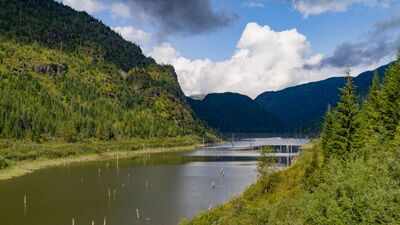
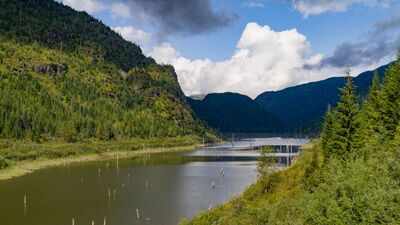
In the summer of 2026, workers and residents around the Williston Reservoir in northern British Columbia witnessed something that sounded like folklore: a large, forested island broke free from the shoreline, drifted across the lake, disappeared from view, and then turned up again about 30 kilometres away, still carrying mature trees, nesting birds and other wildlife. The “ghost island,” as some locals began calling it, had broken loose from saturated, peaty soils along the reservoir’s edge and been carried by wind and currents before grounding again downstream. As reported by Smithsonian Magazine, the event has captivated the public and prompted scientists to study how climate change, reservoir operations and fragile northern soils may be creating more of these drifting landmasses.A reservoir in a remote, changing landscapeThe Williston Reservoir, formed by the W.A.C. Bennett Dam on the Peace River, is one of the largest man-made lakes in North America. It stretches more than 170 kilometres through a rugged, boreal landscape of spruce, pine, wetlands and peatlands. The region is remote, sparsely populated and rich in wildlife, including bears, moose, waterfowl and numerous songbirds.Like many northern ecosystems, this area is warming faster than the global average. Permafrost is thawing, precipitation patterns are shifting and reservoir levels fluctuate in response to hydropower demands and seasonal inflows. All of these factors affect shoreline stability, soil saturation and the way vegetation anchors, or fails to anchor, to the ground.The island’s first appearanceThe story began when reservoir operators and local observers noticed a new island where none had existed before. It was not a small sandbar or gravel spit, but a substantial chunk of land: dozens of metres across, covered with mature trees, shrubs and soil, and already being used by birds and other animals.At first, many assumed it was a previously submerged feature exposed by dropping water levels. But as days passed, the “island” did not stay put. Instead, it began to move, slowly drifting away from the shore as if it were a giant raft. That’s when it became clear: this was not a fixed island at all, but a massive slab of soil and vegetation that had detached from the shoreline and was floating on the reservoir.How a forest can floatFloating islands are rare but not unknown. They form when thick mats of vegetation, roots, peat and soil become buoyant enough to lift off the underlying substrate and ride on the water’s surface. In northern peatlands, this process is facilitated by: thick layers of partially decayed plant material (peat) that are light and spongy; high water tables that saturate soils and reduce friction between layers; and root systems that bind the surface mat together, allowing it to move as a single unit.Around reservoirs, additional factors come into play. Fluctuating water levels can undercut shorelines, while wind and wave action can pry loose large sections of vegetated soil. When conditions align, an entire forested patch can break free and begin to drift.The 15-day journey across WillistonOnce detached, the island was carried by a combination of wind, currents and possibly seiches (standing waves) in the reservoir. Over about 15 days, it travelled roughly 30 kilometres from its point of origin, moving slowly but steadily across open water.During this time, the island was not just a passive object. It remained intact enough to support mature trees, including spruce and other conifers, still rooted in the soil mat; shrubs and ground vegetation that continued to grow and transpire; birds that nested or roosted on the island, treating it like any other piece of land; and small mammals, insects and possibly amphibians that rode along within the soil and vegetation.For observers on the water and along the shore, the sight was surreal: a moving patch of forest, complete with wildlife, gliding across a vast reservoir.Disappearance and rediscoveryAt one point during its journey, the island slipped out of sight—either drifting behind a point of land, into a less-monitored arm of the reservoir, or simply becoming hard to distinguish from the surrounding shoreline vegetation. For a time, it seemed to have vanished, fuelling local speculation and storytelling.Then, about 15 days after it was first spotted, the island was observed again, now grounded along a different section of the reservoir roughly 30 kilometres from where it started. It had not broken apart or sunk; the trees were still standing, the soil mat was still coherent, and animals were still using it. In effect, a functioning ecosystem had hitched a ride across the lake and set down in a new location.Why scientists are paying attentionEvents like this are more than curiosities; they are indicators of how northern landscapes are responding to changing conditions. Researchers are interested in several questions, like:How often are floating islands forming in the Williston and other northern reservoirs?What role do thawing permafrost, saturated peat and reservoir level fluctuations play in detaching these landmasses?How far can they travel, and where do they ultimately end up?What are the implications for wildlife, carbon storage and reservoir operations?Floating islands can transport nutrients, seeds and organisms to new areas, potentially altering local ecosystems. They can also pose navigational hazards for boats and, if they break up, release pulses of organic material into the water. In a warming north, such phenomena may become more common.A symbol of a landscape in motionFor local residents and workers, the drifting island is both fascinating and unsettling. It underscores how dynamic the reservoir shoreline can be, and how climate change is making familiar landscapes feel less stable. Trees that once seemed firmly rooted can, under the right (or wrong) conditions, become passengers on a slow, watery journey.At the same time, the island’s survival—carrying trees, birds and other animals across 30 kilometres of open water—speaks to the resilience of these ecosystems. Even when detached from the ground, the living community held together, adapted and found a new place to rest.What comes nextIn the wake of the island’s reappearance, scientists and reservoir managers are discussing how to monitor similar events in the future. Possibilities include: using satellite imagery and drone surveys to detect new floating islands early; tracking their movement with GPS tags or markers where feasible; studying the soil and vegetation composition to understand what makes some patches more likely to detach; and incorporating floating-island dynamics into reservoir management and climate adaptation plans.For now, the Williston’s “ghost island” remains a striking example of how quickly and dramatically northern landscapes can change. In a single summer, a forested island appeared, vanished and reappeared dozens of kilometres away, carrying its trees and tenants with it: a reminder that in a warming world, even the ground beneath our feet may not stay where we expect it to.A huge forested island appeared in a British Columbia reservoir, vanished, then resurfaced 30 km away 15 days later with trees, birds and other animals still aboard