
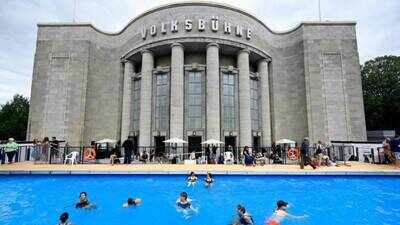
A temporary public swimming pool outside Berlin’s historic Volksbuhne theatre has cancelled a planned event that was due to be open exclusively to Black communities after the programme attracted controversy and scrutiny over its restricted access. The €300,000 pop-up pool, which opened last week as an eight-week summer facility, had planned to close its 25-metre pool to the general public from 12pm to 6pm on Friday, August 14, for an event organised in partnership with anti-discrimination community project Each One Teach One (EOTO).The Volksbuhne website had described the session as being “open exclusively to Black communities”, with visitors asked to respect the collective self-designation and the space associated with it. The theatre has since cancelled the event, citing security concerns and saying that swimming activities involving Black children and teenagers had become targets of right-wing and racist harassment.The decision has triggered a wider debate in Germany over inclusion, public funding and access to public spaces. The temporary pool was originally presented as a symbol against exclusion and commercialisation and as a free summer meeting place for Berlin residents. It is funded by the Volksbuhne, which receives more than €20 million in public funding annually, while the pop-up pool itself has a reported budget of around €300,000 and is expected to attract approximately 20,000 visitors during its eight-week run. The facility can accommodate 46 swimmers at a time. While organisers described the planned Black-community event as an effort to create a safer and more inclusive environment, critics questioned why a publicly funded facility would restrict access to the majority of residents for several hours.
Why was the Black-community swimming event cancelled?
The Volksbuhne said the decision to cancel the event was based on security concerns.According to the theatre, the cancellation followed concerns that swimming opportunities for Black children and teenagers had increasingly become targets of right-wing and racist harassment.The event was being organised in collaboration with EOTO, a publicly funded organisation that runs social and cultural programmes for Black communities.The theatre’s original announcement said that on August 14, the pool would be closed to the general public between noon and 6pm and reserved exclusively for Black communities.The wording prompted criticism from people who questioned whether an event at a publicly funded facility should exclude other members of the public.
What is the Berlin pop-up swimming pool?
The temporary outdoor swimming pool was installed in front of the Volksbuhne am Rosa-Luxemburg-Platz in Berlin and officially opened last week.The facility is expected to remain in operation for eight weeks and was promoted as a free summer gathering place for local residents.The pool is 25 metres long and can accommodate up to 46 swimmers at any one time. Organisers estimate that around 20,000 people could use it during its temporary run.The project has been described as an attempt to provide more opportunities for swimming in Berlin at a time when many existing pools are unavailable.Volksbuhne director Matthias Lilienthal defended the broader idea behind the temporary facility in an interview with German broadcaster ZDF.“Half of the indoor and outdoor pools are closed, so we thought we’d help out Governing Mayor Kai Wegner,” he said.Lilienthal also described the project through the theatre’s artistic lens, saying the Volksbuhne considers even something as ordinary as two people splashing each other to be a theatrical event.
Why is the pool project controversial?
The controversy centres partly on the fact that the pool is publicly funded and was promoted as an inclusive community space.The Volksbuhne receives more than €20 million in public funding every year, while the temporary swimming project itself reportedly costs approximately €300,000.The facility is free for visitors, meaning members of the public do not have to pay to use it.The planned six-hour event for Black communities was therefore criticised by some Berlin residents who felt they would be excluded from a publicly funded facility.Organisers, however, framed the event differently, arguing that creating a dedicated space for Black communities was connected to concerns about racism and harassment.The cancellation means the proposed event will no longer take place, although the temporary pool itself is expected to continue operating as planned.
What is Each One Teach One?
Each One Teach One, known as EOTO, is a community organisation focused on Black people in Germany and works on social, educational and cultural programmes.It was the partner for the planned swimming event at the Volksbuhne.The organisation’s involvement reflected the stated aim of creating a dedicated space for Black communities, particularly amid concerns about discrimination and harassment.The controversy has nevertheless raised questions about how publicly supported cultural institutions should balance targeted community programmes with universal access to public facilities.
Berlin pool controversy comes amid separate German swimming row
The dispute in Berlin comes shortly after another controversy involving swimming in Germany.At the Heidebad lakeside beach in Halle, eastern Germany, a lifeguard introduced a controversial policy requiring bathers to understand German safety instructions or risk being prevented from swimming.Lifeguard Mathias Nobel said the measure was motivated by safety concerns after he had reportedly rescued a toddler who nearly drowned after entering a section of the lake that reaches approximately 138 feet in depth.Nobel said he had struggled to communicate safety instructions to some families who did not speak German.The policy was quickly labelled a “German-only” rule and attracted accusations of discrimination and racism. Authorities in Halle subsequently told him to reverse the language restrictions and warned that measures that could be perceived as xenophobic could damage the city’s reputation.Nobel has denied accusations of racism and maintained that the issue was about safety, communication and respect for lifeguards.
Lifeguard says language barrier created safety concerns
Nobel said that some families could not understand him when he attempted to explain safety rules.He told The Telegraph that he had encountered situations where parents appeared unable to understand questions about their children’s ages or safety equipment.He argued that a language barrier could potentially have serious consequences at a swimming location where lifeguards need to communicate quickly during emergencies.However, the German life-saving association criticised the approach, while the country’s anti-discrimination agency noted that there are no equivalent requirements imposed on German tourists when they swim abroad.
AfD enters the swimming pool controversy
The Halle dispute also became part of Germany’s broader political debate over immigration.The far-right Alternative for Germany (AfD) seized on the controversy, claiming that swimming pools were becoming “danger zones” and arguing that authorities were losing control over public safety.The issue has emerged as immigration remains a major political topic in Germany, particularly ahead of elections in Saxony-Anhalt.The centre-right Christian Democratic Union is currently the largest party in the state parliament, while the AfD finished second in the previous election and holds 23 of the legislature’s 83 seats.At the national level, Chancellor Friedrich Merz’s government has also adopted a tougher position on immigration amid pressure from the AfD.
Volksbuhne is one of Berlin’s historic theatres
The Volksbuhne am Rosa-Luxemburg-Platz dates back to 1914 and is regarded as one of Berlin’s most historic theatres.It attracts approximately 130,000 visitors and stages an average of around 20 events each week.The temporary swimming pool represents an unusual extension of the institution’s cultural programming, with the theatre describing the project as both a public service and an artistic intervention.The cancellation of the Black-community event has now placed the project at the centre of a much wider conversation about racism, inclusion, public funding and who should have access to publicly supported spaces.