
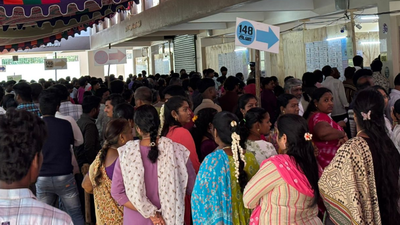
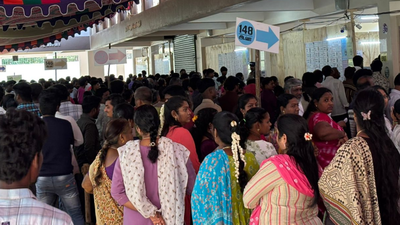
CHENNAI: The headline-grabbing turnout of 83.7% masks a quieter reality — actually, fewer people voted than the last two assembly elections.In percentage terms, data till 9.30pm (excluding postal ballots) showed that the city logged a sharp jump from 60% in 2021 and 61.2% in 2016. But in absolute terms, only 23.7 lakh votes were polled this year, lower than the 24.16 lakh polled in 2021 and 24.3 lakh recorded in 2016. Nearly 15,000 postal ballots were registered in 2021.
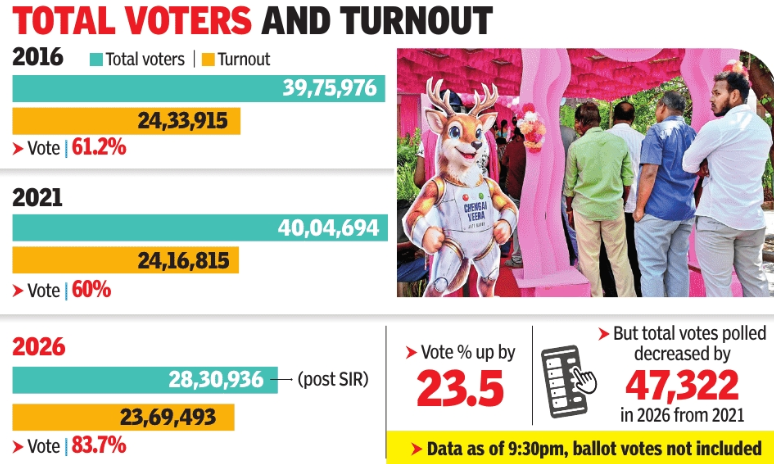
The drop is more pronounced over time. While 2021 saw a marginal dip of 17,100 votes from 2016, 2026 recorded a larger fall of around 47,000 votes (as of 9pm) from 2021 levels, despite the ‘surge’ in turnout percentage. Five out of the 16 core city constituencies saw marginal increase in the turnout, while Perambur recorded almost the same turnout. Kolathur saw 5,000 more voters than last time, while Thiru Vi KaNagar saw 7,000 more voters. Velachery’s turnout increased by about 2,000. RK Nagar saw 10,000 fewer voters as of 9pm, compared to 2021, while Perambur touched around the same 2 lakh votes it polled last time. Villivakkam saw 7,000 fewer votes. Chepauk and Royapuram saw 1,000 and 3,000 increase respectively.The reason: A shrinking voter base. Following SIR revision, Chennai’s electorate fell from more than 40 lakh in 2021 to 28.3 lakh in 2026. A smaller denominator has inflated the turnout percentage, even as total votes polled declined. In simple terms, a larger share of asmaller pool has voted.Though the near-similar number of voters cast their ballots in three elections — 2011, 2016 and 2021 — Chennai has swung between DMK and AIADMK. The AIADMK won 14 of the 16 seats in 2011, DMK took 10 in 2016, and then swept all 16 in 2021. In 2011, the victory margins were big, while in 2016, about seven constituencies were narrow, while in 2021, two seats were narrow.Arun Krishnamurthy, psephologist at Krish Info Media, said the revised rolls reflect a “more realistic electorate”. “The turnout in absolute numbers is not an anomaly. With similar figures, results have swung both ways earlier. These numbers won’t influence outcomes.”He said vote distribution, not turnout, will decide the election, especially with a stronger multi-cornered contest. “There’s a third player now. In most seats, it is a threecornered fight where AIADMK remains competitive.”Ramu Manivannan, professor of political science at Madras University, said higher turnout percentage does not necessarily reflect voter enthusiasm. “There is curiosity when a new player enters, but turnout doesn’t capture that. SIR has regulated deletions. What matters is how votes split in bipolar and triangular contests.”