
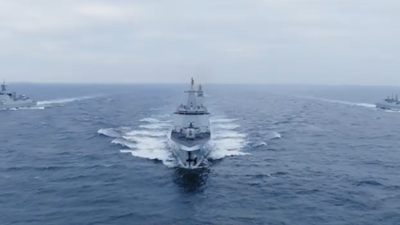
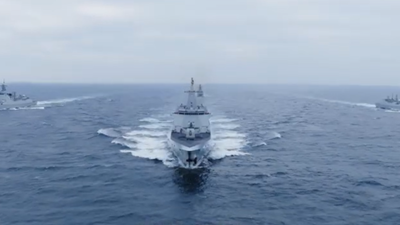
China has hinted that its fourth aircraft carrier could be nuclear-powered, signaling a major leap in its naval capabilities as it pushes to expand its presence across global waters.The film, ‘Into The Deep’, was released on the eve of the 77th anniversary of the People’s Liberation Army (PLA) Navy. It showcases China’s transition from coastal defence to a “blue-water” navy capable of operating far from its shores, with footage of drills in the western Pacific and the use of advanced equipment.A notable element in the video is the portrayal of fictional naval officers named after China’s existing aircraft carriers- Liaoning, Shandong, and Fujian. A fourth character, “He Jian”, has drawn particular attention. Analysts note that “He” sounds like the Chinese word for “nuclear” while “Jian” means “ship”, hinting at the possibility of a nuclear-powered vessel.The character’s age, 19, also aligns with the sequential pennant numbers of China’s carriers—16, 17 and 18—suggesting the next ship could follow the same pattern.
Signs point to a nuclear-powered Type 004
China has not officially confirmed the construction of a new carrier. However, satellite images over the past few years indicate that a large vessel—widely referred to as the Type 004—is being built at a shipyard in Dalian, reported the Independent.The images suggest a ship comparable in size to the United States’ Gerald R. Ford-class carriers. Photographs taken earlier this year reportedly show structures resembling nuclear reactor containment systems, further fueling speculation about nuclear propulsion.If confirmed, the carrier would mark a major leap in China’s naval capabilities. It is expected to be a supercarrier with a displacement of 110,000–120,000 tonnes and the capacity to operate more than 100 aircraft. The vessel is also likely to feature electromagnetic catapults capable of launching advanced aircraft such as the J-35 and KJ-600.China currently operates three aircraft carriers, all conventionally powered. The first, Liaoning, was a refitted Soviet-era vessel commissioned in 2012. It was followed by the indigenously built Shandong in 2019.The most advanced of the three, Fujian, was commissioned last November. With a displacement of 80,000 tonnes, it is equipped with an electromagnetic aircraft launch system (EMALS), a technology previously used only by the United States.
Expanding naval ambitions
The developments come as China seeks to expand its maritime reach. The video underscores the navy’s shift toward deep-sea operations, reflecting broader ambitions to secure sea lanes and project power globally.According to US assessments, China could build up to nine aircraft carriers by 2035, in what the Pentagon describes as the Indo-Pacific’s largest carrier expansion since World War II.China already operates the world’s largest naval fleet by number of warships, with 234 vessels compared to the US Navy’s 219. However, the United States continues to dominate in carrier strength, with 11 nuclear-powered aircraft carriers.China’s growing naval strength is also tied to its strategic and territorial interests. A recent article by China’s natural resources ministry called for stronger measures to “protect” more than 11,000 islands claimed by the country, many located in the East China Sea and South China Sea, as reported by the Independent.Beijing has also expanded its presence in disputed waters through land reclamation, building artificial islands, airstrips and military facilities.Beyond its immediate region, China has increased activity in the Indian Ocean and Arabian Sea, supported by bases in Djibouti and Gwadar, as well as its involvement in Sri Lanka’s Hambantota port.
Regional response
The expansion of China’s naval capabilities is being closely watched in the region. The Indian Navy currently operates two aircraft carriers, INS Vikrant and INS Vikramaditya, and is continuing to add more vessels to maintain its presence in the Indian Ocean.As China advances its carrier programme, the unveiling of ‘Into The Deep’ offers a glimpse into both its current capabilities and its future direction, one that may soon include nuclear-powered carriers.