
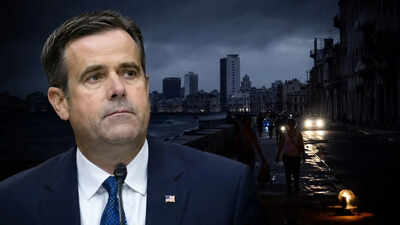
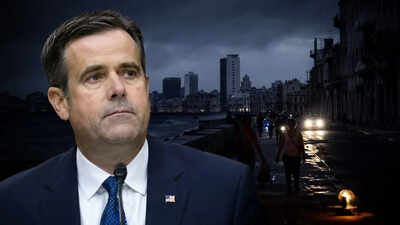
TOI Correspondent from Washington: More than six decades after the CIA orchestrated the disastrous Bay of Pigs invasion to overthrow Fidel Castro, the United States appears close to engineering a bloodless, warless transition in communist Cuba through economic strangulation and political pressure.In an extraordinary development, CIA Director John Ratcliffe openly travelled to Havana on Thursday for high-level talks with Cuban intelligence and political officials as the island reels under catastrophic fuel shortages, 20-hour blackouts, and mounting public unrest.The visit, which Washington made no effort to keep secret, comes after the Trump administration effectively cut off most oil supplies to the island, collapsing much of the country’s power grid and pushing the already battered economy toward breakdown. Cuba’s energy minister Vicente de la O Levy acknowledged this week that the country had “absolutely no fuel oil, absolutely no diesel,” with Havana enduring blackouts lasting up to 22 hours a day. Residents have resorted to cooking with charcoal and wood while protests have erupted in some areas.U.S. and Cuban officials told the press that Ratcliffe met Raul Guillermo Rodríguez Castro – known in Cuba as “Raulito” – Interior Minister Lázaro Álvarez Casas, and senior intelligence officials. The CIA later said Ratcliffe personally conveyed Trump’s message that Washington was prepared to “seriously engage on economic and security issues, but only if Cuba makes fundamental changes.” Translation: Washington wants a friendly, hand-picked, pliant regime in Havana after decades of failed covert operations, sanctions and assassination plots targeting the Castro regime. Trump himself has repeatedly hinted at regime-change ambitions, openly suggesting Cuba “could be next,” while also linking Havana to broader confrontations involving Iran and America’s adversaries.The pressure campaign also bears the unmistakable imprint of Marco Rubio, the Cuban-American U.S Secretary of State whose parents fled Cuba after the revolution and who has long advocated a hardline approach toward Havana. Rubio has publicly argued that Cuba’s communist leadership cannot reform itself and has privately led negotiations pressing Havana to embrace a U.S-linked future. Even as the administration quietly dangled humanitarian assistance and a reported $100 million bailout package, it simultaneously tightened what Cuban officials describe as an “energy blockade,” choking off oil shipments from Venezuela and other suppliers. The Trump administration has also intensified military reconnaissance flights around the island while demanding that Cuba shut down alleged Russian and Chinese intelligence listening posts near Havana.Trump’s January executive order on Cuba specifically cited “Russia’s largest overseas signals intelligence facility” in Lourdes, near Havana, which U.S. officials say intercepts sensitive American communications. Washington also alleges China operates intelligence infrastructure at Bejucal, claims denied by Havana, Moscow and Beijing.Adding to the pressure, U.S. prosecutors in Miami are reportedly preparing a possible indictment against Raúl Castro on charges linked to the 1996 shootdown of planes operated by the anti-Castro humanitarian group Brothers to the Rescue, and potentially narcotics-related allegations.The symbolism of the CIA chief landing in Havana is particularly striking given the agency’s tortured history with Cuba. The CIA organised the failed Bay of Pigs invasion in 1961, backed sabotage campaigns, and was linked to numerous plots to assassinate Fidel Castro — including the now infamous schemes involving exploding cigars and poisoned wetsuits. The current strategy differs mainly in method, not objective.For India, the unfolding drama revives memories of a longstanding friendship with Cuba dating back to the Non-Aligned Movement era. Jawaharlal Nehru and Fidel Castro forged close ties during the Cold War, and New Delhi and Havana traditionally backed each other in multilateral forums, with one memorable moment imprinted in diplomatic history: Fidel Castro enveloping Indira Gandhi in a bear hug during the 7th Summit of the Non-Aligned Movement in March 1983 in New Delhi’s Vigyan Bhavan, long before hugging became a signature move of some leaders to project warmth in ties.