
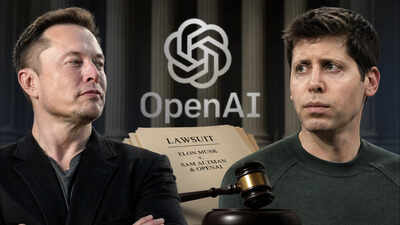
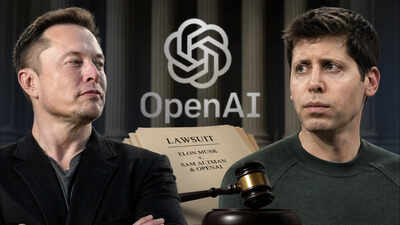
Disclaimer: AI generated image
The most watched courtroom fight in Silicon Valley history is now officially underway. Jury selection kicked off on Monday at a federal courthouse in Oakland, California, and opening statements began Tuesday in Musk vs Altman—a case that started as a billionaire’s grudge match and has slowly evolved into something with real consequences for the AI industry, OpenAI‘s trillion-dollar IPO ambitions, and how the world’s most powerful technology gets built and by whom.Judge Yvonne Gonzalez Rogers is presiding over the case. The nine-person jury’s verdict will be advisory—meaning the judge herself makes the final call. The liability phase is expected to wrap by May 21.Here’s the full picture.
Elon Musk helped build OpenAI—then left, and now wants it dismantled
It all starts with a late-night email. On May 25, 2015, Sam Altman messaged Elon Musk with a pitch: what if they built a “Manhattan Project” for AI? Musk responded a couple of hours later: “Probably worth a conversation.” That conversation became OpenAI.The company was founded as a nonprofit with a mission to advance AI “in the way that is most likely to benefit humanity as a whole, unconstrained by a need to generate financial return.” Musk was a co-chair and a major early funder. He donated around $38 million between 2016 and 2020, helped recruit top researchers including Ilya Sutskever from Google Brain, and was instrumental in getting the lab off the ground during a period when competing with Google felt almost impossible.Then things soured. The relationship with Musk turned difficult around 2017, after he grew impatient with OpenAI’s progress and made a failed bid to take control of the company. He left the board in 2018 and stopped funding.What came next, without Musk, was ChatGPT—one of the fastest-growing consumer products in history. OpenAI raised billions from Microsoft, became one of the world’s most valuable private companies, and is now eyeing an IPO that could value it north of $1 trillion. Musk, watching from the sidelines, wasn’t happy about any of it.
What Musk is actually accusing OpenAI of doing
Musk filed his lawsuit in 2024, and after multiple rewrites, two claims remain going into trial: breach of charitable trust and unjust enrichment.The core argument is that Altman and OpenAI co-founder Greg Brockman deceived Musk into believing OpenAI would stay a nonprofit, locked in to its mission of open, safe AI development for humanity’s benefit. Once they had Musk’s money and his credibility—which helped them recruit top talent that Google was also aggressively courting—they quietly planned a pivot to for-profit, Musk alleges.Musk’s complaint accuses Altman of running a “long con,” describing the nonprofit promises as “hot-air philanthropy” and calling the alleged deceit of “Shakespearean proportions.”He wants Altman and Brockman removed from their leadership roles. He wants OpenAI’s for-profit restructuring reversed. And he’s seeking damages somewhere between $134 billion and $150 billion—which, in an unusual move, he’s asked be redirected to OpenAI’s nonprofit arm rather than paid to himself.
OpenAI says Musk wanted control, not charity
OpenAI’s defense is essentially this: Musk was in the room for all of it. He knew the company would eventually need a for-profit arm. He even wanted to run it—emails in the court record show he pushed to be CEO in 2017 and proposed merging OpenAI into Tesla. When OpenAI’s founders refused to hand him majority control, he left.OpenAI has said Musk is “motivated by jealousy” and “regret for walking away,” and contests that his funding was a donation rather than an investment—meaning it doesn’t entitle him to any ownership stake in the company.OpenAI has maintained a dedicated webpage titled “The truth about Elon Musk and OpenAI,” which runs through its version of events and publishes internal correspondence to support it. Their X posts on the day jury selection began pulled no punches: “This lawsuit has always been a baseless and jealous bid to derail a competitor.”On Monday, Altman showed up to jury selection. Musk didn’t.
Diary entries, Burning Man, and a woman saved in her phone as “Schrödinger’s Cat”
Whatever the legal outcome, this trial was always going to be a document dump of the most awkward kind. Thousands of pages of internal communications, depositions, and private diary entries have already been unsealed, and they are exactly as messy as advertised.A diary entry from Greg Brockman—OpenAI’s co-founder and president—written in late 2017, reads: “This is the only chance we have to get out from Elon. Is he the ‘glorious leader’ that I would pick?” In another entry, he asked himself what it would take to personally reach $1 billion. Brockman later testified that his primary motivation was always the mission, and that the financial question was secondary thinking about a potential for-profit structure. Musk’s lawyers have a different read on it.Shivon Zilis—a former OpenAI board member, longtime Musk ally, and mother of four of his children—sent Musk a text in 2018 asking whether she should stay “close and friendly” to OpenAI to keep information flowing to him, or begin to distance herself. Musk told her to stay close. OpenAI argues this makes her a compromised witness. The judge has ruled her relationship with Musk is relevant to her credibility. In her deposition, when asked whether she’d been in a romantic relationship with Musk, she said “relationship” was a relative term—but acknowledged there had been “romantic moments.“Then there’s Burning Man. OpenAI’s lawyers questioned Musk in deposition about his activities at the 2017 festival, which happened to coincide with a critical period of negotiations about OpenAI’s future. They asked specifically about his use of “rhino ket”—a cocktail of ketamine and amphetamines. Musk said he didn’t know what it was. The judge has ruled ketamine itself is off-limits in court, but Musk’s Burning Man attendance is fair game—relevant, she said, to the question of how closely he was actually paying attention to negotiations he now claims to remember clearly.And from the discovery trove: emails where Musk told Altman he preferred Microsoft over Amazon for compute partnerships because Jeff Bezos “is a bit of a tool.” Mark Zuckerberg privately texted Musk offering to take down content that named DOGE staff members. In a 2023 email, Altman told Musk: “You’re my hero. It really hurts when you publicly attack OpenAI.” Musk responded with an apology, then added: “But the fate of civilization is at stake.“
What’s actually on the line—For both sides
This is not a normal tech lawsuit. The stakes run in multiple directions.For OpenAI, the trial could complicate or derail its IPO plans entirely. A ruling that it improperly converted from nonprofit to for-profit, or that its leadership needs to change, would send shockwaves through investor confidence. OpenAI is currently valued at over $850 billion and is reportedly racing against Anthropic and Musk’s own SpaceX-backed xAI to go public.For Musk, the risks are real too. SpaceX—which now owns xAI—is also eyeing a public offering that could happen as soon as June. Anything damaging that emerges about Musk’s conduct, his business practices, or his personal entanglements during the trial could complicate that.Legal experts have noted that even if Musk doesn’t win outright, he may still extract significant value from the trial in the form of reputational damage to OpenAI and its leadership during the IPO run-up. The PR battle may matter as much as the legal one.Witnesses are expected to include Musk, Altman, Brockman, Microsoft CEO Satya Nadella, former OpenAI CTO Mira Murati, and former chief scientist Ilya Sutskever—whose $4 billion in vested equity at the time of Altman’s brief 2023 firing became one of the more striking numbers to emerge from pre-trial discovery.
The Judge has already made her view clear
Judge Gonzalez Rogers is not a passive presence. During earlier hearings she told the courtroom plainly: “I have billionaires versus billionaires here.” When jury selection got underway and Musk’s lawyers tried to dismiss jurors who expressed negative views of him, she denied the challenges and told the room: “The reality is that people don’t like him. Many people don’t like him. But that doesn’t mean that Americans can’t have integrity for the judicial process.“One prospective juror said Musk “doesn’t care about people.” Another called him “a jerk.” Most said they could still be fair. The nine who were selected—among them a nurse and a person who owns a painting company—will now hear weeks of testimony about promises made over Wednesday dinners in the Bay Area a decade ago, and whether breaking those promises amounts to a $150 billion wrong.Musk has teased the proceedings on X: “The discovery and testimony will blow your mind.” Whether that’s legal strategy, performance, or both, the trial of Silicon Valley’s AI age is finally here.