
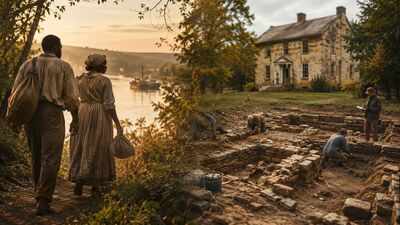
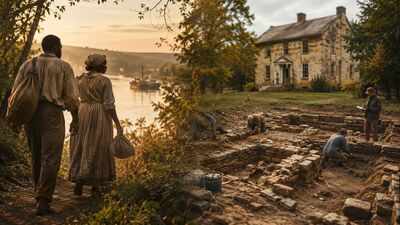
On a summer day in 1831, Thornton and Lucie Blackburn left Louisville with little certainty about what awaited them. They were enslaved, newly married and facing the possibility that Lucie could be sold away from her husband. Their escape began on a steamboat and took them through Cincinnati and into Michigan, where they tried to build a life beyond the reach of Kentucky slaveholders. Freedom there proved fragile. Two years later, the couple were arrested in Detroit, setting off unrest that became known as the Blackburn Riots. Lucie escaped across the Detroit River. Thornton followed soon after. Eventually, they settled in Toronto, where they built a home that would later become an important archaeological site.
Thornton and Lucie Blackburn fled Kentucky to stay together in 1831
Thornton and Lucie Blackburn’s lives were already intertwined when they decided to leave Kentucky. They had met in Louisville and married while living under enslavement, but their future together was uncertain.Lucie had learned that she was likely to be sold further south. For an enslaved married couple, that could mean permanent separation. Waiting for circumstances to improve carried its own risks, so they chose to leave.On July 3, 1831, they boarded a steamboat using forged documents that presented them as free people. The first part of the journey took them along the Ohio River to Cincinnati.From there, they continued by stagecoach towards the Michigan Territory. It was not Canada, but it offered a significant change from the situation they had left behind in Kentucky. Michigan was a free territory, and northern communities were becoming increasingly important destinations for people escaping slavery.The Blackburns eventually reached Detroit and remained there for roughly two years. During that period, they were able to establish themselves within the city’s Black community and experience a degree of independence that had been impossible in Louisville. But the security they had found was temporary.
A stranger from Kentucky exposed the Blackburns’ new life
In June 1833, a traveller from Kentucky recognised Thornton while he was out on a Detroit street. The sighting was enough to bring the couple’s past back into view.Their former enslavers sought their arrest, and the Blackburns were taken into custody under the Fugitive Slave Act of 1793. The law allowed enslavers to pursue people who had escaped from slavery across state lines, creating a serious danger for those who had reached northern territory.For Thornton and Lucie, the prospect was especially stark. They could be sent back to Kentucky, where they faced a return to the system from which they had spent two years trying to escape.Word of the case spread through Detroit. A crowd gathered outside the courthouse and demanded that the Blackburns be released. Tensions rose sharply, with threats that parts of the city would be burned if the couple were returned.The confrontation became known as the Blackburn Riots of 1833. It was an important early episode in Detroit’s history of racial conflict and resistance, but the protest did not immediately secure the Blackburns’ freedom. They remained imprisoned. Then Lucie’s opportunity came.
Thornton’s rescue followed Lucie’s escape across the river
On June 16, two women went to visit Lucie in her cell. During the visit, one of them exchanged places with her, giving Lucie a chance to leave the jail unnoticed.She made her way towards the Detroit River and crossed into Amherstburg on the Canadian side. By reaching Upper Canada, Lucie had put an international border between herself and the Kentucky enslavers seeking her return. Thornton was still behind bars.The following day, a large group of armed supporters arrived at the jail. Around 200 people took part in the rescue, and Thornton was freed during the confrontation. He then crossed the Detroit River with seven of those who had helped him.They reached Sandwich, in Upper Canada, an area that is now part of Windsor, Ontario.The Blackburns had escaped the immediate threat of being sent back to Kentucky, but their troubles did not end at the border.
Canada refused to send the Blackburns back to face harsher punishment
After arriving in Ontario, the Blackburns and Thornton’s rescuers were jailed again. Detroit authorities accused them of involvement in the violence and of attempting to kill a sheriff who had been injured during Thornton’s rescue.The case raised a difficult question. The people involved had crossed into a jurisdiction where slavery was being abolished, and returning them to the United States could expose them to punishment that would not have been permitted under Canadian law.Sir John Colborne, the lieutenant-governor of Upper Canada, became involved. He ruled that the Blackburns could not be returned to a jurisdiction where they would face a harsher punishment than Canadian law allowed.The decision had significance beyond the couple themselves. The principle that a person should not simply be surrendered to another jurisdiction when the consequences would conflict with Canadian law is regarded as an early foundation for Canada’s approach to extradition.For the Blackburns, it meant they could stay. They spent close to a year in Amherstburg before moving to Toronto in 1834.
A house in Toronto marked the beginning of a different life
Toronto offered the Blackburns something they had not been able to have in Kentucky or during their uncertain years in Detroit: the chance to establish a permanent home.They built a house on what was then Sackville Street. Thornton found work as a waiter at Osgoode Hall, where he encountered an idea that would eventually become an important part of Toronto’s transport history.He had learned about the hackney cab, a horse-drawn vehicle used to carry passengers. The type of cab was already appearing elsewhere in Canada, including Montreal. Thornton saw that a similar service could work in Toronto.He and Lucie hired a mechanic to construct their own vehicle. It seated four passengers, was pulled by one horse and was painted red and yellow. They called it “The City”.The business became Toronto’s first taxi company, giving Thornton another role in the city he had reached after fleeing slavery. His life was no longer defined solely by the circumstances of his escape.
A new life in Toronto gave the Blackburns a chance to help others
The Blackburns’ house was also connected to the wider movement of Black people arriving in Canada after escaping slavery in the United States.Freedom seekers could need somewhere to stay when they first arrived, and the Blackburns opened their home to some of them. Among those who found shelter with the couple was Ann Maria Jackson, who arrived with her seven children.One of those children was Albert Jackson. He later became Toronto’s first Black mail carrier.The Blackburns’ involvement extended beyond their own property. In the nearby St. John’s Ward, they built six houses and rented them to other Black families and freedom seekers. Their growing presence in the neighbourhood made their property part of a much larger story about the Black community that was developing in nineteenth-century Toronto.Thornton also remained involved in abolitionist activity. In 1851, he served as a delegate to the North American Convention of Coloured Freemen at St. Lawrence Hall. Later, he became vice president of the Canadian Mill and Mercantile Association in Buxton, Ontario. The couple eventually retired in 1865.
The house disappeared as Toronto changed
The Blackburns’ home did not survive into the twentieth century. In 1887, the Toronto School Board constructed Sackville Street Public School on part of the property. The school is now known as Inglenook Community High School, and the physical landscape around the former Blackburn property has changed considerably since Thornton and Lucie lived there.Thornton died in 1890. Lucie survived him by five years, dying in 1895. By then, the house where they had built their life in Toronto was already part of a changing city. The physical traces of the couple’s story became harder to see.For decades, there was little at the site to indicate the significance of what had once stood there.
Archaeology brought the Blackburns’ story back to the surface
That changed in 1985, when archaeologist Dr Karolyn Smardz Frost led an excavation of the Blackburn property.The work became the first archaeological excavation of an Underground Railroad site in Canada. Beneath the later layers of the neighbourhood, archaeologists found evidence connected to the house and the people who had lived there.The excavation did something that written records alone could not. It placed the Blackburns’ story back into the physical setting where much of their Canadian life had unfolded. Their house was gone. The neighbourhood had changed. Yet the site remained capable of revealing traces of the couple’s presence.Thornton and Lucie had arrived in Canada after a flight that took them through Kentucky, Ohio and Michigan, followed by imprisonment, public unrest and a dangerous escape across the Detroit River. In Toronto, they built a home, started a business and offered shelter to people following paths not entirely unlike their own.Nearly two centuries after their escape from slavery, the excavation showed that the ground beneath the later city still held part of that history.