
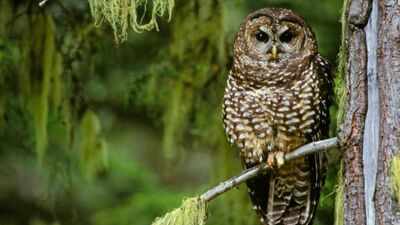
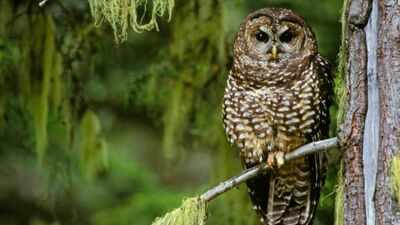
In 1990, a small bird became an unlikely symbol of one of America’s fiercest environmental battles. The northern spotted owl was listed as threatened under the Endangered Species Act, putting the future of vast stretches of old-growth forest in the Pacific Northwest at the centre of a bitter fight between environmentalists and the logging industry.Thirty-six years later, scientists say the species has reached a far more alarming point. The northern spotted owl is already functionally extinct, or close to it, across large portions of its historic range, according to a new study from Oregon State University.Functional extinction does not necessarily mean that every individual bird has disappeared. Instead, it means a species has become so rare in an area that its population can no longer perform its normal ecological role or reproduce at a rate that allows it to persist.The research, published in the journal Ecological Applications, found that owl populations have fallen so dramatically in parts of Oregon, Washington and northern California that they may no longer be able to maintain viable populations or perform their normal ecological role. Damon Lesmeister, a US Forest Service wildlife biologist and study co-author, said the situation is not simply a future possibility. Functional extinction, he said, “has happened.”
The owl that sparked America’s ‘timber wars ’
The northern spotted owl became one of the most recognisable symbols of the environmental conflicts that swept through the Pacific Northwest in the late 1980s and 1990s.The owl depends heavily on mature and old-growth forests, which also represented some of the region’s most valuable timber resources. When federal protections were imposed in 1990, restrictions on logging across large areas followed, triggering intense opposition from timber companies, workers and communities dependent on the industry.For environmentalists, however, protecting the owl meant protecting an entire ecosystem. Its decline was closely tied to the disappearance and fragmentation of the old-growth forests it relied on. More than three decades of conservation efforts have since failed to reverse the species’ decline.
Scientists listened to millions of hours of forest sounds
The latest study used an unusual approach to understand how the birds are faring: scientists listened to them.Researchers deployed passive acoustic recording devices across more than 38,000 square miles of federally managed spotted owl habitat in Oregon, Washington and northwestern California. They divided the landscape into sampling areas roughly corresponding to the typical territory of a northern spotted owl. In 2023, researchers selected 1,027 sampling areas and placed four recording devices in each. The devices collectively captured about 2.1 million hours of sound.Scientists then used machine-learning models to identify calls from northern spotted owls and barred owls, a competing species whose presence has expanded across the region.Northern spotted owl calls were detected in just 261 of the 1,027 sampling areas, while barred owl calls were detected in 891. Researchers identified more than 34,000 northern spotted owl recordings compared with nearly 280,000 recordings of barred owls.Across the entire study area, barred owls were heard more than eight times as often as northern spotted owls.
One against another
Habitat loss remains one of the major threats facing northern spotted owls. Decades of logging reduced the mature forests the species depends on, while wildfires have added another challenge.But scientists say the owl now faces an additional and increasingly important threat: the barred owl. Barred owls are native to eastern North America but have expanded westward into the Pacific Northwest. They compete with northern spotted owls for food, nesting areas and territory, putting additional pressure on populations already weakened by habitat loss.The new study found that northern spotted owls are approaching functional extinction thresholds in Washington and along the Oregon Coast. In parts of the Washington Cascades north of Seattle, researchers did not detect northern spotted owls at all.Scientists say the latest findings do not mean conservation efforts are pointless. Researchers have pointed to several possible strategies, including protecting landscapes suitable for nesting, continuing habitat conservation and managing barred owl populations.Barred owl removal remains one of the most controversial proposals because it involves killing one owl species to protect another. Previous experiments have suggested that removing barred owls can help northern spotted owl populations persist. Another possible approach is captive breeding and reintroduction, which has already been explored in Canada.