
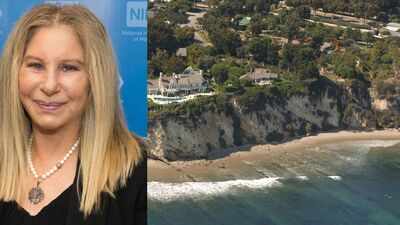
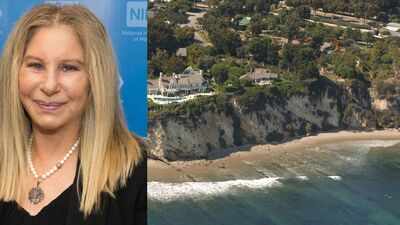
For years, Barbra Streisand’s Ramirez Canyon estate had been a private Malibu retreat, complete with five houses, landscaped grounds and interiors reflecting her fascination with Art Deco.The property had proved difficult to sell, remaining on the market from 1987 until 1993, while its listing price fell from $18 million to $11.5 million. Then Streisand chose a very different future for the estate. According to Los Angeles Times, in November 1993, she agreed to donate the roughly 17,000-square-foot property to the Santa Monica Mountains Conservancy, with state appraisers valuing the gift at $15 million. The plan went beyond simply protecting the land.The conservancy envisioned an environmental research centre, space for visiting scholars and researchers, conferences and eventual public access. For Streisand, the donation offered a way to keep the unusual estate together rather than see it gradually divided or lose the character that had made it distinctive.
Barbra Streisand’s Ramirez Canyon property became a $15 million conservation gift
The Ramirez Canyon property was not an ordinary piece of undeveloped mountain land. Five houses stood across the estate, arranged among trees and gardens, with the buildings collectively covering roughly 17,000 square feet.For years, the property had also been on the real estate market. It was listed in 1987 and remained available until the summer of 1993. Its asking price had reportedly begun at $18 million before eventually falling to $11.5 million.By then, Streisand had started discussing another possibility with the Santa Monica Mountains Conservancy. The conversations began around three months before the donation was announced.State appraisers valued the estate at $15 million, making it, according to the conservancy’s executive director Joseph T. Edmiston, the most valuable property ever donated to the Santa Monica Mountains National Recreation Area at that point, as reported by Los Angeles Times.
New conservation centre was planned for the heart of the Malibu estate
The plan was not simply to preserve the estate as an untouched piece of Malibu. The conservancy intended to establish an environmental research complex there, called the Streisand Center for Conservancy Studies.The buildings were expected to provide space for environmental work, including a scholars-in-residence programme. Edmiston said the centre could accommodate visiting academics and researchers studying land conservation and related subjects.Part of the grounds was also expected to be opened to the public. The location offered a possible connection with the existing trail network through the Santa Monica Mountains, giving the property a role beyond research and administration.The conservancy was due to take possession on December 1, 1993. Its first planned conference was scheduled for February and was to focus on greenways including former rights of way, railway routes and other corridors that could be incorporated into urban park systems.
The property’s history stretched from political concerts to Art Deco interiors
The estate had already played a public role before its donation. In 1986, Streisand hosted a benefit concert there for Democratic senatorial candidates. The event was taped for cable television and marked her first public performance in six years.Reportedly, the concert raised $1.5 million for the political candidates. The televised programme also generated an estimated $7 million for charities and causes supported by Streisand.Away from the concert, the property was known for its collection of distinctive houses and its carefully designed interiors. One of the residences was featured in Architectural Digest in late 1993, with particular attention given to Streisand’s interest in Art Deco design.That house contained an extensive collection of period furniture and decorative objects. Much of the collection was due to be offered at auction in New York the following March.
The plan aimed to preserve the estate’s distinctive architecture and interiors
The estate’s buildings were not expected to disappear simply because the land was moving into conservation ownership. Edmiston described the collection of structures as part of what made the property suitable for the proposed centre.There was an English country-estate quality to the grounds, alongside several different architectural styles. Two of the houses had a country character, with one resembling a heavily remodelled barn. Another was a Mediterranean-style villa with a projection room measuring about 2,000 square feet.The conservancy was also interested in retaining some of the furnishings. Rather than stripping the buildings of their interiors, officials hoped Streisand might donate at least part of the Art Deco collection as well. If that was not possible, they considered purchasing selected pieces.
A major addition to the Santa Monica Mountains
Edmiston said, “There have been three major donations in the history of the Santa Monica Mountains”.The Santa Monica Mountains Conservancy had been established in 1981, with responsibilities that included acquiring land in the mountains and supporting environmental education. By the time of Streisand’s gift, it had acquired about 20,000 acres.The organisation placed the new donation alongside two earlier major private gifts. The first was the 186-acre Will Rogers estate, which entered the state park system in 1944. At the time, that property had been valued at $550,000.The other was the 10-acre oceanfront estate of actor Leo Carrillo, donated later and valued at $300,000.Streisand’s property was considerably larger in both its appraised value and the scale of its buildings. Its intended use also reflected the conservancy’s expanding interest in research and environmental education.