
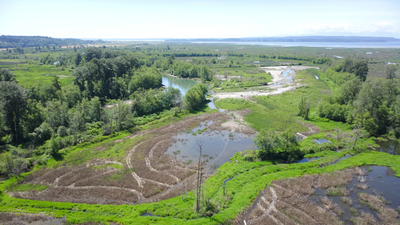
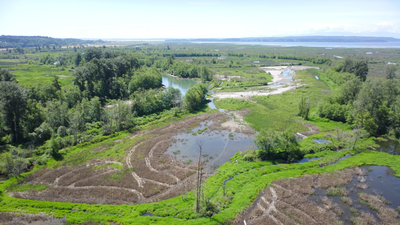
Heavy earth-moving equipment began work in June 2026 on a major coastal restoration project in Skagit County, Washington. The project will remove old sea defences and breach river levees across two islands in the South Fork Skagit River delta.The Island Unit Restoration Project, managed by the Washington Department of Fish and Wildlife (WDFW), will restore 270 acres of former farmland in the Skagit Wildlife Area to natural intertidal wetlands over the next two years.By reconnecting isolated marshes to the tides, the project will remove barriers that block water movement and open access to hundreds of additional acres of intertidal estuary across the wider delta. The restored tidal channels will provide important habitat for young Puget Sound Chinook salmon, a species protected under the United States Endangered Species Act (ESA).
Removing old dikes to restore tidal flows
The Island Unit is made up of two islands in the South Fork Skagit River estuary. The islands can only be reached by boat.In the early 1900s, farmers built dikes and drained the tidal wetlands to create farmland. WDFW bought the land in the 1950s and mainly managed it for wildlife, but the old structures continued to block natural water flows and fish migration routes.Engineers working on the project will remove old dikes, levees, and tidegates. This will allow saltwater from Skagit Bay and freshwater from the Skagit River’s Freshwater, Deepwater, and Steamboat sloughs to flow across the islands again.According to details released by WDFW, Aberdeen-based contractor Brumfield Construction, Inc. will also dig new internal channels, build low-angle landings for small boats, and create raised earth mounds that will stay above water during normal daily tides.
Important nursery habitat for young salmon
Estuaries are coastal areas where freshwater rivers meet saltwater. These areas provide rich feeding grounds for fish and other wildlife.For young Chinook salmon, known as smolts, sheltered tidal channels are important places to stop and feed as they travel from rivers toward the ocean.“This project doesn’t just restore habitat on this 270-acre site; it removes barriers to reconnect hundreds more acres of intertidal estuary across the South Fork Skagit River delta,” said Jenny Baker, senior restoration specialist and project manager at WDFW, in an agency statement.“Young Chinook will quickly use these rich feeding grounds so that they grow bigger and survive better once they leave the shelter of the estuary and head out into Whidbey Basin, Puget Sound, and the ocean beyond,” Baker said.The Island Unit project follows the nearby Milltown Island Estuary Restoration Project. Earthwork on that project was completed in late 2024, while native plant restoration is still underway.
Temporary closures and future recreation
Because of heavy equipment and construction activity, WDFW said the Island Unit will be closed to the public from July 2026 through autumn 2028.The nearby Skagit Headquarters Unit boat launch and parking area will also have temporary closures as construction equipment is brought to the site.Although access will be limited during construction, the final design will continue to support recreation. The area is popular with waterfowl hunters, kayakers, boaters, and wildlife photographers.“Through years of collaboration with treaty tribes, advisory group members, waterfowl hunters, and partner organizations, we’re proud of how this project balances habitat restoration for Chinook salmon recovery with continued recreational access for hunting, boating, paddling, and wildlife watching,” said Brendan Brokes, WDFW’s North Puget Sound Regional Director.After construction, the new low-angle landings will make it easier for paddlers and hunters to bring small boats ashore. The raised recreational mounds will be planted with native trees and shrubs to create more wildlife habitat.WDFW also plans to install permanent waterfowl hunting blinds on some of the mounds overlooking permanent water features.
State and federal funding
State biologists first proposed the Island Unit project in the late 2010s. Beginning in 2020, the project went through public comment periods, reviews with stakeholders, and consultations with regional treaty tribes.Construction is being paid for with a mix of state and federal funding.Federal money comes from the Bipartisan Infrastructure Law and the Inflation Reduction Act (IRA), distributed through the National Oceanic and Atmospheric Administration (NOAA).State funding comes from the Puget Sound Acquisition and Restoration Fund and Washington’s Climate Commitment Act (CCA), a cap-and-invest program that supports climate resilience and pollution reduction.Earlier planning, design, and environmental permitting were funded through Washington state capital budgets, the Washington Salmon Recovery Funding Board, and the Estuary and Salmon Restoration Program (ESRP).