
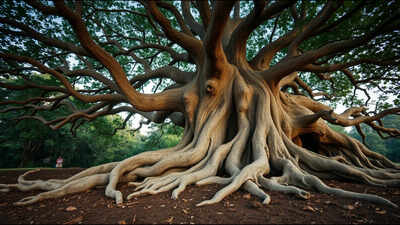
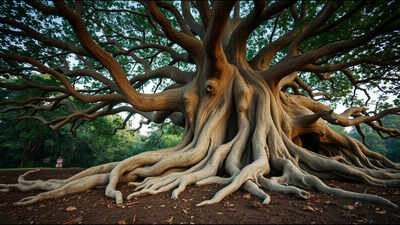
On a stretch of coastline in Rio Grande do Norte, Brazil, a single cashew tree has grown so large that visitors need an elevated walkway just to take in its full shape. Known locally as the Cajueiro de Pirangi, or in Portuguese as the Maior Cajueiro do Mundo, the tree covers roughly 8,500 square metres, an area equivalent to about 70 ordinary cashew trees, despite technically remaining one single, continuously connected plant. Recognised by Guinness World Records as the largest cashew tree on Earth, the tree still produces a genuine harvest each year, yielding up to 2.5 tonnes of cashew fruit, or somewhere around 60,000 to 80,000 individual cashews, depending on the season.
How one cashew tree grew large enough to resemble a forest
According to Guinness World Records, the tree’s limbs radiate out roughly 50 metres from its central trunk, and its unusual scale comes down to a genetic mutation that allows most of its branches to put down entirely new sets of roots wherever they happen to touch the ground. Rather than growing upward the way a typical cashew tree does, the Pirangi tree’s branches instead grow outward and, weighed down by their own mass over time, gradually bend until they make contact with the sandy soil beneath them.Once a branch touches down, it develops what botanists call adventitious roots, roots that form from an unusual point on a plant rather than from an existing root system, effectively creating a new, self-supporting trunk. That new trunk remains physically connected to the original tree even as it continues extending the canopy outward, which is why the whole structure is counted as a single plant despite looking, from ground level, far more like a small, dense forest. Guinness notes that out of the tree’s five main original branches, four continue this rooting pattern, while the fifth, known locally as Salário Mínimo, or minimum wage, behaves normally and stopped extending once it first reached the ground.
Why the tree’s precise age and origins remain uncertain
The tree’s exact age is genuinely disputed. Local tradition holds that it was planted in 1888 by a fisherman named Luís Inácio de Oliveira, who is said to have later died resting in its shade, and Guinness records list the tree as being over 100 years old based on this account. Because the tree’s continuous rooting and rebranching process makes conventional trunk-based age estimation unreliable, some researchers examining its growth pattern have suggested the plant could realistically be far older, with some estimates running into the centuries or longer, though no method has definitively settled the question.
How the tree became an official Guinness World Record holder
A Guinness World Records team formally measured the tree’s canopy in 1994, confirming its status as the largest cashew tree on record and cementing its place as a defining attraction for the Natal region ever since. The tree sits within a dedicated park in Pirangi do Norte, part of the municipality of Parnamirim, roughly 12 kilometres from central Natal, where local authorities have built suspended walkways specifically to protect its extensive root system from the hundreds of thousands of visitors who come to see it each year.Managing a plant that continues expanding indefinitely has created its own set of practical challenges. Brazil’s Institute of Sustainable Development and Environment of Rio Grande do Norte, known locally as Idema, has had to intervene directly as the tree’s growth pushed against the boundaries of its park, including installing a supporting pergola in 2012 to hold up branches that had begun extending out over a public road.
How much fruit the tree actually produces each year
Despite its unusual growth habit, the Pirangi tree continues to function as a genuinely productive cashew plant. During its harvest season, which typically runs from around November through January, the tree yields up to 2.5 tonnes of cashew fruit in a strong year, translating to tens of thousands of individual cashews collected from across its sprawling canopy, though annual totals vary considerably depending on rainfall and other seasonal conditions along Brazil’s Potiguar coastline.
Why a rival tree has challenged its record
The Pirangi tree’s record has not gone entirely unchallenged. A separate cashew tree located in Cajueiro da Praia, in the neighbouring state of Piauí, has been studied by researchers at the State University of Piauí and is reported to cover an even larger area, around 8,800 square metres. That tree, however, has not received an official measurement or recognition from Guinness World Records, leaving the Pirangi tree as the internationally recognised record holder even as the rivalry between the two continues to draw local attention.
Why the tree remains a defining symbol of the region
More than a century after it was reportedly first planted, the Cajueiro de Pirangi has become far more than a botanical curiosity. It draws hundreds of thousands of visitors annually, supports a small local tourism economy built around guided walks, cashew-based food and handicrafts, and continues to serve as a genuine point of regional pride for Rio Grande do Norte. As a single, still expanding organism that has spent more than a century quietly turning itself into a forest, the tree remains a striking, ongoing example of how a single unusual genetic trait can reshape not just a plant’s own growth, but the landscape and community built up around it.