
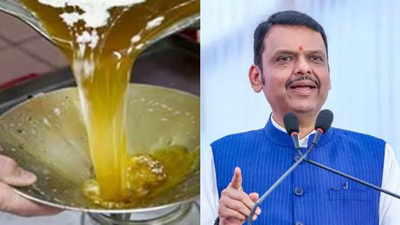
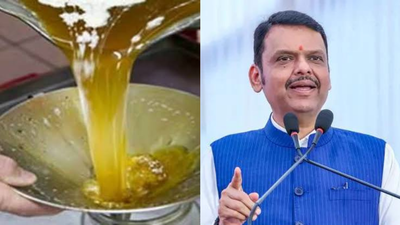
MUMBAI: Maharashtra chief minister Devendra Fadnavis on Tuesday said enforcement action against the sale of loose edible oil would be kept in abeyance for a year, putting the Food and Drug Administration’s (FDA) decision on hold.However, there would be no further extension after this period and compliance with the law would be mandatory, news agency PTI reported.Therefore, during this one-year period, every trader will have to make the necessary changes to their business practices in accordance with the law, Fadnavis said.
Govt to form committees to help traders comply
A joint committee comprising FDA representatives and traders will be constituted to recommend measures and provide guidance for implementing these changes, an official release said.The committee will recommend solutions and measures to help traditional traders understand what changes they need to make to comply with the law, it said.Fadnavis assured loose edible oil traders that the state government would provide assistance, facilities and, where necessary, grants or subsidies to help them make the transition.The committee will prepare a plan for legally compliant changes for traders, edible oil sellers, manufacturers and repackaging businesses involved in the sector.The government will endeavour to assist traders in creating quality-testing systems, packaging facilities and other necessary infrastructure, Fadnavis said.Earlier in the day, the CM chaired a meeting of loose edible oil traders at Mantralaya.Deputy CM Sunetra Pawar, revenue minister Chandrashekhar Bawankule, FDA and special assistance minister Narhari Zirwal and senior officials were present.“Enforcement action against the sale of loose edible oil would be kept in abeyance for one year for the time being. However, there would be no further extension after this period, and compliance with the law would be mandatory,” Fadnavis said.
‘Need to balance law with needs of citizens’
The CM said that there is a demand for and a need for loose edible oil even in rural areas. At the same time, the livelihoods of many traders depend on this business.Therefore, it is necessary to find an appropriate balance between the law and the needs of ordinary citizens.The use and sale of loose edible oil has been carried out traditionally in the state for many years. Hence, traders need to be given some time to change this system, the CM said.“The law will take its course; however, a transition period is necessary to move from traditional business practices to a system that complies with the law,” Fadnavis said.Two committees will be constituted to recommend solutions to issues related to the loose edible oil business.One of these committees will study the difficulties faced by traders operating through traditional methods and recommend measures required to help them make legally compliant changes.The second committee will recommend measures for creating the necessary arrangements and facilities for edible oil sellers, manufacturers, repackaging businesses and other stakeholders.Fadnavis directed both committees to coordinate and consult with all stakeholders and submit their reports to the government within one month.“The government does not wish to deprive any trader of their livelihood. While ensuring compliance with the law, emphasis will be placed on creating the necessary facilities so that traders can conduct their businesses in a better and safer manner. Wherever necessary, the government will extend its cooperation to help businesses adopt these changes,” Fadnavis said.
FDA had warned against loose edible oil
Last month, FDA commissioner Tukaram Mundhe had urged consumers not to buy loose or unsealed edible oil, calling it unsafe.He had said a compliance order had been issued for the sector due to violations, including adulteration.Following the FDA’s move, Fadnavis had stressed that the state government was seeking a “middle path” to balance strict quality enforcement with the livelihoods of traditional oil vendors and small consumers, PTI reported.
Legal provisions introduced in 2011
In addition to curbing adulteration of edible oil, the Centre had introduced legal provisions in this regard in 2011, taking into consideration its impact on citizens’ health.The Central Advisory Committee has issued directions for stricter regulation of the sale of loose edible oil.Four notifications have been issued for regulating the implementation of this law, up to August 28, 2020.There are currently 2,103 licensed loose edible oil businesses operating in the state.Of these, 370 businesses hold licences to sell edible oil after repackaging, while 489 businesses hold licences for edible oil production.(With agency inputs)