
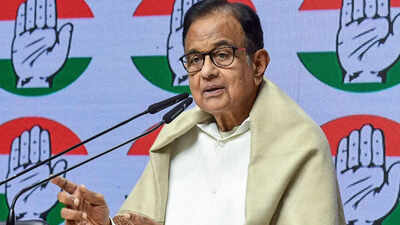
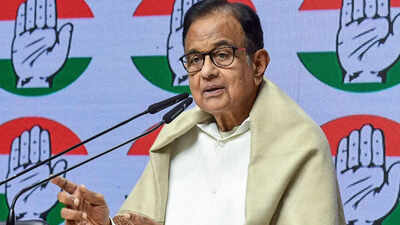
NEW DELHI: Former union minister P Chidambaram has opposed the proposed ‘One Nation, One Election’ framework before a joint parliamentary committee, calling the initiative “unconstitutional”, “monstrous” and “mindless”.Chidambaram, who appeared before the panel examining the Constitution (129th Amendment) Bill, 2024, and the Union Territories Laws (Amendment) Bill, 2024, argued that synchronising Lok Sabha and state assembly elections could violate the constitutional framework governing elected legislatures.Sources, quoted by news agency PTI, said the former home and finance minister told the panel that since legislatures are elected for five-year terms, curtailing their tenure would amount to a violation of the basic structure of the Constitution.Chidambaram also said his conscience did not allow him to support the proposed legislation and argued that the government does not have the required two-thirds majority to pass the bills, sources told PTI.The Congress leader described the proposal to hold nationwide elections simultaneously as a “mindless” exercise and strongly opposed the government’s push for simultaneous polls.Trinamool Congress (TMC) MP Sagarika Ghosh, who is also a member of the committee, separately opposed the bills. Ghosh said the proposal could give “unbridled” power to the Election Commission, sources said.The joint committee, headed by BJP MP PP Chaudhary, also heard representations from around 10 Padma awardees, including Tarlochan Singh, Navin Khanna, Meenakshi Jain and Niru Kumar. While some supported simultaneous elections, others opposed the proposal, warning that it could lead to “chaos” in the country.
Share your thoughts in the comments
Be respectful · TOI community guidelines
The two bills were introduced in the Lok Sabha in December 2024 and subsequently referred to the joint committee for detailed examination.The proposal followed recommendations from a high-level committee headed by former president Ram Nath Kovind, which suggested holding Lok Sabha, state assembly and local body elections simultaneously in a phased manner. Union Home Minister Amit Shah was also a member of the panel.India had earlier held Lok Sabha and state assembly elections together from 1951-52 through 1967. The cycle was disrupted after premature dissolutions of some state assemblies in 1968 and 1969, followed by the early dissolution of the Fourth Lok Sabha in 1970 and fresh general elections in 1971.Since then, staggered election cycles have become the norm, with several Lok Sabha and state assembly terms ending before their full five-year tenure.