
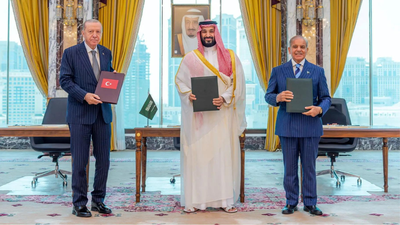
The signing of the Mecca Joint Defence Agreement by Saudi Arabia, Pakistan and Turkey on Friday marked one of the most significant strategic realignments in West Asia in recent years.The agreement reportedly commits the three countries to treat an armed attack on one member as an attack on all — a principle that immediately invited comparisons with Nato’s Article 5.
It also formalises a strategic triangle that combines Saudi Arabia’s financial power, Turkey’s advanced defence industry and Nato experience, and Pakistan’s large military and nuclear capability.
What is the Mecca deal?
The mutual defence agreement was signed by Saudi Crown Prince Mohammed bin Salman, Turkish President Recep Tayyip Erdogan and Pakistan Prime Minister Shehbaz Sharif in Jeddah.The deal states that an armed attack on any one of the three countries will be regarded as an attack on all. It also commits the parties to closer defence cooperation and collective deterrence.That language is consequential. It moves the relationship beyond training exercises, arms purchases and bilateral military cooperation towards a formal political pledge.
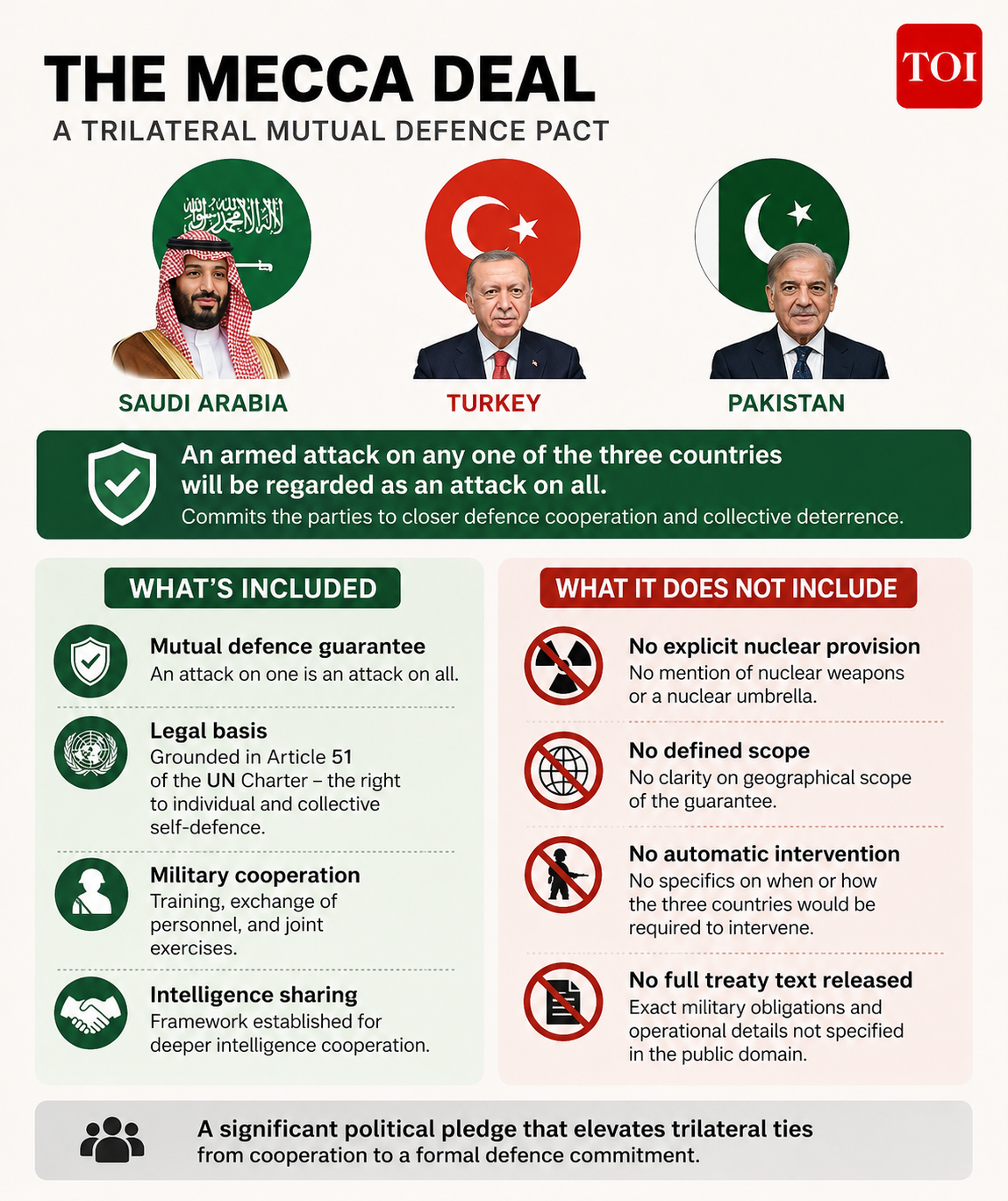
The deal states that an armed attack on any one of the three countries will be regarded as an attack on all.
Although the full treaty text has not been published, officials outlined several concrete elements of the Mecca Joint Defence Agreement.Turkish sources told The New Arab that the pact is grounded in Article 51 of the UN Charter, the right to individual and collective self-defence, thereby giving Saudi Arabia, Turkey and Pakistan a joint self-defence right against external threats.Unlike the earlier bilateral Saudi–Pakistan Strategic Mutual Defence Agreement (SMDA), which was reported to encompass “all military means” (including speculation about a nuclear umbrella), the trilateral Mecca deal’s statement does not explicitly address nuclear weapons or sharing.The agreement is described as including cooperation in the military field, notably training, exchange of personnel and the conduct of joint exercises.Multiple reports add that it establishes a framework for deeper intelligence sharing among the three states.However, publicly available announcement do not specify the exact military obligations, the geographical scope of the guarantee, or the circumstances in which the three countries would be required to intervene.
Why now?
Timing is everything.The agreement comes against the backdrop of months of escalating conflict involving Iran, Israel and the United States.Iranian missile and drone attacks, disruption of Gulf shipping, and fears that the conflict could spill deeper into the Gulf have shaken Saudi Arabia’s confidence in the existing regional security architecture.For decades, Riyadh depended primarily on American military protection. But repeated regional crises have fuelled doubts within Gulf capitals about whether Washington is willing, or able, to remain the region’s sole security guarantor.The result has been a search for new security arrangements.Pakistan has long been Saudi Arabia’s closest military partner, having trained thousands of Saudi personnel and stationed troops in the Kingdom over several decades. Turkey, meanwhile, has emerged as one of the world’s fastest-growing defence exporters, supplying drones, naval systems and advanced military technology to several Gulf states.The new pact effectively brings these existing relationships under one strategic umbrella.
Islamic Nato ? Not yet but close
Like Nato, the agreement reportedly contains a collective-defence clause.Unlike Nato, however, the Mecca deal lacks several defining characteristics: it has no integrated military headquarters, no unified command structure, and no joint force permanently assigned to the alliance. It also does not establish an institutional political framework, a common budget, or a treaty-based organisation with standing bodies.More importantly, Nato members are bound by decades of operational integration and standardised military procedures, whereas the new trilateral arrangement currently appears to be a political and military cooperation framework rather than a fully integrated alliance.The Mecca pact is better understood as a strategic framework that could eventually evolve into something larger rather than a finished alliance.Its future will depend on whether it expands to include countries such as Egypt, Jordan or other Gulf states.
A strategic umbrella
Saudi Arabia, Pakistan and Turkey each bring a distinct strength to the new defence partnership, making the grouping more complementary than competitive.If the pact develops into a deeper military alliance, it would combine Saudi Arabia’s financial muscle, Turkey’s defence technology and Pakistan’s military manpower into a formidable strategic bloc.Saudi Arabia is the alliance’s financial and geopolitical anchor. It is one of the world’s biggest defence spenders, investing more than $70 billion annually on advanced military capabilities, including F-15SA fighter jets, Eurofighter Typhoons, Patriot and THAAD air defence systems, Apache helicopters and modern naval assets.Beyond its military hardware, Riyadh’s greatest contribution is its ability to fund joint procurement, defence research and military infrastructure.
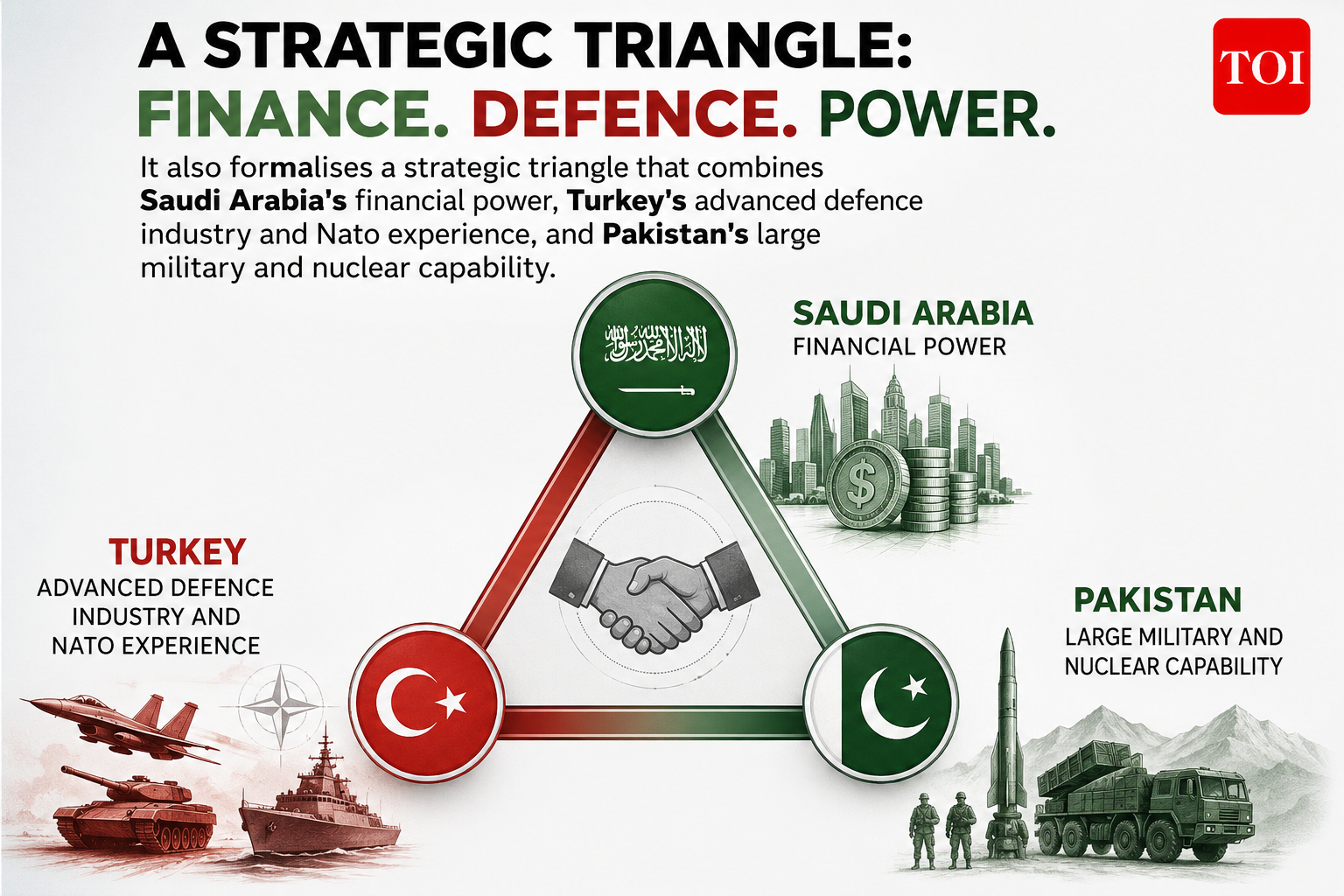
Saudi Arabia, Pakistan and Turkey each bring a distinct strength to the new defence partnership
Its strategic location, overlooking both the Red Sea and the Persian Gulf, also gives it influence over some of the world’s busiest maritime trade routes, including the Bab el-Mandeb and the Strait of Hormuz. As custodian of Islam’s two holiest cities, Saudi Arabia also carries unmatched religious and political influence across much of the Muslim world.Turkey contributes something Saudi Arabia lacks: a mature, indigenous defence industry backed by extensive operational experience.A Nato member with one of the alliance’s largest militaries, Turkey has spent years developing its own military technology, emerging as a global exporter of drones, warships, missiles and armoured vehicles.Its Bayraktar drones have gained international recognition, while projects such as the KAAN fifth-generation fighter and MILGEM warships underline Ankara’s ambition to become a major defence manufacturer. Turkish forces have also gained valuable combat experience through operations in Syria, Iraq and Libya, giving the country expertise in modern warfare that complements its industrial capabilities.Pakistan’s biggest asset is its military strength and strategic deterrence.With one of the world’s largest standing armies and decades of operational experience in both conventional warfare and counter-insurgency, Pakistan brings significant manpower to the partnership. More importantly, it is the only Muslim-majority country with nuclear weapons, giving the alliance an added layer of strategic weight, even though there is no indication that the pact includes any form of nuclear umbrella or sharing arrangement.Pakistan has also maintained close military ties with Saudi Arabia for decades, regularly training Saudi forces and deploying troops to help secure the Kingdom.Together, the three countries create a partnership that explains why the pact is attracting attention well beyond the Middle East.
Iran in crosshairs?
The timing makes Iran the obvious strategic reference point.Gulf states have faced missile and drone threats, attacks on critical infrastructure and the continuing risk of disruption around energy routes.The new agreement comes amid a wider regional conflict in which Gulf countries have come under fire after US and Israeli attacks on Iran, according to reporting by Reuters.The pact certainly creates a powerful Sunni security grouping against Shia-dominated Iran.The pact’s defenders insist that it is defensive and not directed against any particular country. But formal alliances are judged not only by their stated purpose but also by their strategic effect.Iran is likely to read the agreement as an effort to consolidate a Sunni-majority security coalition on its western flank.Saudi Arabia and Iran restored diplomatic relations in 2023, with China’s mediation, but that rapprochement did not erase their rivalry over regional influence, missile capabilities, proxy networks and the security of the Gulf.For Riyadh, the pact could provide insurance at a moment when confidence in external security (read US) guarantees has weakened.For Pakistan, the agreement offers diplomatic and economic benefits, as well as a route to expand its military role in the Gulf.Turkey’s participation is more complicated. Ankara has its own ambitions in the Middle East, maintains relations with Iran despite disputes, and remains a Nato member. Its involvement could give the pact technological and operational depth, but it could also make the alliance harder to manage. Turkey may not want to be drawn automatically into every Saudi-Iranian confrontation.
Where does Israel fit into this?
Ironically, Israel may not view the pact as entirely negative.Although Turkey has sharply criticised Israel throughout the Gaza conflict, Saudi Arabia has quietly maintained channels of communication with both Washington and Israel despite suspending normalisation talks after the Hamas attacks.From Israel’s perspective, any regional grouping that increases pressure on Iran creates mixed strategic consequences.On one hand, stronger Sunni military coordination could indirectly constrain Iranian regional ambitions.On the other, a bloc led partly by Turkey—which has become one of Israel’s strongest critics—introduces a more uncertain variable into the regional balance.Israel is therefore likely to watch the pact carefully rather than oppose it outright.Its main concern will be whether the alliance remains focused on collective Gulf security or gradually evolves into a broader political and military coalition that adopts explicitly anti-Israel positions.
The big picture
The Mecca Joint Defence Agreement is a major step in reshaping the post-American security order in West Asia.It reflects a region increasingly willing to build its own security architecture instead of relying exclusively on outside powers.Whether the pact evolves into a genuine military alliance will depend on its implementation.If it develops permanent institutions, conducts regular integrated exercises, establishes joint commands and expands membership, comparisons with Nato may become more credible.For now, however, it is best viewed as an ambitious strategic alignment rather than a fully fledged military alliance.For Iran, it represents a stronger regional balancing coalition.For Israel, it is both a potential opportunity and a source of uncertainty.And for India, it is not an immediate threat — but it is unquestionably a geopolitical development that warrants close attention, particularly because Pakistan now sits at the heart of an emerging security architecture that links Gulf wealth, Turkish military technology and Pakistani military capability into a single strategic framework.