
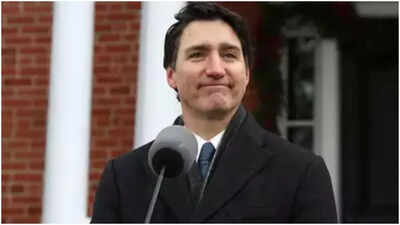
Justin Trudeau has lived his entire life under public scrutiny, yet he maintained his sense of detachment, and it is evident now more than ever as after his resignation as the Canadian Prime Minister, Trudeau stepped away from politics. Though he is very much in public life, he rarely comments on political issues. This may take one back to how he was when he stepped into politics; he was a young man living under the massive shadow of his father, Pierre Trudeau. After he died in 2000, Justin delivered a dramatic televised eulogy at his father’s state funeral, closing with the words “Je t’aime, papa”, before resting his head on his father’s flag-draped coffin. Immediately, there was chatter of the younger Trudeau entering politics.In 2001, in a piece that Justin Trudeau wrote for the Globe and Mail, he admitted or pretended an ignorance to current affairs. “I don’t read the newspapers, I don’t watch the news,” he wrote. “I figure, if something important happens, someone will tell me.”
Rise and fall of Justin Trudeau
When Trudeau entered politics, comparisons with his father, former Prime Minister Pierre Trudeau, were inevitable. Pierre Trudeau had dominated Canadian politics from the late 1960s through the early 1980s, becoming an icon of Canadian federalism and constitutional reform. Justin inherited not only his father’s famous surname but also an ability to connect with audiences through compelling public speaking and an approachable personality. Before politics, he worked as a teacher and was involved in youth and charitable initiatives. Although critics dismissed him as inexperienced and famous mainly because of his family name, Trudeau steadily built his political credentials after winning a seat in Parliament in 2008.His defining breakthrough came in 2013 when he became leader of the Liberal Party. At the time, the Liberals were in crisis. The party had suffered its worst-ever electoral defeat in 2011, finishing third behind the Conservatives and the New Democratic Party. Many political observers believed it would take years for the Liberals to recover. Trudeau, however, energized the party almost immediately. He attracted thousands of new members, revitalized fundraising and presented a message of optimism that contrasted sharply with what he portrayed as the more cautious and security-focused politics of Conservative Prime Minister Stephen Harper.The 2015 federal election became Trudeau’s finest political moment. Campaigning under the slogan “Real Change,” he promised tax reforms benefiting the middle class, greater openness in government, significant investments in infrastructure, action on climate change and a more welcoming approach to immigration. He also pledged that 2015 would be Canada’s last election under the first-past-the-post electoral system, raising expectations for democratic reform. Most strikingly, he led the Liberals from third place in Parliament to a majority government—one of the greatest electoral comebacks in Canadian history.Trudeau’s early years in office earned him widespread international attention. He appointed Canada’s first gender-balanced cabinet, famously responding to a reporter’s question about why equal numbers of men and women had been selected by saying, “Because it’s 2015.” The remark quickly became symbolic of his commitment to gender equality. His government accepted tens of thousands of Syrian refugees, strengthened Canada’s image as a welcoming country and championed diversity and multiculturalism. Internationally, Trudeau cultivated an image of Canada as a progressive middle power committed to climate action, international cooperation and liberal democratic values.The first major blow to Trudeau came in 2019 with the SNC-Lavalin affair. Allegations emerged that senior officials in Trudeau’s office had pressured Attorney General Jody Wilson-Raybould to intervene in a criminal prosecution involving the engineering giant SNC-Lavalin. Wilson-Raybould resigned from cabinet, testified before Parliament and described inappropriate political pressure. The controversy dominated national headlines, resulted in cabinet resignations and led the federal ethics commissioner to conclude that Trudeau had improperly attempted to influence the attorney general. For a leader who had campaigned on integrity and accountable government, the scandal significantly damaged his credibility.The COVID-19 pandemic briefly altered Trudeau’s political fortunes. His government introduced unprecedented emergency measures, including income support programs for workers and businesses affected by lockdowns. Initially, many Canadians rallied behind the government’s response, and Trudeau’s approval ratings improved.In 2022, the Conservatives picked a new leader, Pierre Poilievre. Poilievre didn’t bother with polite politics; he spent two years straight hammering Trudeau as an out-of-touch elitist who broke the country. By 2024, the public was just completely exhausted by Trudeau. The Liberals started losing elections in areas they had held for decades. Then, in late 2024, his top ally and Finance Minister, Chrystia Freeland, quit. His own party members started turning on him behind closed doors. In 2025, he announced his resignation and gradually stepped away from politics.