
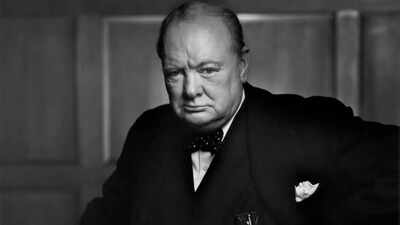
Churchill’s line keeps turning up in articles about public speaking, usually pulled out as a neat rule for how to hold an audience. It sits in that category of quotes people repeat without always checking the setting it came from. Still, it survives because it speaks to something familiar in communication. Most speeches either run too long and lose people, or stay too thin and never really land. Churchill, who built much of his reputation on wartime addresses and parliamentary delivery, had a habit of compressing ideas into short, punchy images. This one is no different. It frames speech length as a balancing act, not a formula. The focus is on keeping attention without drowning the subject in detail, a problem that shows up just as much in modern presentations and media commentary as it did in his political era.
Quote of the day by Winston Churchill
“A good speech should be like a woman’s skirt; long enough to cover the subject and short enough to create interest.”
What is the meaning behind the quote by Winston Churchill
The quote is often read as a joke at first, mostly because of the comparison, but the point underneath is more practical than it sounds. It is about how much information a speaker should give before attention starts to fade. Churchill is pointing towards a middle space where a message is complete but still light enough to hold interest.There is no strict rule inside it. The idea shifts depending on the situation, audience, and subject. A speech in parliament would not look the same as a campaign rally or a formal address. Yet the same problem sits underneath all of them. Too much detail starts to blur the main point. Too little makes it feel unfinished.That tension is really what the quote is circling. It is not about style alone. It is about judgment in delivery. Knowing when to stop is part of the skill, even if that part is often ignored in preparation.
Speech length and audience attention rarely match
In real settings, speeches rarely land exactly as planned on paper. A section that looks fine in writing can feel long when spoken. A point that seems clear to the speaker may not register the same way for the audience.Churchill’s observation sits in that gap. Attention is not stable. It moves. People tune in and drift out without warning, sometimes even during important points. Because of that, length becomes less about counting words and more about reading the room.This is where many speeches slip. They try to cover everything evenly, instead of shaping what actually needs emphasis. The result is often a steady decline in attention rather than a clear message landing at the end.
Clarity comes from restraint not excess detail
There is a tendency in public speaking to assume that more detail equals better communication. In practice, it often works the other way. Extra explanation can dilute the main idea instead of strengthening it.Churchill’s framing leans into restraint. Not cutting meaning, but trimming what surrounds it. The idea is that a speech should carry its subject without weighing it down. That requires selection, and selection is rarely clean or comfortable.In political communication, especially, this becomes noticeable. The strongest moments are often not the most detailed ones, but the ones where the message is sharp enough to stay in memory. Everything else tends to fade quickly after delivery.
Why the quote still gets repeated in modern communication
The reason this line keeps resurfacing is not just Churchill’s name. It is because the problem it describes has not gone away. If anything, it has become more visible in environments where attention is limited and competition for it is constant.Presentations, interviews, social media clips, and even internal meetings follow the same pressure. People have less time to listen, and more things are pulling attention away. In that setting, long explanations struggle to hold ground unless they are tightly structured.The quote survives because it fits that reality without needing to be updated. It is not a technical rule. It reads more like a reminder that communication is judged in real time, not in draft form.
Speech writing is less about length and more about control
Behind most effective speeches is a quiet process of cutting. Not everything written makes it to delivery. The shaping happens in what gets removed rather than what gets added.Churchill’s style, often studied in political communication, reflects that discipline. His speeches are remembered for clarity, but that clarity usually comes from what is not included as much as what is.Control in this sense is not about a strict structure. It is about deciding what the audience actually needs to carry forward. Everything else risks becoming noise, even if it is well-written or accurate.
Modern media pushes the same balance problem further
In today’s communication space, the problem Churchill pointed out has become more compressed. Attention is fragmented across formats, screens and constant updates. Long-form speech still exists, but it competes with short-form delivery at every step.That does not make long communication obsolete. It just raises the bar for focus. If something runs long, it has to justify that length continuously. Otherwise, attention drops off early.This is where the balance Churchill describes still applies, even outside formal speeches. Articles, videos, interviews, even voice notes carry the same pressure. Enough to explain, not so much that interest breaks.
Interpretation beyond literal reading
The quote is sometimes treated as a surface-level joke, but it works better as a general communication principle. It points to judgment rather than structure. Knowing how much to say is not a fixed skill. It changes with context, audience, and purpose.There is also an unspoken layer in it. Speech is not only about information. It is also about pacing and timing. When something is revealed, what is said matters as much. Too early, and it feels flat. Too late, and attention is gone.Churchill’s framing compresses all of that into a single image, which is probably why it stays in circulation. It is simple enough to repeat, but flexible enough to apply in different settings.
Other famous quotes by Winston Churchill
- “Success is not final, failure is not fatal: it is the courage to continue that counts.”
- “If you are going through hell, keep going.”
- “To improve is to change; to be perfect is to change often.”
- “Courage is rightly esteemed the first of human qualities because it is the quality which guarantees all others.”
- “Never give in, never give in, never, never, never.”