
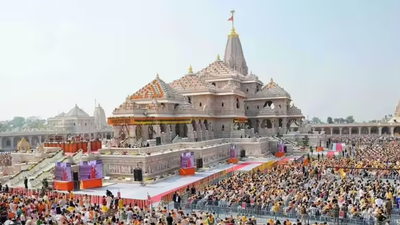
AYODHYA/LUCKNOW: Shri Ram Janmabhoomi Teerth Kshetra Trust, which manages the Ram temple complex, is not accountable to either central or UP govt.The ministry of home affairs told the Central Information Commission on Feb 20 last year that all decisions are taken internally by the trust, with the authority resting solely with its permanent trustees.An RTI applicant, Neeraj Sharma, in early 2024, sought the names of the public information officers for the Ram temple trust from the central government but his appeal was turned down by the ministry of home affairs.He moved Delhi high court in Feb 2024 after which directions were issued to central information commission to decide whether Ram temple trust was a public authority or an autonomous body after seeking MHA’s response and evaluating it.Based on the MHA response, the commission in its final order stated that the temple trust is an independent organisation set up as per the verdict of the Apex Court and owes no financial support or administrative control from the state or central government. Ruling that SRJBTK is not a public authority, the CIC said its working will not come under the purview of RTI Act.The structure of the trust gains significance ahead of its July 6 meeting, when the members will decide the future of general secretary Champat Rai and trustee Anil Mishra who have quit their posts on moral grounds amid the donation theft row.Out of 15 trust members, four have no voting rights while one has passed away. As Rai and Mishra are still eligible to attend the meeting, at least six of the remaining 10 members of the trust will need to reach a consensus, making the decision process delicate.Since the trust was constituted as a self-operating body whose management and functioning is decided by its members internally, no statutory body in the country has the power to terminate Rai and Mishra. Though four govt officials, representing the Centre and state govt, are also trust members, they do not have any decision-making powers or voting rights.“Even if Champat Rai ceases to be the general secretary, he has the right to continue as a member. Similarly, Anil Mishra can be relieved of his responsibilities and still continue to be associated with the trust. So far, we have not heard about a framework through which a member could be expelled, so the only way out is resignation,” said a source associated with the temple’s internal dynamics.The trust members could also discuss the way forward in case complete overhauling of the present structure is required. Members who are unable to join the meeting personally can join virtually, as the IT cell of the trust provides a video-conferencing link to all the members in advance.A meeting of the trust is convened every three months to take up important matters, and the last meeting took place on March 21, with the key agenda being Ram Navami preparations. Tasked with the responsibility of overseeing the construction work on Ram temple from Jan 2021, Gopal Nagarakatte (Rao), a senior VHP functionary from Karnataka, is among the invitee trust members. The trust did not announce when he was brought on board. He is the third individual who is facing the heat at present after Rai and Mishra.The trust was established in Feb 2020 as per the Nov 2019 order of the Supreme Court in favour of the construction of the Ram temple. The first meeting of the trust was held in Delhi where Mahant Nritya Gopal Das was elected its president while VHP vice-president, Rai the general secretary and Govind Giri Dev treasurer. UP cadre retired IAS officer and former principal secretary of PM Narendra Modi, Nirependra Mishra, was appointed the chairman of the construction committee.Another important member of the trust was K Parasaran, a senior SC advocate who successfully represented the Hindu side in the title dispute. His Delhi house is the registered address of the trust. Among others are Swami Vasudevanand Saraswati Ji Maharaj from Prayagraj, Swami Vishwaprasannatheertha Ji Maharaj from Pejawar Math, Udupi, Yugpurush Paramanand Giri Ji Maharaj from Haridwar, Mahant Dinendra Das from Nirmohi Akhara, Ayodhya, Vimalendra Mohan Pratap Mishra, a representative from the royal family of Ayodhya, Dr Anil Mishra, an Ayodhya-based homeopathic doctor and Kameshwar Chaupal from Patna, representing the Dalit community.After Choupal’s death, RSS worker Krishna Mohan was inducted in his place while Vimalendra Mohan Pratap Mishra’s place is still vacant after his death. Apart from Nripendra Mishra, other three ex-officio members who don’t have voting rights are Prashant Lokhande (IAS), joint secretary, ministry of home affairs (representative of the Central government), Sanjay Prasad (IAS), ACS, home, representative of the state government, and Shashank Tripathi (IAS), DM of Ayodhya.As general secretary, Rai was calling the shots at the top since the construction work started in Aug 2020, followed by Anil Mishra who was the administrative head of the temple. Nagarakatte continues to be in-charge of the construction and civil works. Though Rai and Mishra have not been seen on the temple premises from the time the controversy brewed up, Nagarakatte continues to oversee the construction progress.Key RSS and VHP functionaries, Suresh Bhaiya Joshi and Dinesh Chandra, are among the other two invitee members who have been participating in the meetings, and details of their involvement too have never been disclosed publicly. The invitee members do not have voting rights or decision-making powers, said sources, but are free to voice their concerns and opinions to improve the overall working, offerings and services of the Trust.Only Rai, Mishra and Nagarakatte have administrative powers and the authority to issue aarti and VIP passes in the trust, a scenario which does not go well with other office-bearers because of their limited roles.Similarly, if a vacancy arises, the new member could be brought on board only through a majority resolution by the existing permanent members.