
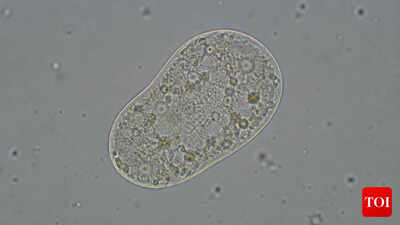
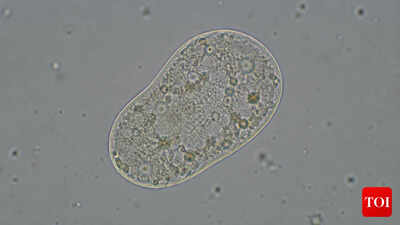
Scientists at the University of Minnesota have announced a major step in synthetic biology: a laboratory-made system dubbed ‘SpudCell’ that mimics many behaviors of living cells.Built from lifeless chemicals in a so-called bottom-up approach, SpudCell eats, grows, copies its genetic instructions and divides — completing a birth-to-division life cycle in the lab.But does that mean it’s alive? The short answer: not quite — and that ambiguity is exactly what makes SpudCell important.
What SpudCell is
SpudCell is a pared-down, cell-like structure assembled piece by piece.Researchers mixed a “broth” of molecules — about a hundred types of proteins and small chemicals needed for basic cell chemistry — plus selected genes from a virus and E. coli.Lipid building blocks formed membranes that spontaneously enclosed portions of the soup, creating bubble-like compartments. Some bubbles happened to contain the right combination of genes and proteins to carry out life-like reactions: importing nutrients, making proteins (with supplied ribosomes), growing and then dividing.
Why it matters
Named for its potato-like shape, SpudCell isn’t the first synthetic cell, but it is the first bottom-up creation shown to complete multiple generations of growth and division after being built from nonliving components.Unlike earlier “top-down” minimal cells that began as living organisms and were pared back, SpudCell was constructed from chemicals — a meaningful advance for understanding what components are truly essential for life-like behavior.
Where it still falls short
SpudCell imitates many hallmarks of life but depends on human help.Crucially, it cannot assemble its own ribosomes — the molecular machines that make proteins — so researchers must supply functional ribosomes externally.Because those borrowed ribosomes degrade, a SpudCell lineage lasts only about five to ten generations before function fails.Its genome is also tiny (around 90,000 base pairs across seven DNA pieces) and fragmented, so genetic material is not reliably passed intact to offspring.These limitations are why scientists stop short of calling SpudCell unequivocally “alive.”The team’s priorities are to enable SpudCells to build their own ribosomes, improve faithful genome transmission, and reduce dependence on supplied proteins — steps that would let lineages persist longer and behave more like natural cells.
The big picture
SpudCell marks a watershed in bottom-up synthetic biology: not definitive “life,” but a convincing, engineered approximation that reproduces core behaviors of living cells.Studying simplified systems strips away biological complexity, letting scientists test which genes and structures are necessary for basic cellular tasks.That knowledge can illuminate fundamental biology, help design custom biological machines for medicine or carbon capture, and provide controlled platforms for experimenting with evolution and molecular engineering. The creators have set up an open research effort called Biotic to let others reproduce and extend SpudCell work.