
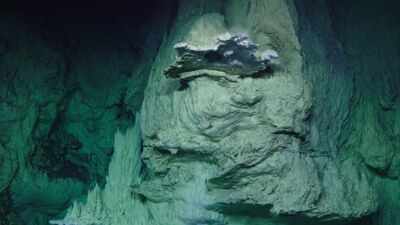
Scientists have uncovered new evidence that helps answer one of the biggest questions about the mysterious Lost City hydrothermal field, a unique underwater ecosystem deep in the Atlantic Ocean. By drilling more than a kilometre beneath the seabed, researchers found superheated water whose chemical composition closely matches the fluid that flows out of the Lost City’s famous white chimneys, ScienceX reported.The discovery suggests that these unusual underwater vents are supplied by a hidden source of hot, hydrogen-rich water deep below the ocean floor. The findings help scientists better understand how life can survive in places where sunlight never reaches. It may also offer clues about existence of life in other worlds. The study was published in the journal Geochemistry, Geophysics, Geosystems.
Life without sunlight
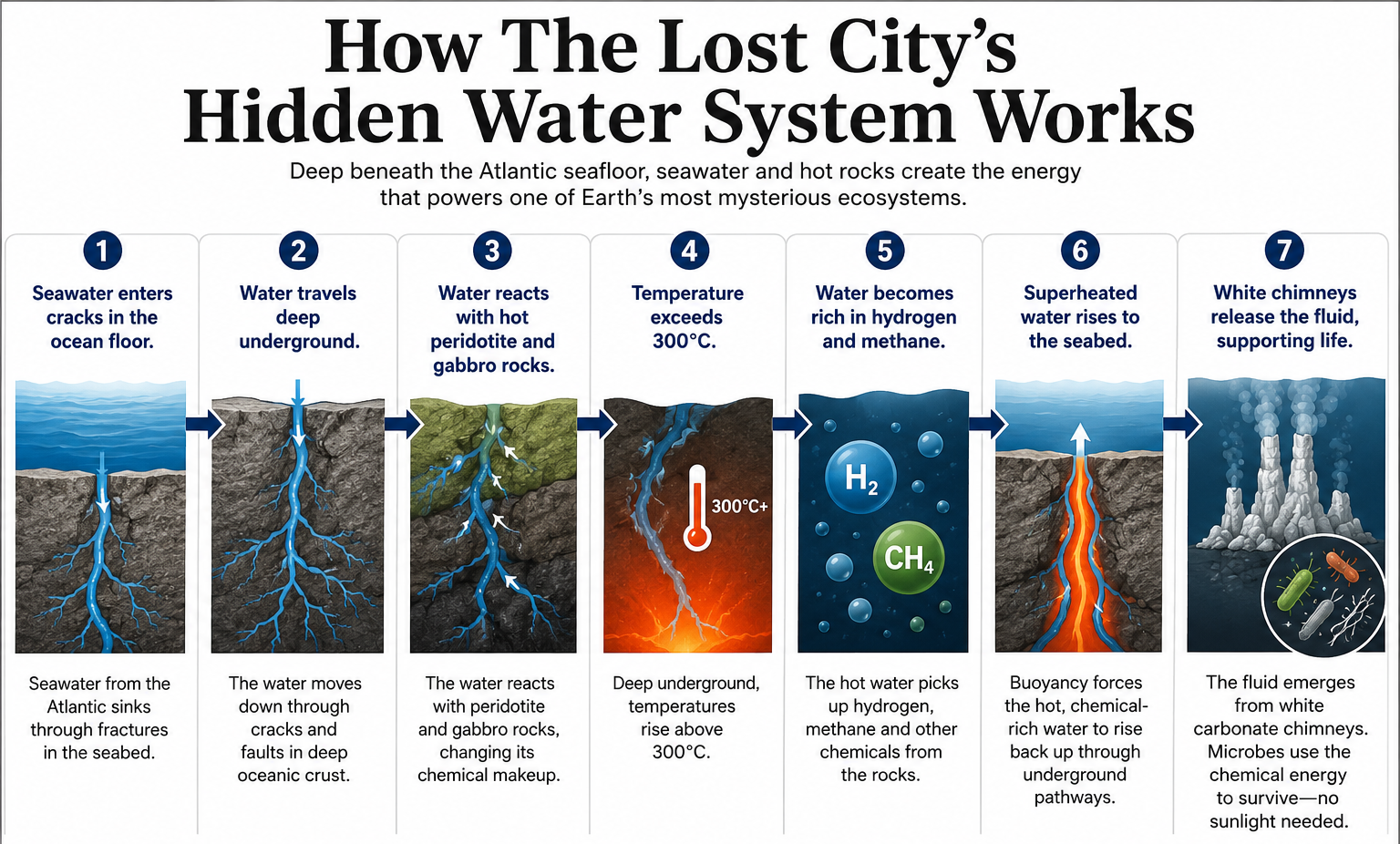
The Lost City hydrothermal field lies deep in the Atlantic Ocean and is unlike most ecosystems on Earth. The organisms living there survive using chemical energy produced when seawater reacts with rocks beneath the ocean floor.The area is known for its tall white carbonate chimneys. Alkaline hot springs release fluids rich in hydrogen and methane from it. These chemicals give energy for microbes and other organisms living around the vents.Scientists knew about these vents, however, they did not know exactly where the energy-rich water feeding the vents came from.Researchers carried out a drilling expedition in 2023 as part of the International Ocean Discovery Program’s Expedition 399.
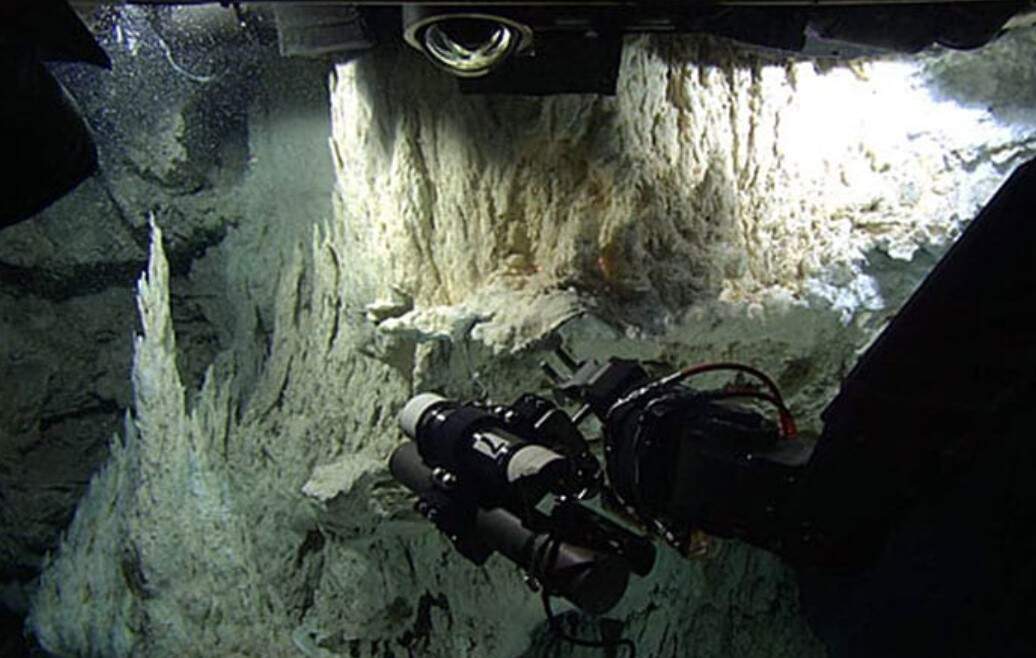
Hydrocarbons are routinely generated by the simple interaction of seawater with the rocks under the Lost City hydrothermal vent field (Woods Hole Oceanographic Institution photo)
Drilling below seabed
The team drilled a borehole nearly 1.3 kilometres below the ocean floor in the Atlantis Massif, a large underwater mountain located about 800 metres north of the Lost City hydrothermal field.The borehole passed through deep rocks that form part of Earth’s mantle. These included peridotite, a rock found deep inside the Earth, along with layers of another rock called gabbro. Both rock types are important because they react with seawater over long periods.After drilling was completed, the scientists pumped water from different depths inside the borehole to study its chemistry.They found that at depths between about 675 and 800 metres below the seafloor, as much as 80% of the water was natural formation water. This is water that has been moving through rocks underground rather than water introduced during drilling.
Chemistry reveals history
The chemical makeup of the deep water showed signs that it had spent a long time reacting with hot rocks underground.One of the strongest clues was that the water contained almost no magnesium but large amounts of calcium. Scientists say this kind of chemical signature is a well-known sign that seawater has reacted extensively with rocks at very high temperatures.The water also contained high levels of elements such as lithium, rubidium, cesium and strontium, all of which are picked up during these reactions.Based on these chemical clues, the researchers concluded that the water had interacted with rocks at temperatures of at least 300 degrees Celsius. Although the borehole had cooled by the time the samples were collected, its chemistry showed that the water had once been much hotter.Most importantly, the chemical composition closely matched that of the fluids flowing out of the Lost City vents.
.
Why discovery matters
The findings improve scientists’ understanding of how chemical energy moves through Earth’s crust and supports life in places without sunlight.Hydrogen produced during these water-rock reactions serves as an important energy source for microorganisms. Studying these systems could help researchers understand how some of Earth’s earliest life forms survived billions of years ago. Scientists consider the Lost City to be one of the closest natural examples of environments that might exist beneath the icy surfaces of ocean worlds elsewhere in the Solar System. If similar reactions between water and rocks occur on those worlds, they could also produce the chemical energy needed to support microscopic life.However researchers also warn that yhe water samples were collected only a few days after drilling, so they were mixed with seawater, freshwater and drilling fluids. Because of this, scientists cannot yet determine the exact contribution from different rock types.The study also does not prove that there is a direct underground connection between the borehole and the Lost City’s chimneys. In future expeditions, the team plans to return after the borehole has stabilised.