
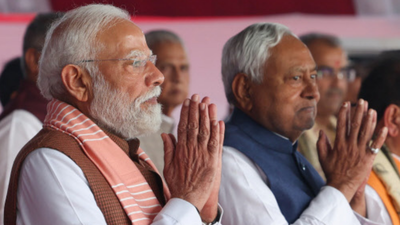
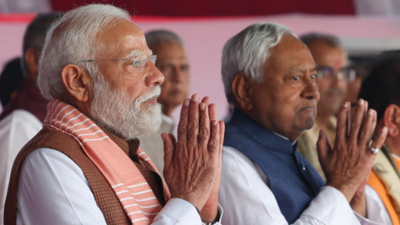
NEW DELHI: The “josh” is high for the Bharatiya Janata Party (BJP) as Bihar is all set to get its chief minister from the saffron party. Samrat Choudhary was elected the leader of the NDA legislative party, paving the way for him to become the first BJP CM of Bihar. And with this, the BJP once again has delivered a masterclass on “how to own the alliance.”Choudhary, who is expected to take the oath on April 15, takes over the top post from Nitish Kumar, who resigned earlier in the day. It definitely is a high moment for the BJP, which has been trying to keep the alliance smooth and yet have the upper hand. The announcement also feels like a repeat of what happened in Maharashtra when Devendra Fadnavis was reinstated as the chief minister of the state.
The ‘big brother’
For most of the 2000s, the BJP was the quieter partner in Bihar, drawing strength from Nitish Kumar’s credibility and caste coalition. In 2005 and again in 2010, it was Nitish who led from the front, with JD(U) consistently getting more seats than the BJP.However, this balance began to crack in 2014. Nitish’s decision to walk out of the NDA over Narendra Modi as the prime ministerial candidate backfired badly. Fighting separately, JD(U) was reduced to just 2 Lok Sabha seats and Nitish Kumar resigned from the CM post, taking the moral responsibility.In the 2015 assembly elections, the BJP had the largest vote share of 25% and 53 seats, but still fell short of power as the Mahagathbandhan (RJD – 80; JD(U) – 71) stitched together a stronger social coalition. When Nitish returned to the NDA in 2017, the BJP was no longer the same player. By 2020, it had clearly moved ahead within the alliance, winning significantly more seats than JD(U). The party got 74 seats and JD(U) got 43 seats. Though Nitish remained the CM, the equation within the alliance had shifted.By 2025, the BJP had completely flipped the script. The NDA contested the assembly elections with Nitish Kumar as its CM face. However, the BJP with 89 seats, once again emerged as the bigger partner than the JD(U) that got 85 seats. While Nitish Kumar remained the CM, the BJP took control over key portfolios like Home. And finally within a year, managed to give Bihar its first BJP CM with Samrat Choudhary.
The return of Fadnavis
Before Bihar, it was Maharashtra where BJP applied the similar formula. Here, the BJP showed how alliances could be reworked from within, turning partners into dependents and reclaiming major control without breaking the coalition.There was a time when Devendra Fadnavis had to step down and Eknath Shinde was made the CM as the Shiv Sena and the Nationalist Congress Party (NCP) split and came together with the BJP. However, in the 2024 assembly elections, the BJP emerged as the single largest party in the ruling Mahayuti with 132 of 288 seats. Backed by stronger numbers, the BJP pushed for leadership change, and on December 5, 2024, Fadnavis took oath as CM, with Shinde moving to the deputy CM role.Once back at the helm, the BJP moved to centralise power. Key portfolios like home, finance and law were retained by the CMO, reducing the operational space for both Shinde and Ajit Pawar, who also served as deputy CM. The alliance remained intact, but its internal balance shifted decisively. After Ajit Pawar’s death his wife Sunetra Pawar was given his post in the Maharashtra cabinet. The BJP’s electoral strength further cemented its position. In the January 2026 municipal elections, it performed strongly across urban centres, including Mumbai.In both Bihar and Maharashtra, the BJP’s rise within alliances has shown how to do it without breaking the coalition. By expanding its own voter base while narrowing the space for its partners, the BJP has shown that alliances can be a pathway to dominance, not compromise.This “hollowing out” of regional satraps from within is not merely a tactic; it is a refined electoral science that the BJP has perfected over the last decade. By the time Samrat Choudhary was elected to lead the NDA in Bihar, the JD(U) was no longer the defiant force of the early 2010s. It had become a party whose survival was inextricably linked to the BJP’s organisational oxygen. The question ‘who next after Nitish Kumar’ remains the biggest existential one for the JD(U) right now.The strategy hinges on a concept political analysts call “lateral absorption.” In Bihar, the BJP did not just defeat the opposition; it slowly absorbed the core constituency of its own ally. Nitish Kumar’s primary strength was the Extremely Backward Classes (EBCs) — a fragmented but massive voting bloc. Through targeted central welfare schemes and the elevation of leaders like Samrat Choudhary (who hails from the influential Kushwaha community), the BJP created a direct line to the EBC voter, bypassing the need for Nitish as a middleman.The transition that culminated today was accelerated by Nitish Kumar’s own move to the Rajya Sabha. While the BJP framed it as a “promotion” for the veteran socialist leader to the national stage, the timing was surgically precise. By moving Nitish to Delhi, the BJP removed the final psychological barrier for the Bihar electorate to accept a saffron-clad leader at the helm in Patna. It was a mirror image of Maharashtra, where Eknath Shinde, once the face of the revolt, was eventually forced to concede the pole position to Fadnavis once the BJP’s own numbers became too large to ignore.
The ‘double engine’ system
The genius of the playbook lies in how the BJP manages anti-incumbency. In both states, whenever the public grew weary of the regional leader, the BJP successfully positioned itself as the “corrective force” within the same government. In Maharashtra, the BJP allowed Shinde to take the initial heat of the “rebel” tag, only to swoop in as the stable, senior partner once the dust settled. In Bihar, the BJP spent the 2020-2025 term increasingly distancing itself from Nitish’s unpopular decisions while simultaneously taking credit for the ‘double-engine’ development projects funded by the Centre.The numerical shift in the 2025 Bihar polls (89 seats for BJP vs 85 for JD(U)) provided the moral and mathematical mandate for today’s takeover. But the real victory was in the municipal elections of early 2026. Much like in Mumbai, the BJP’s dominance in Bihar’s urban local bodies proved that the party’s “Lotus” symbol now carried more weight than the JD(U)’s “Arrow.”
The new national standard
With Bihar now soon under a BJP chief minister and Maharashtra firmly back in Devendra Fadnavis’s grip, the BJP has sent a clear message to all current and future allies: the “junior partner” phase is temporary. The party’s alliance strategy is now a conveyor belt that leads to singular dominance. As Samrat Choudhary prepares for his oath tomorrow, April 15, the “Nitish era” hasn’t just ended; it has been archived. The socialist legacy of Karpoori Thakur has been repackaged into a new brand of subaltern Hindutva — one where the BJP is no longer the supporting actor but the director, producer, and lead star.