
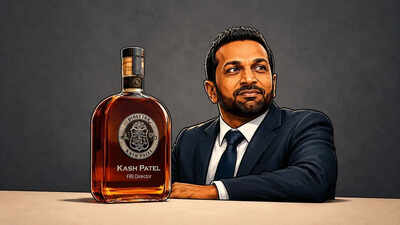
The Indian-American comedian Nimesh Patel has a hilarious take on the social hierarchy of Indian-Americans. At the top, he argues, are the software Indians, the doctor Indians and the lawyer Indians. At the bottom are the gas station Indians and the liquor store Indians. And perhaps that explains Kash Patel’s rage when a bottle of his personalised bourbon went missing.
Poll
Do you think Kash Patel response to the missing bourbon bottle was justified?
Federal Bourbon Investigation
For most people, a missing bottle of bourbon would be a small private tragedy, the sort of thing that produces a few suspicious glances, one dramatic accusation aimed at the most cheerful person in the room, and then a grudging acceptance that good alcohol, like good pens and umbrellas, has a way of disappearing in polite company. For Kash Patel, according to reports, it appears to have become something closer to a miniature federal emergency, complete with alleged threats of polygraphs, prosecution and the kind of institutional panic one would normally associate with an actual crime rather than the unexplained disappearance of one bottle from the director’s personal stash.
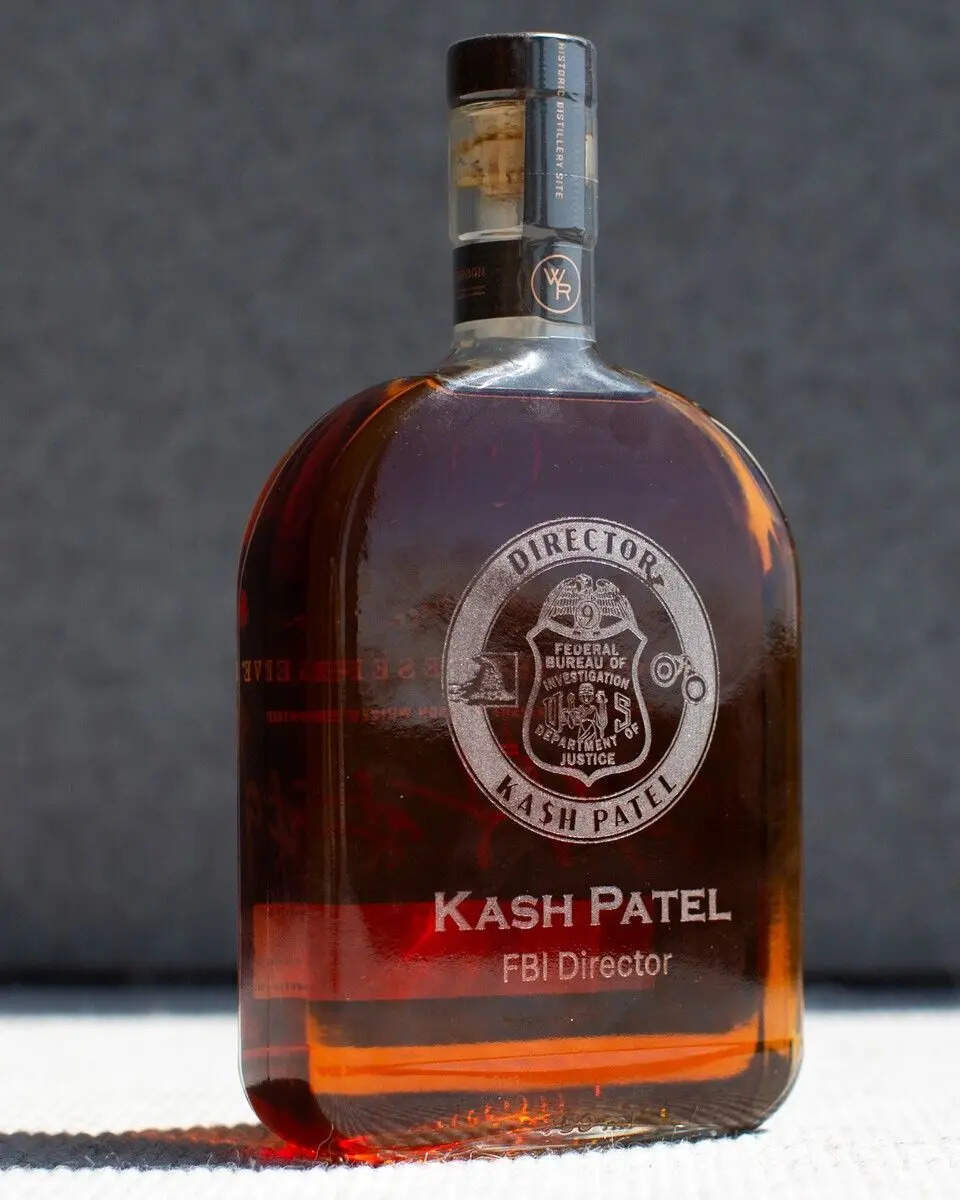
The setting made it even more absurd. At the FBI’s training facility in Quantico, Virginia, where Ultimate Fighting Championship athletes were reportedly teaching mixed martial arts to aspiring agents and senior staff, at least one bottle from Patel’s supply of personalised bourbon allegedly went missing. The report claimed Patel “lost his mind”, and agents reportedly sought legal advice after he allegedly threatened to polygraph and prosecute staff. There is something almost perfect about that image: the premier law enforcement agency of the United States, an institution associated with fingerprints, wiretaps, mob bosses, terrorist plots, spies and the stern mythology of men in suits knocking on doors at dawn, suddenly consumed by the mystery of one vanished bottle of whiskey.The important detail, of course, is that this was not just whiskey. It was Kash Patel whiskey, or at least whiskey transformed into a Kash Patel object, reportedly engraved with “Kash Patel FBI Director”, an FBI-style shield, an eagle, his signature and the number 9, presumably a reference to his place in the line of FBI directors. In any reasonably sane institutional culture, such a thing would already invite a quiet conversation about judgment, restraint and whether the head of the FBI should be turning his office into a souvenir stall. In Trumpworld, however, it belongs to a recognisable political theology, where the leader’s name must travel everywhere, preferably on hats, sneakers, coins, watches, bottles, Bibles and anything else that can be monetised before the next rally, lawsuit or cable-news appearance.
Trumpism as merchandise
Donald Trump did not invent self-promotion in American politics, but he did perfect its conversion into merchandise. The MAGA cap was never merely a cap; it was a uniform, a tribal marker, a donation receipt, a portable grievance and a declaration that the wearer had joined a movement in which politics was no longer only argued, but worn. Trump understood earlier than most that in the age of fandom, belief has to become tactile. The supporter must be able to touch it, wear it, drink from it, frame it, forward it, collect it and, most importantly, purchase it.Kash Patel seems to have absorbed this grammar with the devotion of a coaching-class topper who has memorised not only the syllabus but the footnotes. His wider brand universe has reportedly included beanies, T-shirts, orange camo hoodies, trucker caps, playing cards, Punisher imagery, challenge coins and the immortal spelling “Ka$h”, a typographical flourish that does more work than most autobiographies. “Kash” is a name. “Ka$h” is a franchise. It sounds like a crypto token, a podcast promo code, a tactical lifestyle brand and a midlife crisis launched at a Las Vegas ballroom all at once. It is juvenile, certainly, but it is also revealing, because the point is not dignity or institutional seriousness. The point is recognition.This is why the missing bottle matters. The issue is not that a public official likes bourbon, or that commemorative items exist in law enforcement culture. Challenge coins, plaques, signed memorabilia and ceremonial gifts have existed for years in bureaucracies, police forces and militaries. The issue is what happens when the institution becomes a surface for the office-holder’s personal mythology. A coin honouring a unit or mission points outward towards service and memory. A bottle carrying the director’s name, title and implied historical ranking points inward towards the man. One honours the office. The other advertises the office-holder.
The Indian-American ladder
This is what makes Patel such a fascinating Indian-American figure. The classic Indian-American success story was built on credentialed restraint: study hard, speak softly, become a doctor, engineer, lawyer, professor, CEO or spelling bee winner, and do not embarrass the family unless the embarrassment comes with tenure, a Fortune 500 title or a Nobel Prize. Bobby Jindal and Nikki Haley, in different ways, represented the older assimilation script, in which identity had to be managed carefully, sanded down, translated, made palatable and then presented to conservative America as proof that the system worked. Patel belongs to a different tradition altogether. He did not become invisible to rise through the establishment. He became flamboyantly visible inside Trump’s anti-establishment theatre.
That is why he has always been the anti-Jindal in the Indian-American political imagination. He is not the polite model minority trying to make America comfortable with difference; he is the MAGA warrior who seems to have understood that the new path to power rewards noise, grievance, performance and total loyalty to the man at the centre of the circus. He is not the immigrant son who slips into the establishment by mastering its etiquette. He is the immigrant son who storms into it wearing the rhetorical equivalent of a Punisher scarf, a WhatsApp forward and a personalised challenge coin.This is where Nimesh Patel’s joke becomes more than a joke. The old Indian-American social hierarchy was about respectability, which is why the doctor, software engineer and lawyer occupied the top tiers of the immigrant pantheon while the gas station owner and liquor store owner remained trapped in the comic basement, despite often making more money than the people mocking them. The hierarchy was not really about wealth. It was about smell, surface and status. The doctor’s office smelt of antiseptic authority. The software engineer’s cubicle smelt of stock options. The liquor store smelt of retail hustle, survival and the slightly embarrassing truth that immigrant success in America has often been built behind counters, under fluorescent lights, selling things more glamorous people consume without acknowledging the person who sold them.Patel’s alleged bourbon saga collapses that entire ladder into a single ridiculous image: the Indian-American success story who reaches the top of American law enforcement and then reportedly loses it because a bottle of his own branded liquor has gone missing. It is upward mobility as farce, the model minority arriving at the Hoover Building only for the story to end at the liquor cabinet.
The FBI as a merch table
The deeper problem, though, is not Indian-American comedy. It is the Trumpification of institutions, where public office stops being a trust and becomes another surface on which the leader’s name can be stamped. The FBI’s authority depends on impersonality. The badge matters because it is supposed to be larger than the man wearing it. The seal matters because it represents the state, not the ego of whichever loyalist has been handed the office. The director matters because he is temporary, while the institution is supposed to endure beyond him. Once the director’s name starts appearing on bottles, coins and apparel, the Bureau begins to look less like a pillar of law enforcement and more like a premium stall at CPAC with subpoena power.That would be tacky in a campaign; inside the FBI, it becomes corrosive. If the director gives you a bottle, what exactly are you accepting: a gift, a signal, a favour, a test, or an invitation to participate in the theatre of his personal brand? If you refuse, do you seem disloyal? If you accept too eagerly, are you now part of the court? If one goes missing, are you a suspect in a workplace nuisance or a minor traitor to the king’s household? This is how personalised power works. The object is never merely an object. The king’s scarf, the king’s coin, the king’s bottle, the king’s cap and the king’s mood all become part of the atmosphere, and everyone learns to read them because everyone knows the wrong interpretation can be costly.
Trump’s Washington has always had this feudal quality. Loyalty is not treated as an internal principle, but as a public performance that must be renewed constantly through praise, costume, repetition and aggression. One must wear the colours, repeat the slogans, defend the absurdity, attack the enemy and pretend that each new humiliation is actually evidence of strength. In that world, a bottle engraved with the director’s name is not an odd vanity object. It is a miniature version of the entire system, where the personal brand is the government and the government exists to protect the personal brand.
Cosplay politics
Patel’s alleged bourbon meltdown also exposes the insecurity beneath the MAGA performance of masculinity. The imagery is always force: UFC, Punisher skulls, whiskey, challenge coins, guns or replica guns, tactical clothing, flags, boots, gravel-voiced podcasts and the endless promise that real men are finally back in charge. Yet the louder the performance becomes, the more fragile it can appear, because truly serious men and serious institutions rarely need every object around them to announce their seriousness. A confident FBI director does not need his name engraved on bourbon. A confident law-and-order movement does not need to look like a merchandising collaboration between a weapons expo, a podcast studio and an airport duty-free shop.
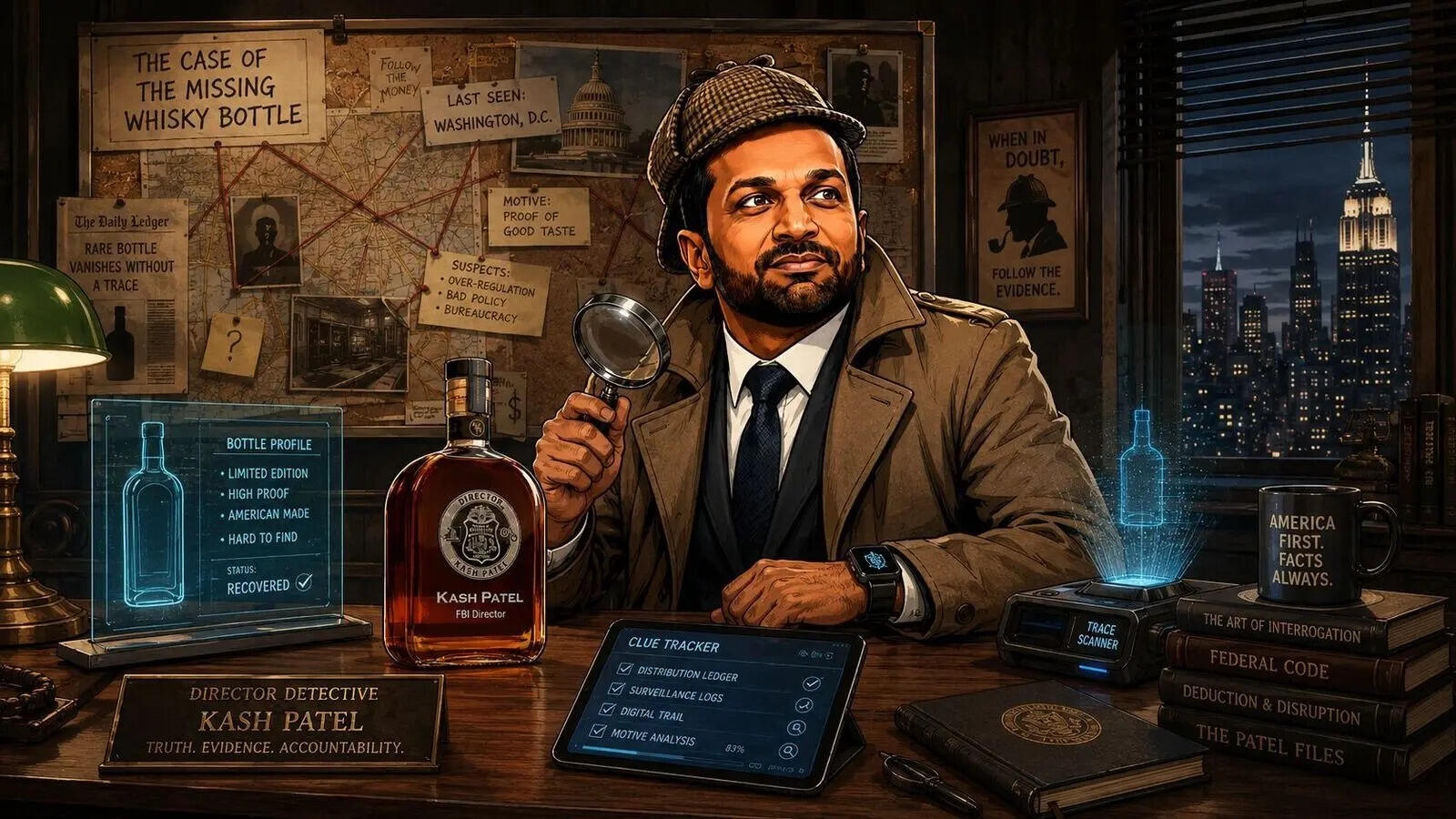
This is the old problem of cosplay politics. It borrows the costume of strength without necessarily possessing the discipline of strength. Political movements have always loved props because props simplify identity. The Roman senator’s toga, the Rajput sword, the cowboy hat, the revolutionary scarf, the soldier’s coin, the strongman’s watch and the red MAGA cap all work because they turn ideology into an instantly recognisable image. Trump understood this instinct better than anyone. He turned the red cap into a crown for people who thought they hated crowns. Patel’s reported bourbon bottle is the same impulse in smaller and stranger form: it is not enough to run the FBI; the bottle must say that you run the FBI.There is an echo of J Edgar Hoover here, but only up to a point. Hoover certainly built a cult around himself, and nobody should pretend that the FBI’s past is a clean temple of republican virtue. Hoover understood fear, secrecy, files and institutional mythmaking. His ego was bureaucratic, archival and menacing. Patel’s reported ego belongs to a different age. It is influencer-era authority, where power seeks not silence but content, not mystery but circulation, not fear alone but visibility. Hoover kept dossiers. Patel, in this telling, keeps merch. One was the dark old bureaucracy. The other is the algorithm with a badge.
The gift shop of the self
That is what makes the alleged polygraph threat so bleakly funny. The polygraph is one of America’s great procedural props, a machine that promises to convert sweat, pulse and anxiety into truth, and to imagine it being invoked over a missing bottle of branded bourbon is to watch the security state wander into a Curb Your Enthusiasm episode written by Kafka. What is loyalty? What is truth? Who moved the bottle? Did you betray the Bureau, the director or the brand? The Trump-era answer is almost always the same: the real betrayal is embarrassing the brand.This is why the comparison with Trump’s deals matters. Trump has always treated the line between politics and commerce as a technicality observed by lesser men. The presidency did not erase the Trump brand; it amplified it. The name that sat on towers, hotels, casinos, steaks, universities and golf courses became a political theology, and then the theology became a sales funnel. The old conservative vocabulary of duty, restraint and constitutional seriousness gave way to a gold-plated carnival where grievance could be monetised, persecution could be packaged and the leader’s face could be sold back to supporters in a dozen forms. Patel’s alleged bourbon culture looks like a smaller branch office of the same empire, with the FBI shield turned into decoration and the director’s name turned into label copy.
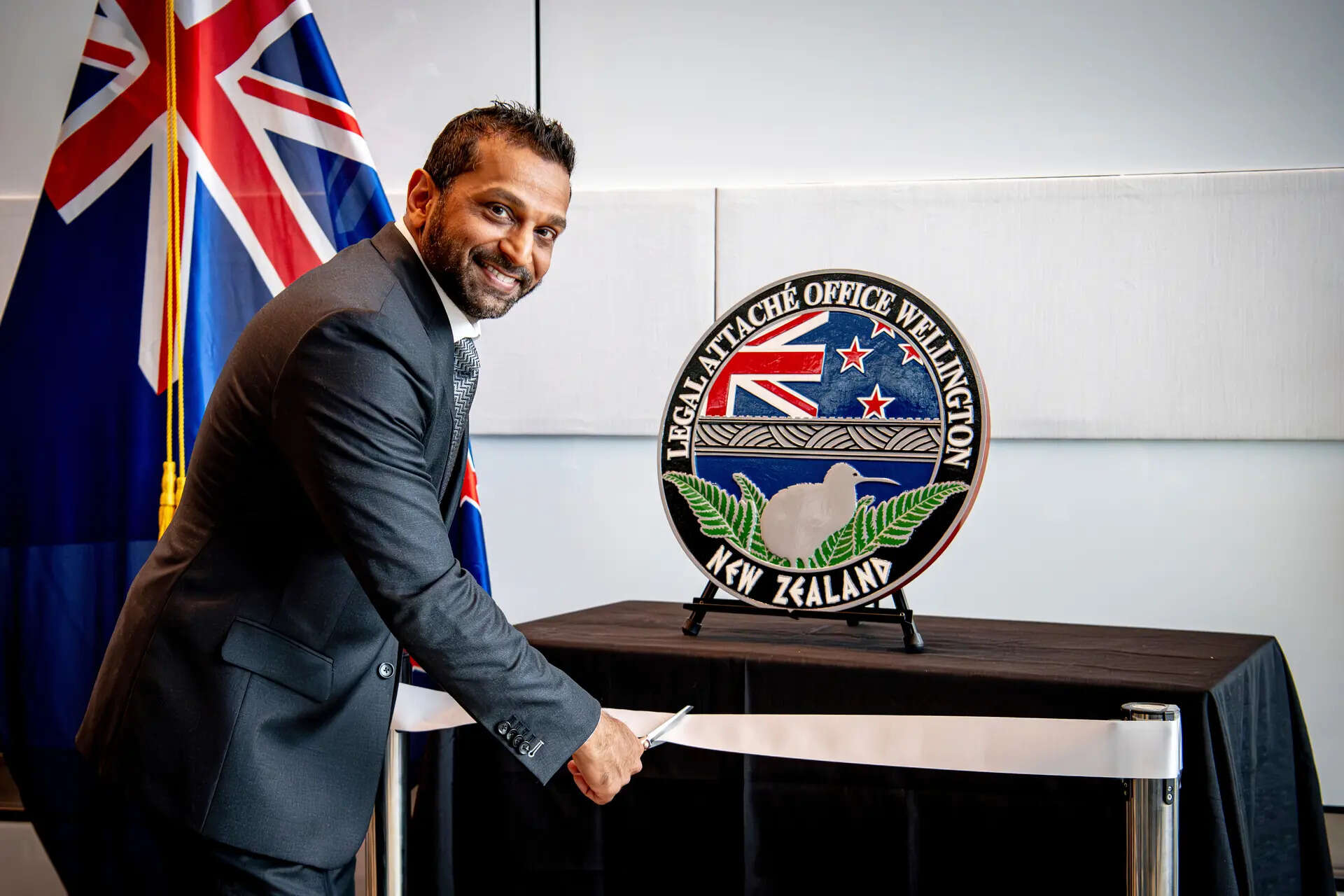
FILE – In this photo released by the U.S. Embassy in Wellington, New Zealand, FBI Director Kash Patel cuts the ribbon at the official opening of the FBI office in Wellington, New Zealand, July 31, 2025. (Ola Thorsen/U.S. Embassy via AP, File)
In the end, the image is hard to improve upon: Kash Patel, Indian-American success story, MAGA warrior and FBI director, allegedly going bonkers over a vanished bottle of bourbon bearing his own name. Not a state secret, not a national security breach, not a mole inside the Bureau, but a bottle, a souvenir, a branded object from the gift shop of the self.Paisa laya, indeed. What Patel appears to have brought to the FBI was not only immigrant ambition or law-and-order zeal, but the Trumpian gospel of merch, ego and grievance. He brought the liquor-store end of the joke into the Hoover Building, engraved his name on it, and when one bottle allegedly vanished, treated the disappearance as if someone had stolen a piece of the brand.