


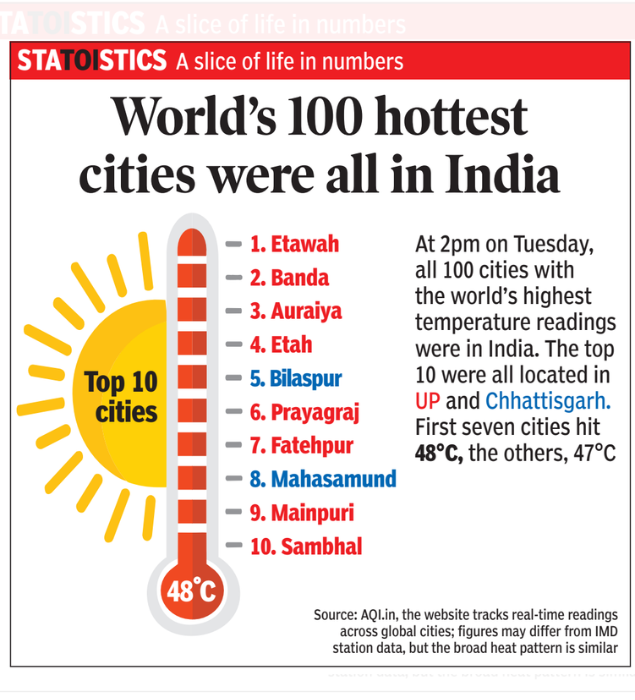
LUCKNOW: Banda in Uttar Pradesh baked at a blistering 48.2 Celsius Tuesday, turning roads gummy, metal searing hot and afternoon air into a blast furnace. Bundelkhand’s parched district has emerged as Asia’s hottest location four times in a month and topped global heat charts twice, a grim badge for a place meteorologists and geologists described as a fast-expanding “man-made heat island”. On Tuesday, only Saudi Arabia’s Jeddah at 48.6°C and Arafat at 48.4°C were hotter anywhere on Earth. Banda hit 47.6°C on May 18 – highest in world that day and hottest May reading there in 75 years. It earlier touched 47.6°C on April 27, also ranking first globally. Asia’s highest temperatures were recorded there on April 17 (45.4°C), April 27, May 17 (46.4°C) and May 18.
.
All-time record remains 49.2° Celsius logged on June 10, 2019. Scientists said what alarms them now is frequency. Forty-sevens and forty-eights are no longer rare spikes. Step outside too long in such heat and dehydration can spiral into heat exhaustion, then fatal heatstroke within minutes. Asphalt softens. Tyres burst. Tin roofs radiate like griddles. Why Banda is boiling Meteorologists blamed fierce dry westerlies from the Thar desert, cloudless skies and relentless solar radiation. Bundelkhand’s rocky crust worsens the heat by absorbing it quickly and releasing it slowly after sunset. “Southern UP missed the cooling impact of western disturbances earlier this month. Banda entered heatwave conditions with already elevated temperatures,” said IMD senior scientist Mohammad Danish. “Hard and stony terrain absorbs heat rapidly under direct sunlight and releases it slowly, making Banda highly vulnerable to extreme temperatures.” Barren Land, Dying Rivers Geologists said weather alone is not responsible. Banda has barely 3% green cover across around 105 sq km – the lowest in Bundelkhand. Chitrakoot has 18% forest cover, Lalitpur 11.5% and Jhansi 6%. Drying rivers, shrinking groundwater, relentless sand mining and expanding concrete patches have stripped away the natural cooling systems. “Banda’s albedo is high. Sunlight is trapped instead of being balanced by moisture and vegetation,” said geology professor Dhruv Sen Singh. Experts described a vicious cycle: less vegetation means less moisture, less moisture means hotter land, hotter land kills more vegetation. (With inputs from Vivek Chauhan)