
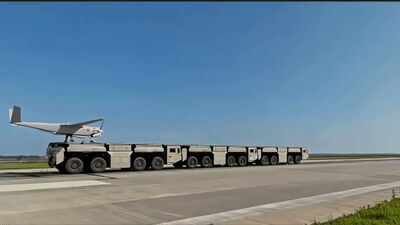
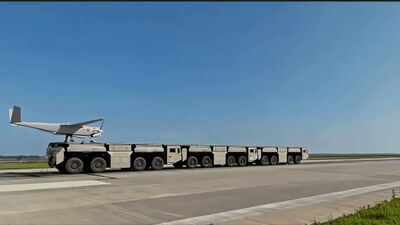
China has released footage of a truck-mounted Electromagnetic Aircraft Launch System (EMALS), showcasing a mobile platform capable of launching fixed-wing drones without requiring a conventional runway.The newly released video shows a fixed-wing unmanned aerial vehicle mounted on a long launch rail carried by three heavy trucks. The electromagnetic catapult rapidly accelerates the drone along the rail before launching it into the air within seconds, allowing it to transition seamlessly to powered flight using its own engine.The demonstration offers a glimpse into the People’s Liberation Army’s efforts to improve the mobility, survivability and flexibility of its unmanned aviation capabilities through rapidly deployable launch systems.How the system worksThe ground-based EMALS adapts the same core electromagnetic launch technology used aboard China’s Type 003 Fujian aircraft carrier to launch fighter aircraft.Instead of being installed on a warship, however, the launcher is mounted on multiple heavy trucks, allowing it to be transported and deployed from a wide range of locations. The modular system can be assembled in the field and used to launch fixed-wing drones from areas where conventional runways are unavailable or vulnerable.Unlike traditional launch systems that rely on rocket boosters, compressed air or hydraulic mechanisms, EMALS uses a linear electric motor to accelerate an aircraft along a launch rail.Before launch, the drone is secured to a shuttle attached to the rail. Electrical energy generates a moving magnetic field that rapidly propels the shuttle forward. Once the required take-off speed is reached, the drone separates from the shuttle and continues flying using its own propulsion system.Compared with conventional catapult systems, electromagnetic launch provides smoother acceleration, places less stress on the airframe and allows launch parameters to be adjusted according to the aircraft’s weight and mission requirements.Designed for rapid deploymentThe demonstration also highlights the launcher’s advanced all-wheel steering system. Despite being composed of three connected trucks, the platform can manoeuvre in a tight turning radius, allowing operators to align the launch rail with the prevailing wind before take-off.Positioning into a headwind is particularly important for fixed-wing aircraft because it reduces the ground speed required for lift-off, improves launch efficiency and enhances operational safety.The emergence of long-range precision-guided missiles, loitering munitions and drone warfare has made fixed airbases increasingly vulnerable during modern conflicts. As a result, many militaries are looking for ways to disperse aircraft and UAV operations across multiple locations rather than relying on permanent runways.A mobile EMALS allows fixed-wing drones to be launched from temporary operating bases, highways, remote islands or forward deployment areas. This reduces dependence on established airfields and makes drone operations more resilient in contested environments.The electromagnetic launcher could also support larger fixed-wing UAVs than portable catapult systems, enabling the deployment of drones carrying heavier payloads such as intelligence, surveillance and reconnaissance sensors, electronic warfare equipment or precision-guided munitions.