
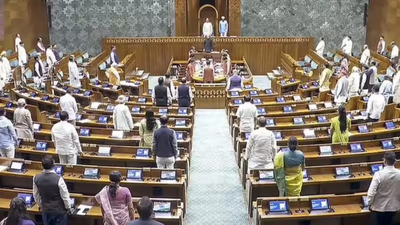
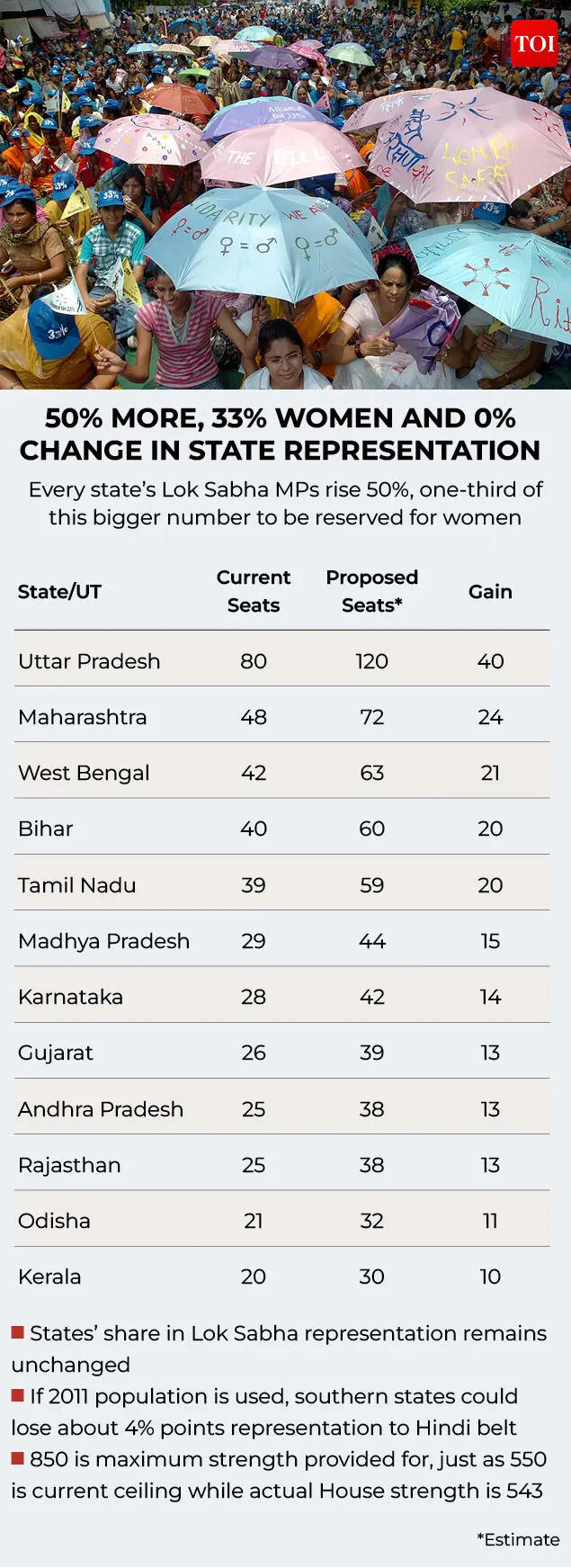
NEW DELHI: The special session of Parliament on Thursday is set for a heated debate as three key bills — the Constitution (One Hundred and Thirty-First Amendment) Bill, 2026, the Delimitation Bill, 2026, and the Union Territories Laws (Amendment) Bill, 2026, including a proposal to implement women’s reservation from the 2029 Lok Sabha elections and a controversial delimitation exercise are to be tabled. Opposition parties have strongly objected to the plan to redraw constituencies and increase the number of seats in the Lok Sabha.Opposition stanceWhile opposition leaders have strongly opposed and criticised the Delimitation Bill, they have expressed support in principle for the women’s reservation proposal, raising concerns over its implementation and timing. Tamil Nadu chief minister M K Stalin on Thursday staged a protest in Namakkal by raising a black flag and burning a copy of the Delimitation Bill, signalling strong opposition to the proposed exercise, which he argues could significantly reduce the representation of southern states.Congress president and Leader of Opposition in the Rajya Sabha Mallikarjun Kharge said the opposition supports women’s reservation but has reservations about the manner of its introduction. He added that opposition parties want it implemented immediately while opposing the proposed delimitation framework, also questioning its functioning in Assam and Jammu and Kashmir.Congress general secretary Jairam Ramesh said there is a “unanimous resolve” among opposition parties to oppose the delimitation exercise, adding that linking it with women’s reservation is problematic. He further said the opposition wants women’s reservation to apply from the 2029 elections based on the current strength of 543 Lok Sabha seats.Leader of opposition in the Lok Sabha Rahul Gandhi called the proposal a “dangerous plan” to “gerrymander” Lok Sabha constituencies for electoral advantage, warning it could distort representation across states. Congress leader KC Venugopal termed the bill an “anti-national act,” arguing it may impact marginalised communities and weaken the federal structure.What the bills seek to doThe Constitution (One Hundred and Thirty-First Amendment) Bill, 2026 :The Union government has framed the Constitution (131st Amendment) Bill, 2026 proposing a significant expansion of the Lok Sabha’s strength from the current 550 members to a maximum of 850, comprising 815 members from States and 35 from Union Territories. The Constitution (One Hundred and Thirty-First Amendment) Bill, 2026 seeks to implement women’s reservation in legislatures from the 2029 Lok Sabha elections on the basis of the 2011 Census.
–
The government has been urging support for the amendment, with Prime Minister Narendra Modi urging consensus to ensure its implementation. Law minister Arjun Ram Meghwal is expected to introduce the bill in the Lok Sabha, with procedural steps proposed to enable its passage alongside related legislation. According to Bar & Bench, the government is planning to implement women’s reservation ahead of the 2029 General Elections by bringing in an amendment to operationalise the 2023 Act and a constitutional amendment to delink the delimitation process from the 2027 Census.The Delimitation Bill, 2026 : The Delimitation Bill, 2026 provides for readjustment of seats in the Lok Sabha and state and Union Territory legislative assemblies, and the division of each state and Union Territory into territorial constituencies. The exercise is based on a population-based revision using the 2011 Census. It proposes delimitation as a wider political overhaul aiming to change the size and composition of state legislative assemblies and the Lok Sabha. The proposed Delimitation Bill’s implementation is also linked to a population-based revision of constituencies based on the 2011 Census. The proposal is being opposed by several opposition parties, which have expressed concerns over its impact on representation, including the proposal to increase Lok Sabha seats from 543 to 850.The Union Territories Laws (Amendment) Bill, 2026 : The Union Territories Laws (Amendment) Bill, 2026 seeks to align electoral and administrative provisions in Union Territories with the changes proposed under the women’s reservation and delimitation-related legislation. It is expected to be introduced by Home Minister Amit Shah as part of the legislative package.