
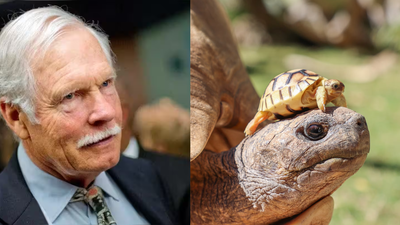
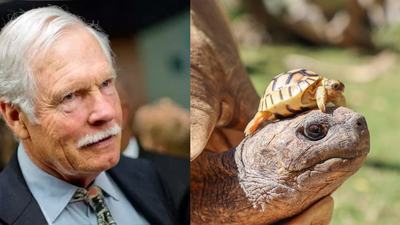
For thousands of years, the Bolson tortoise had been missing from the grasslands of New Mexico. Then a private ranch offered the species something it had not had in generations: space to start again. What began with just 30 captive tortoises grew into a population of roughly 800 through a long-running conservation effort backed by Ted Turner’s Turner Endangered Species Fund. Among the animals was Gertie, an elderly female estimated to be at least 80 years old, whose eggs have helped keep the breeding programme going.As reported by Turtle Conservancy, in 2023, nearly two dozen tortoises were released onto Turner’s vast Armendaris Ranch, marking a new chapter in the attempt to establish a free-living population. Their return is not a quick rescue story. It is a slow experiment in whether a species absent from the American Southwest for thousands of years can find its way home again.
How Ted Turner helped bring the Bolson tortoise back to the US
The Bolson tortoise is North America’s largest and rarest tortoise species. It was not even known to science until the late 1950s, and much about its natural history remains poorly understood. Fossil evidence, however, shows that its range was once far wider than it is today.The tortoise once occupied parts of the southwestern United States and extended into the southern Great Plains, including areas of what are now Texas and Oklahoma. In New Mexico, its disappearance dates back thousands of years.Its remaining wild population is now concentrated in the grasslands of north-central Mexico. Fewer than 2,500 animals are thought to survive there, and the population continues to face pressure from people collecting tortoises as pets, hunting them for food and converting grassland habitat to farmland.
Ted Turner’s conservation effort began with just 30 Bolson tortoises
Part of the answer began decades ago with a group of captive Bolson tortoises kept at the Appleton-Whittell Research Ranch.Among them was a large female named Gertie. Her exact age is unknown, although biologists estimate that she is at least in her 80s. Despite her age, she remains of breeding age and has continued producing eggs.According to the US Fish & Wildlife Service, when caretaker Ariel Appleton died in 2004, her estate donated the tortoises to facilities belonging to Ted Turner’s Turner Endangered Species Fund in southern New Mexico. Biologists Scott Hillard and Chris Wiese subsequently began working to build a recovery population that could eventually support reintroduction.There were only 30 tortoises in the Appleton group; that number would eventually become 800.
PC: AP News
More than 400 hatchlings helped Ted Turner build a future for the species
The Turner project has operated on a timetable very different from that of most conservation programmes. Bolson tortoises are slow-growing animals, and raising young to adulthood takes years.According to Tucson Herpetological Society and AP News, since 2006, work at the Turner ranch and the Living Desert Zoo and Gardens in Carlsbad has produced more than 400 hatchlings. Over time, the captive population assembled by the Turner Endangered Species Fund and its partners reached roughly 800 tortoises.For the biologists involved, simply increasing the number of animals was never the final objective. The intention was to produce tortoises capable of living without the constant protection of captivity.
A new home on a vast New Mexico ranch
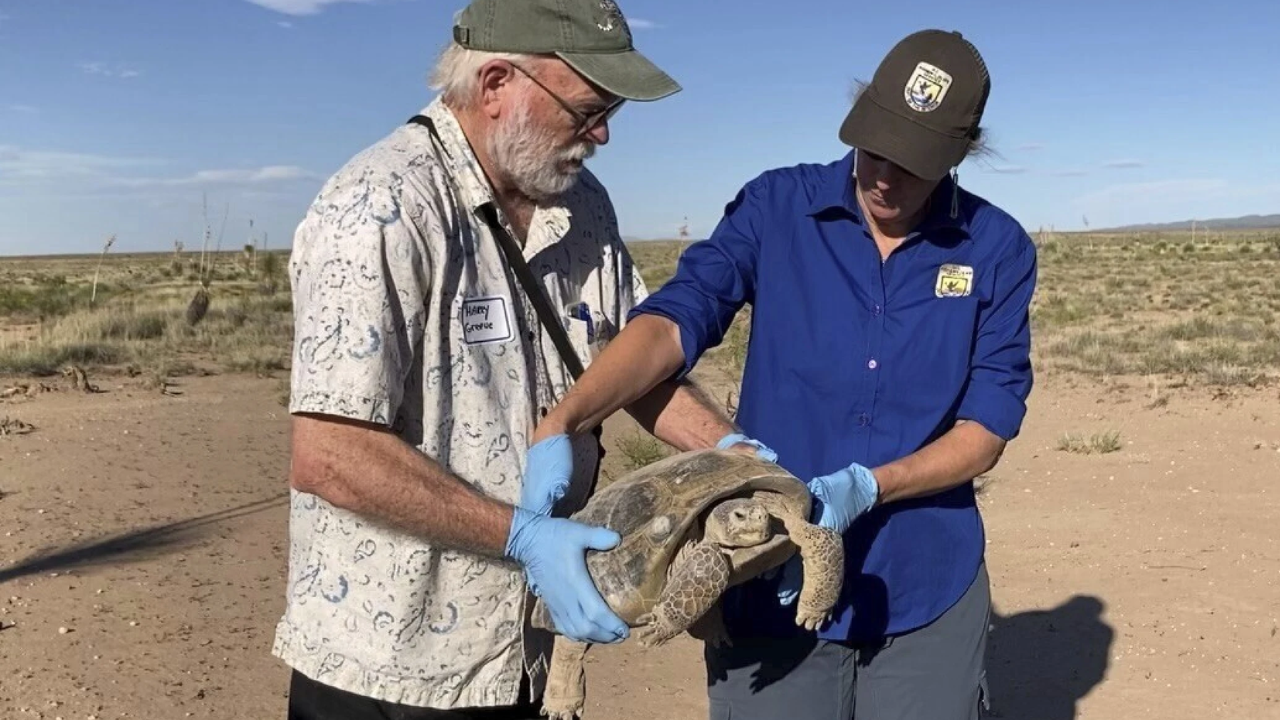
The Armendaris Ranch in central New Mexico covers more than 560 square miles, or about 1,450 square kilometres. Its grassland landscape resembles the kind of habitat where Bolson tortoises live in Mexico, making it a candidate for the next stage of the project.In September 2023, nearly two dozen tortoises were released there, including 20 adults. They were initially placed in a 16.5-acre enclosure where they could move around without the protection of conventional captive facilities.The animals were fitted with transponders so wildlife managers could keep track of them. Monitoring is expected to be limited, with checks once a year rather than constant intervention.The intention is eventually to let them expand beyond the enclosure and establish a free-ranging population across suitable parts of the ranch. For the tortoises, that means burrows, grass, weather and predators rather than keepers and pens.
Deep burrows protect the Bolson tortoise but can also expose it to people
A Bolson tortoise is not an animal that spends its days wandering across open ground.The species spends roughly 85% of its time in earthen burrows, some of which can reach around 20 metres in length. The burrows provide shelter from the harsh conditions of the grasslands and form an important part of the animal’s daily life.When they sense movement, they can head towards the entrance of their burrow to investigate or defend it. The same instinct can expose them to people, particularly in areas where tortoises are collected.The Turner ranch offers something the remaining wild population increasingly lacks: a large, remote landscape where human contact can be kept to a minimum.
The 2023 agreement changed what recovery could look like
The Bolson tortoise had traditionally been treated under US wildlife policy as a foreign endangered species. Since the species had disappeared from the United States thousands of years ago, conservationists had to consider whether the Endangered Species Act could be used to support its recovery within the country.That question became less theoretical in September 2023, when the US Fish and Wildlife Service and the Turner organisation entered into a Safe Harbor Agreement.The agreement cleared the way for captive tortoises to be released on the ranch and helped create a framework for establishing a free-living population. It also gave private landowners protections from certain additional regulatory burdens associated with endangered species recovery.The arrangement could eventually help officials explore similar approaches for other species whose recovery depends on private land.
Recovery may take longer than a human lifetime
The biggest challenge may simply be time. A hatchling can take several years or more to reach just over 11 centimetres in length, depending on weather and the availability of food. Adults can eventually reach about 37 centimetres.US Fish and Wildlife Service field supervisor Shawn Sartorius has said the results of the breeding and restoration work may not be known during his lifetime. The population being established now is intended to be something that can pass to the next generation of conservationists.Gertie offers an unusual link between those generations. The elderly tortoise helped anchor the original captive population and is still producing offspring.