
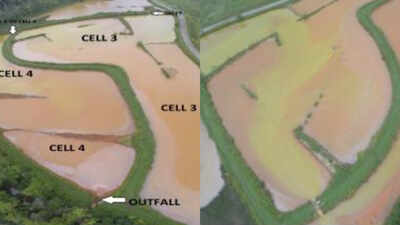
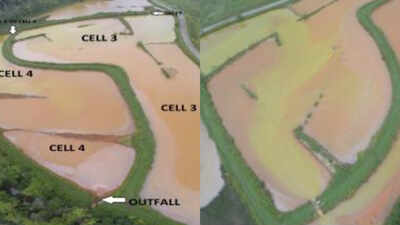
Monastery Run Wetland 1, near Latrobe, Pennsylvania, was built in 1997-1998 as a passive treatment system for several discharges from an abandoned underground mine. Adequate retention time for iron removal from mine water before discharge to Four Mile Run is provided by the use of settling ponds and wetlands. The Office of Surface Mining Reclamation and Enforcement (OSMRE) and the Pennsylvania Department of Environmental Protection (PA DEP) investigated the system to identify reasons for enhancing its treatment performance. Scroll down for the details of the findings.
Fluorescent dye reveals water flow
In July 2019, scientists injected Cell 1 with a fluorescent yellow-green Xanthene dye and followed its passage through the first two cells. The test did successfully establish retention times in those areas but the dye became very diluted in Cells 3 and 4 after another large mine-water source entered Cell 2.A second test was therefore carried out in August, this time using an unmanned aircraft system (UAS). To track the movement of dye through Cells 3 and 4, researchers injected dye at the outlet of Cell 2, and used a 3DR Solo drone equipped with a GoPro Hero4 Black camera to follow the dye.
Drone data shows low retention
Due to the battery limitations of the drone, the researchers conducted 12 flights of approximately 8-10 minutes each at altitudes up to 200 feet. Visual observations indicated a retention time of about 61 minutes in Cell 3 and 66 minutes in Cell 4. Aerial video estimates were similar at approximately 64 and 66 minutes.The total hydraulic retention time of the wetland, when the results from all four cells were combined, was approximately 4.65 hours. This was well under the 29 hours anticipated at the design flow of 1,710 gallons per minute.
Needs major upgrades
The results show that Wetland 1 needs a lot of modification to increase its water retention and aeration capacity. These changes are deemed necessary to improve dissolved iron removal and to reestablish the treatment system’s efficacy.